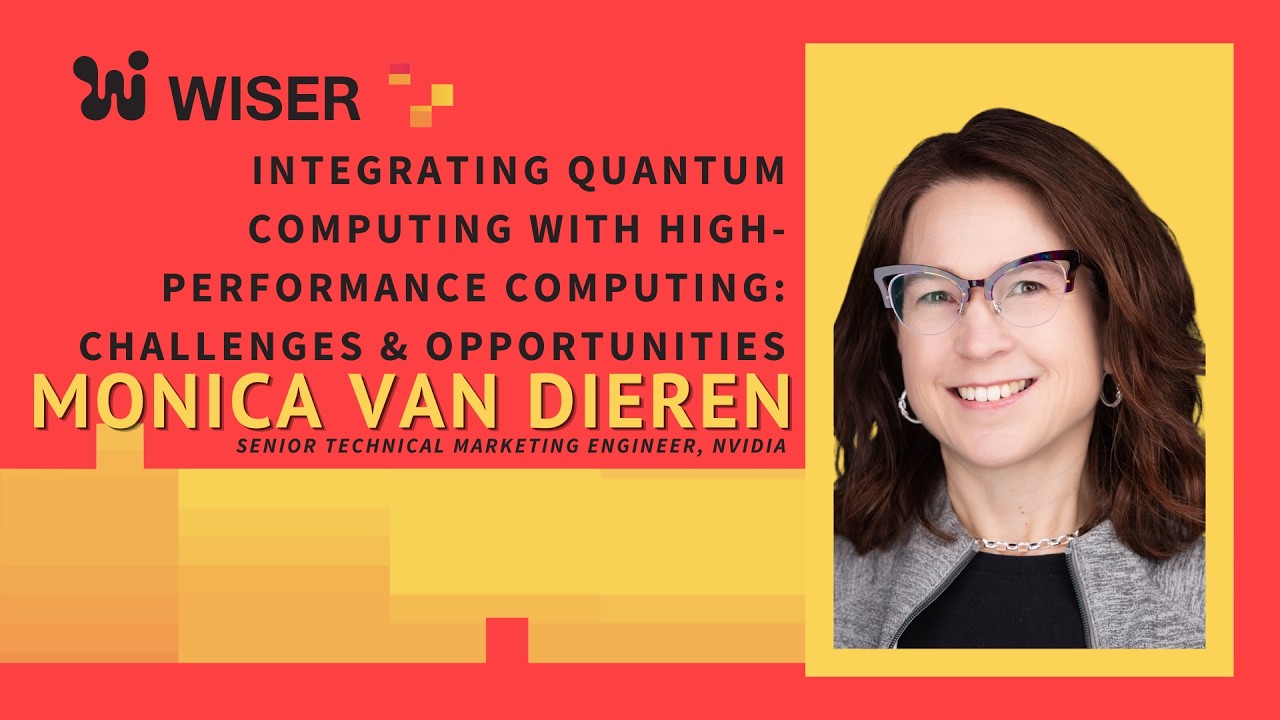
Integrating High Performance Computing Challenges & Opportunities - Monica Van Dieren
Keywords
Summary
160 words
Critical Evaluation
Value of the Information & Strength of the Argument
The talk provides valuable insights into the practical challenges of integrating quantum and classical computing, drawing on the speaker’s experience at NVIDIA and IBM. The argumentation is coherent and well-structured, moving from the basics of GPU parallelization to specific applications in quantum computing. The speaker effectively argues that GPUs are indispensable for quantum computing, not just for simulation but also for calibration, error correction, and hybrid workflows. She supports her points with concrete examples, such as the use of AI models for calibration and error decoding, and references to partnerships with various companies. The presentation is persuasive and grounded in industry practice, though it lacks quantitative data or case studies to further substantiate the claims.
Scientific Rigor, Source Quality, Title Accuracy
The talk demonstrates scientific rigor in its technical explanations, particularly in describing matrix multiplication and the role of GPUs. The speaker cites NVIDIA’s CUDA-Q platform and its components, but does not provide external references or citations to academic literature. The sources mentioned are primarily NVIDIA’s own tools and partnerships, which are relevant but not independent. The title accurately reflects the content, which focuses on the challenges and opportunities of integrating HPC and quantum computing. The talk is an expert opinion rather than a peer-reviewed study, but it is informative and credible given the speaker’s background.
225 words
Title / Content Match
The title accurately reflects the content, which discusses the challenges and opportunities of integrating HPC with quantum computing.
Quality & Reliability
7/10
The speaker is a senior technical marketing engineer at NVIDIA with a PhD in mathematical sciences and extensive experience in quantum and HPC. The talk is an expert overview of the integration of quantum computing with HPC, focusing on NVIDIA's CUDA-Q platform and AI models. It is not a peer-reviewed study but provides credible insights into current industry challenges and solutions.
Key Moments
Markers derived by PSI from the transcript: the creator did not define chapters.
- Introduction to the talk and speaker background.
- Explanation of GPU parallelization and matrix multiplication.
- Introduction to CUDA-Q and its role in quantum programming.
- Discussion on the need for GPUs in quantum simulation and error correction.
- Overview of NVIDIA's Ising models for calibration and error correction.
- Examples of AI-driven hybrid algorithms like QAOA and VQE.
- Challenges in quantum computing and the role of AI supercomputing.
- Importance of connecting quantum computers to HPC centers.
- Future directions and the need for collaboration across the ecosystem.
Cited Sources
- WISER — Organization hosting the talk.
- WISER Quantum + AI Summer Program — Program related to the talk.
Concurring Sources
- NVIDIA CUDA-Q — Official page for CUDA-Q, the platform discussed in the talk.
Contribution & Novelties
The talk provides a comprehensive overview of how NVIDIA is integrating quantum computing with HPC, highlighting the critical role of GPUs and AI in addressing challenges such as calibration, error correction, and hybrid algorithms. It offers a unique perspective from an industry leader, emphasizing that quantum computing cannot be realized without classical HPC resources. The presentation introduces NVIDIA’s CUDA-Q platform and its AI models, which are not widely known to the general public, thus contributing to the dissemination of cutting-edge industry developments.
Pour aller plus loin :
- Quantum computing — Provides foundational knowledge on quantum computing principles.
- High-performance computing — Explains the concept of HPC and its applications.
- CUDA — Details NVIDIA’s parallel computing platform and programming model.
- Quantum error correction — Discusses techniques for mitigating errors in quantum systems.
- Variational quantum eigensolver — A hybrid algorithm mentioned in the talk.
141 words
Radar Profile
The radar profile shows high scores in information quantity and technical level, reflecting the talk's depth and breadth. The quality and reliability scores are slightly lower, indicating that while the content is credible, it is based on expert opinion rather than peer-reviewed research. The overall balance suggests a technically rich but not fully rigorous presentation.
💬 No comments were provided for analysis.