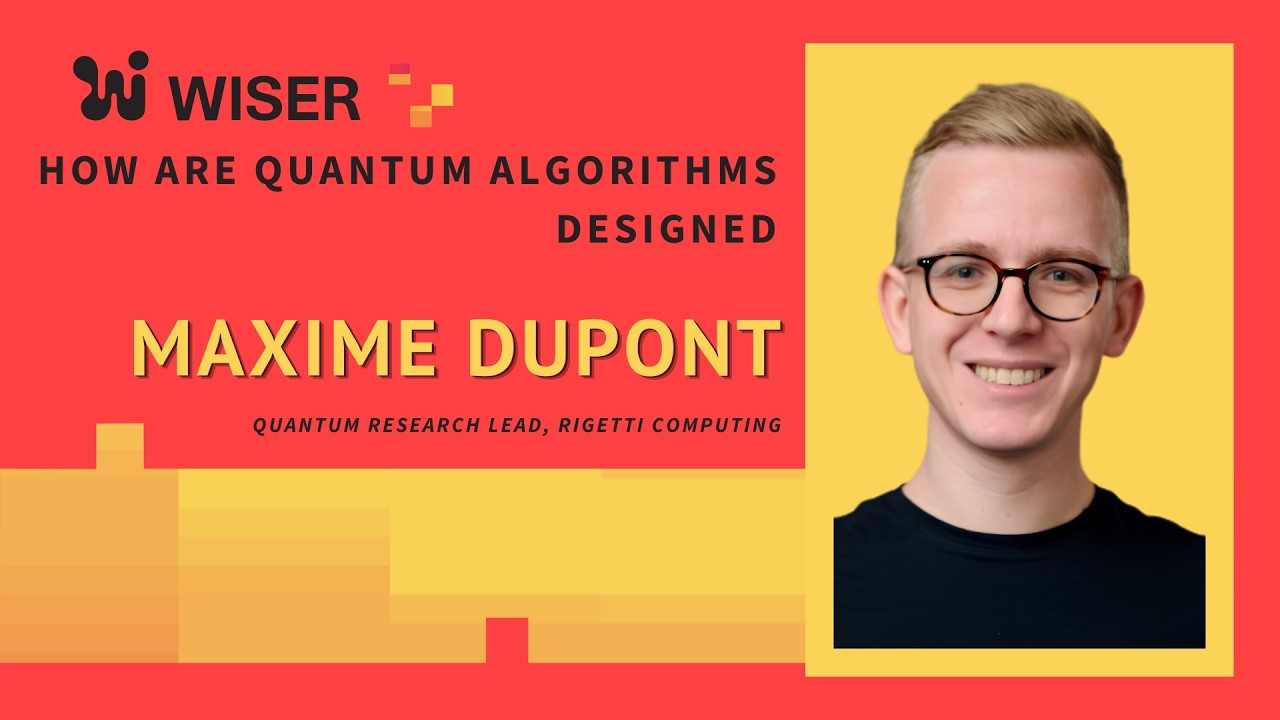
How are Quantum Algorithms Designed - Maxime Dupont
Keywords
Summary
164 words
Critical Evaluation
Value of the Information & Strength of the Argument
The talk provides valuable insights into the practical design of quantum optimization algorithms, bridging theoretical concepts with concrete implementations. The speaker’s argumentation is solid, supported by experimental results and theoretical analysis. He clearly explains the intuition behind the quantum relax and round algorithm and provides benchmarks against classical solvers. The presentation is well-structured, building from fundamentals to advanced topics, and effectively communicates the current state and challenges of the field.
Scientific Rigor, Source Quality, Title Accuracy
The talk demonstrates scientific rigor through its logical structure and reference to specific research works, including those from Google, Harvard, and Rigetti. However, the speaker does not provide detailed citations or external sources, relying primarily on his own expertise and company research. The title is somewhat broad but accurately reflects the content, which focuses on quantum algorithm design for optimization. The talk does not include any advertising or sponsored content.
155 words
Title / Content Match
The title is somewhat generic but accurately reflects the content: the talk covers the design principles of quantum algorithms, focusing on optimization and the speaker's recent research.
Quality & Reliability
8/10
The talk is given by a quantum research lead at Rigetti Computing, with a PhD in physics and postdoctoral experience. The content is technically accurate, well-structured, and grounded in current research. However, it is a high-level overview with limited formal proofs, and some claims are based on the speaker's own work without external verification.
Key Moments
Markers derived by PSI from the transcript: the creator did not define chapters.
- Introduction to optimization and quantum optimization
- Challenges for quantum optimization: large problems and noisy hardware
- Strategies for handling large problems: encoding and light-cone tricks
- Introduction to QAOA and its light-cone structure
- Quantum relax and round algorithm: concept and intuition
- Benchmark results: 99% accuracy on large Max-Cut problems
- Runtime comparison with classical solvers and quantum preconditioning
- Conclusion and future research directions
Cited Sources
- WISER — Organization hosting the talk
- WISER Quantum + AI Summer Program — Program in which the talk was given
Concurring Sources
- Quantum Approximate Optimization Algorithm — Original paper by Farhi et al. on QAOA, which is central to the talk.
- Quantum optimization for Max-Cut — Recent work on quantum optimization for Max-Cut, supporting the talk's focus.
Dissenting Sources
- Classical heuristics for Max-Cut — This paper shows that classical heuristics can achieve high performance on Max-Cut, challenging the quantum advantage claims.
Contribution & Novelties
The talk presents a novel quantum algorithm, ‘quantum relax and round’, which uses expectation values from QAOA to solve large optimization problems with high accuracy. It also introduces the concept of ‘quantum preconditioning’ as a general framework for transforming problems to make them easier for classical solvers. These ideas contribute to the ongoing research on practical quantum optimization.
Pour aller plus loin :
- Quantum Approximate Optimization Algorithm (QAOA) — The foundational algorithm discussed in the talk.
- Max-Cut problem — The benchmark problem used in the talk.
- Simulated annealing — A classical heuristic used for comparison in the talk.
- Tensor networks — Classical emulation techniques mentioned in the talk.
- Quantum annealing — A quantum optimization approach related to QAOA.
118 words
Radar Profile
The radar profile shows high scores in information quantity, quality, and technical level, indicating a dense and well-presented talk. The global reliability is also high, reflecting the speaker's expertise and the soundness of the presented research. The overall profile suggests a valuable resource for those interested in quantum optimization.
💬 No comments were provided for analysis.