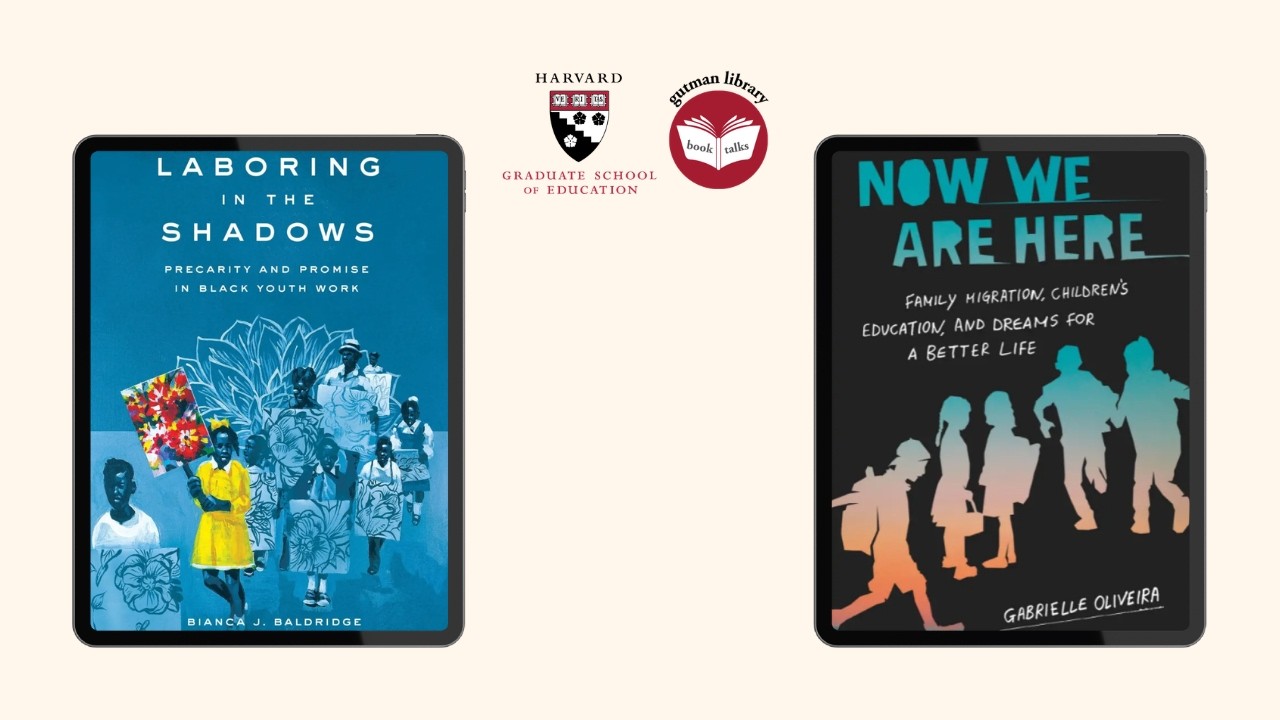
Laboring in the Shadows & Now We Are Here | Gutman Library Hybrid Book Talk
Keywords
Summary
156 words
Critical Evaluation
Value of the Information & Strength of the Argument
The value of the information is high, as it provides direct insights from two leading scholars in education and migration studies. The authors present their arguments clearly, drawing on ethnographic data and personal experiences. They effectively articulate the structural issues affecting youth workers and immigrant families, and they support their claims with references to their own research and broader academic literature. The argumentation is solid, with a nuanced discussion of complex topics such as precarity, hope, and the ethics of research. The authors also demonstrate reflexivity, acknowledging their own positions and the limitations of their work.
Scientific Rigor, Source Quality, Title Accuracy
The scientific rigor is evident in the authors’ descriptions of their methodologies, including ethnography and community-engaged research. They reference academic concepts and prior research, such as the work of Sarah Jaffe and Jeff Duncan-Andrade, and they discuss the theoretical frameworks underpinning their books. The sources cited are primarily their own books and academic publications, which are credible. The title accurately reflects the content, as the talk is centered on the two books. The discussion is well-structured and maintains a high level of academic integrity.
195 words
Title / Content Match
The title accurately reflects the content: a book talk featuring the two books 'Laboring in the Shadows' and 'Now We Are Here'.
Quality & Reliability
8/10
The talk features two established scholars discussing their peer-reviewed books, with clear methodological grounding and references to academic literature. The discussion is moderated by a professor, and the content is consistent with academic standards. However, as a book talk, it is not a formal peer-reviewed presentation and lacks detailed evidence for some claims.
Key Moments
Markers derived by PSI from the transcript: the creator did not define chapters.
- Introduction of the event and speakers by the moderator, Adriana Umaña-Taylor.
- Gabrielle Oliveira introduces the format of the talk: authors asking each other questions.
- Bianca Baldridge discusses her motivation for writing 'Laboring in the Shadows', including her personal background in youth work.
- Gabrielle Oliveira explains her motivation for writing 'Now We Are Here', focusing on the impact of immigration policy on children.
- Discussion of the quote from a youth worker about being expected to be martyrs, and the structural exploitation in nonprofit work.
- Bianca Baldridge discusses the concept of 'critical hope' and the importance of joy in youth work.
- Gabrielle Oliveira talks about the framework of 'multiple disruptions' for immigrant families and the ethical considerations of research.
- The authors discuss the balance between precarity and promise in their books, and the importance of not creating either/or narratives.
Cited Sources
- Harvard Graduate School of Education — Institution hosting the event.
- Baldridge & Oliveira Books — Link provided in the description for more information about the books.
Concurring Sources
- Motherhood Across Borders — Oliveira's first book, which provides background to her research on immigrant mothers.
- Reclaiming Community — Baldridge's first book, which explores community-based organizations and market-based reforms.
External References
Contribution & Novelties
The talk provides a unique opportunity to hear two scholars discuss their recent books in a conversational format, offering insights into their motivations, methodologies, and the key themes of their work. It highlights the importance of community-based education and the experiences of immigrant families, contributing to the fields of education, sociology, and migration studies.
Pour aller plus loin :
- Critical Hope — Concept discussed by Baldridge, referencing Jeff Duncan-Andrade’s work.
- Ethnography — Methodological approach used in both books.
- Transnationalism — Key concept in Oliveira’s research on immigrant families.
88 words
Radar Profile
The radar profile shows high scores in quantity and quality of information, reflecting the depth of the discussion. The technical level is moderate, as the talk is accessible to a general audience but still engages with academic concepts. The overall reliability is high, given the authors' expertise and the institutional context.
💬 No comments were provided for analysis.