The Impact of a Two Generation College Pipeline Program | Pier Seminar
Keywords
Summary
152 words
Critical Evaluation
Value of the Information & Strength of the Argument
The value of the information is high, as it provides rigorous causal evidence on a comprehensive college access program. The argumentation is solid, grounded in a well-designed quasi-experimental approach with attention to threats to validity. The speaker transparently discusses limitations, such as the lack of data on aspirations and the potential for endogenous school mobility. The use of a pre-analysis plan strengthens the credibility of the findings. The presentation also engages with audience questions, clarifying methodological choices and potential alternative explanations.
Scientific Rigor, Source Quality, Title Accuracy
The scientific rigor is high, with a clear identification strategy, robustness checks, and appropriate clustering of standard errors. The sources are primarily administrative data from CPS and NSC, which are reliable. The title accurately reflects the content, focusing on the impact of a two-generation program. The presentation does not cite external sources beyond the data, but the methodology is well-established. The adequacy between title and content is strong, as the talk directly addresses the program’s impact.
172 words
Title / Content Match
The title accurately reflects the content, which focuses on the impact of a two-generation college pipeline program (Hope Chicago) on college enrollment and other outcomes.
Quality & Reliability
8/10
The presentation is based on a quasi-experimental design with a pre-analysis plan, using administrative data from Chicago Public Schools and the National Student Clearinghouse. The speaker is an associate professor at the University of Chicago Harris School with policy experience. The methodology is transparent, including discussion of identification assumptions and robustness checks. However, the results are preliminary and not yet peer-reviewed.
Key Moments
Markers derived by PSI from the transcript: the creator did not define chapters.
- Introduction by Thomas Kane, welcoming Lesley Turner and outlining the seminar format.
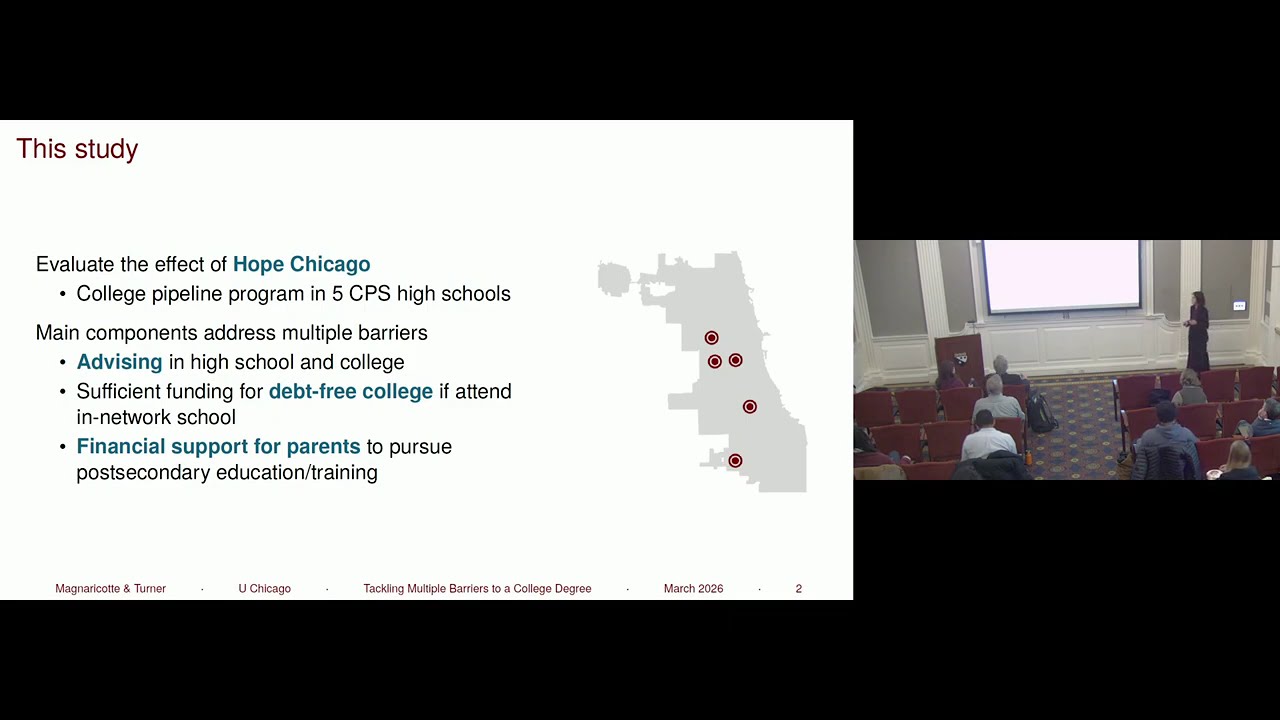
- Lesley Turner introduces Hope Chicago program, its components, and the research question.
- Discussion of barriers to college enrollment and how Hope Chicago addresses them.
- Description of the data sources: CPS administrative data and National Student Clearinghouse.
- Explanation of the difference-in-differences design and the control group of 10 shortlisted schools.
- Presentation of baseline characteristics and parallel trends in pre-period.
- Main results: 14.4 percentage point increase in immediate college enrollment, a 41% relative increase.
- Discussion of heterogeneity by baseline test scores and potential mechanisms.
- Audience questions on family budget constraints and spillover effects.
- Discussion of limitations, including data on aspirations and potential endogenous mobility.
Cited Sources
- Harvard Graduate School of Education — Host institution of the seminar.
- HGSE LinkedIn — Social media channel of the host institution.
- HGSE Threads — Social media channel of the host institution.
Concurring Sources
- Hope Chicago — Official program website providing details on the initiative.
Contribution & Novelties
This study provides novel causal evidence on a comprehensive two-generation college pipeline program, which combines advising, financial aid, and parental education support. The use of a pre-analysis plan and a quasi-experimental design with a carefully selected control group strengthens the credibility of the findings. The program’s design allows for the examination of multiple mechanisms simultaneously, offering insights into the relative importance of different barriers to college access. The study also explores spillover effects on younger siblings, contributing to the literature on family-wide impacts of educational interventions.
Pour aller plus loin :
- Two-generation programs — Overview of two-generation education models.
- Difference-in-differences — Methodological background.
- National Student Clearinghouse — Data source used for college enrollment outcomes.
114 words
Radar Profile
The radar profile shows high scores in information quantity, quality, and reliability, with a slightly lower technical level, reflecting the presentation's focus on policy implications rather than advanced econometric details. The overall assessment is strong, indicating a valuable contribution to education policy research.