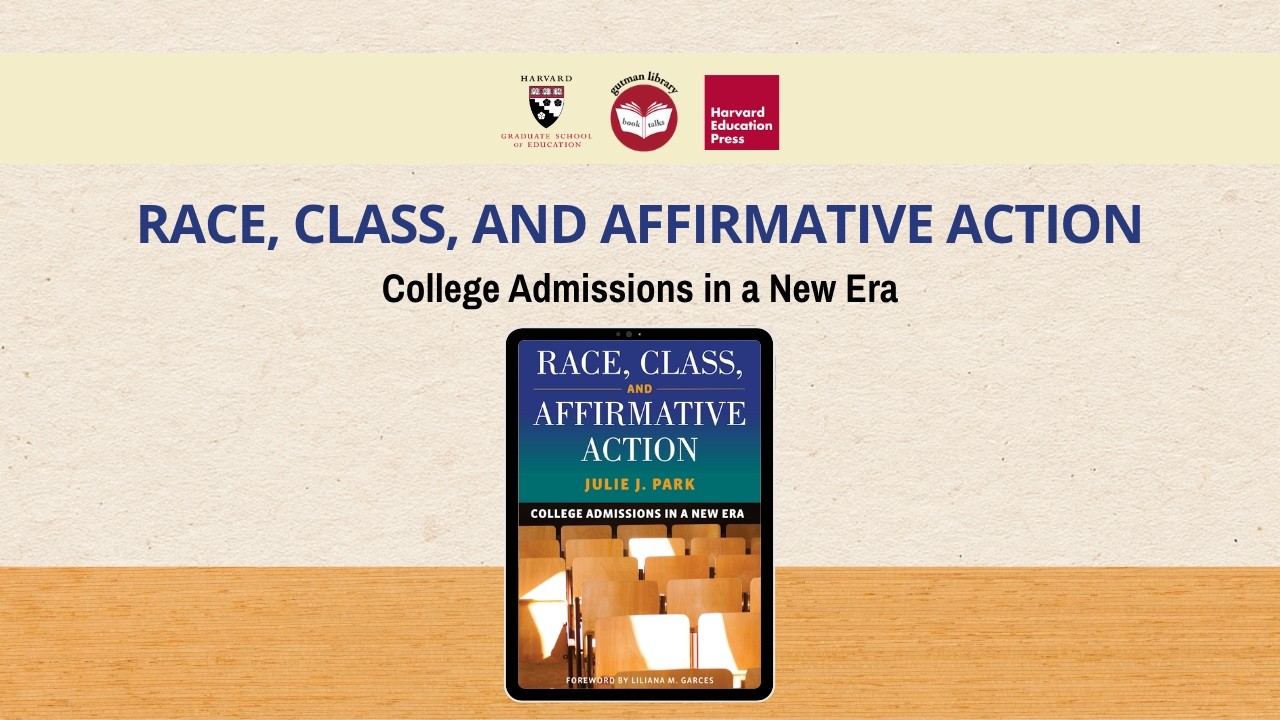
Race, Class, and Affirmative Action | Gutman Library Hybrid Book Talk
Keywords
Summary
163 words
Critical Evaluation
Value of the Information & Strength of the Argument
The value of the information is high, as it provides a nuanced and expert perspective on a complex and timely topic. Park offers a well-reasoned argument that affirmative action is not dead but severely restricted, and she supports this with references to legal cases, institutional examples, and research. She also critiques the Opportunity Insights research, pointing out inconsistencies in their own practices, which adds depth to the discussion. The argumentation is solid, as Park acknowledges complexities and avoids oversimplification. She presents multiple viewpoints and encourages critical thinking about the purpose of higher education and the role of admissions in achieving societal goals.
111 words
Title / Content Match
The title accurately reflects the content, which is a book talk focused on race, class, and affirmative action in college admissions.
Quality & Reliability
8/10
The discussion is led by a recognized expert in higher education admissions, with references to legal cases, research, and institutional practices. The content is well-structured and nuanced, though it reflects the author's perspective and does not include formal citations or peer-reviewed sources within the talk.
Key Moments
Markers derived by PSI from the transcript: the creator did not define chapters.
- Introduction of Julie Park and moderator OiYan Poon by the editor.
- Julie Park provides a synopsis of her book, arguing that affirmative action is not dead but severely curtailed.
- Discussion on the evolution of race-conscious admissions and the impact of the SFFA ruling.
- Critique of Opportunity Insights research on standardized testing and their own admissions practices.
- Discussion on alternative strategies like economic diversity initiatives and percent plans.
- Exploration of the purpose of higher education and how admissions should align with it.
- Discussion on the importance of institutional leadership and legal options to defend race-conscious admissions.
Cited Sources
- Harvard Graduate School of Education — Institution hosting the book talk.
- HGSE LinkedIn — Social media channel for the institution.
- HGSE Threads — Social media channel for the institution.
Concurring Sources
- Students for Fair Admissions v. Harvard — The Supreme Court case that is central to the book's discussion.
- Opportunity Insights — Research organization whose work on standardized testing is critiqued in the book.
Dissenting Sources
- Opportunity Insights — Park critiques their research and practices, suggesting that their policy recommendations may not be as clear-cut as presented.
Contribution & Novelties
The book provides a timely and nuanced analysis of the post-SFFA landscape, arguing that race-conscious admissions are not dead but severely restricted. It offers a comprehensive review of the legal and policy implications, critiques of research, and practical strategies for institutions. The book also highlights the importance of institutional leadership and legal options that are often overlooked.
Pour aller plus loin :
- Students for Fair Admissions v. Harvard — Background on the Supreme Court case.
- Opportunity Insights — Research organization discussed in the book.
- The Chronicle of Higher Education — Source of investigative article on Opportunity Insights.
97 words
Radar Profile
The radar profile shows high scores in quantity and quality of information, reflecting the depth and expertise of the discussion. The technical level is moderate, making it accessible to a broad audience. The overall reliability is high due to the author's credentials and the use of credible sources.