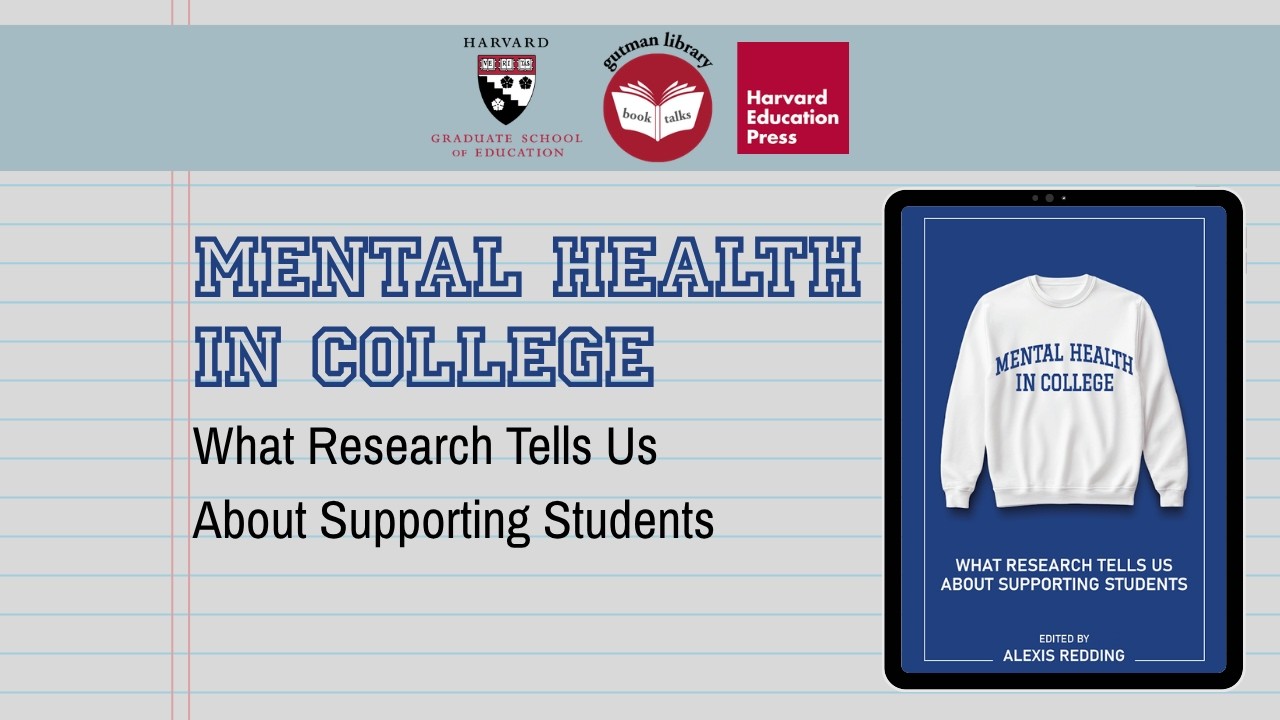
Mental Health in College | Gutman Library Virtual Book Talk
Keywords
Summary
142 words
Critical Evaluation
Value of the Information & Strength of the Argument
The value of the information is high, as it provides practical insights from experienced practitioners and researchers. The argumentation is solid, grounded in research and professional experience. The panelists effectively argue for a holistic approach to student mental health, moving beyond clinical treatment to include prevention and community-based support. They present compelling examples, such as the ‘college hour’ and strength-based approaches for veterans, which illustrate the feasibility of their recommendations. The discussion is well-structured, with each panelist clearly articulating their chapter’s contributions and connecting them to broader themes.
Scientific Rigor, Source Quality, Title Accuracy
The scientific rigor is evident in the panelists’ references to research and specific studies, such as the work by Sullivan and Yoon on student veterans. The sources are credible, coming from academic and institutional contexts. The title accurately reflects the content, which is a book talk on mental health in college. The discussion is well-organized and stays on topic, with each panelist addressing relevant aspects of student mental health. The quality of sources is high, as the book is published by Harvard Education Press and the panelists are experts in their fields.
195 words
Title / Content Match
The title accurately reflects the content: a book talk on mental health in college, featuring the editor and contributors discussing key themes and chapters.
Quality & Reliability
8/10
The video features a panel of experts from Harvard and other institutions, discussing a book published by Harvard Education Press. The content is well-structured, evidence-informed, and includes references to specific studies and practices. However, it is primarily a discussion and promotional event, not a peer-reviewed presentation, so the score is high but not perfect.
Key Moments
Markers derived by PSI from the transcript: the creator did not define chapters.
- Introduction by Molly Cerrone, acquisitions editor at Harvard Education Press, introducing Alexis Redding and the panelists.
- Alexis Redding introduces the book's purpose and the panelists, emphasizing the need to expand the narrative of college students.
- Dustin Liu discusses his chapter on supporting students through career transitions, highlighting the importance of purpose and community.
- Adam Milano talks about his chapter on student veterans, emphasizing the diversity of experiences and the importance of belonging.
- Adrian Gonzales shares his work at San Diego Miramar College, including the 'college hour' initiative and embedding mental health support.
- Discussion on targeted universalism and how supporting specific groups benefits all students.
- Panelists answer questions from the audience, addressing practical implementation and challenges.
- Further discussion on the role of faculty and staff in supporting student mental health.
- Concluding remarks and information on how to access the book.
Cited Sources
- Harvard Graduate School of Education — Mentioned as the host institution and resource for further information.
- Mental Health in College: What Research Tells Us About Supporting Students — The book being discussed, published by Harvard Education Press.
- HGSE LinkedIn — Social media channel for the Harvard Graduate School of Education.
- HGSE Threads — Social media channel for the Harvard Graduate School of Education.
Concurring Sources
- Harvard Graduate School of Education — The host institution, providing credibility and alignment with the book's themes.
- Mental Health in College: What Research Tells Us About Supporting Students — The book itself, which is the primary source of the discussion.
Contribution & Novelties
The video provides a comprehensive overview of the book’s contributions, emphasizing a holistic, community-based approach to student mental health. It introduces the concept of ’targeted universalism’ and practical examples like the ‘college hour’ at community colleges. The panelists highlight the importance of expanding the definition of college students and addressing transitions and belonging.
Pour aller plus loin :
- Targeted Universalism — A policy approach discussed in the video, relevant for designing inclusive support systems.
- Stanford Life Design Lab — The source of design thinking exercises mentioned by Dustin Liu for helping students navigate career transitions.
- Student Veterans of America — An organization providing resources and support for student veterans, relevant to Adam Milano’s chapter.
- American College Health Association — A professional organization with resources on college health and mental health, useful for further reading.
134 words
Radar Profile
The radar profile shows high scores in quantity and quality of information, with a slightly lower technical level, indicating accessible yet substantive content. The global reliability is high, reflecting the expertise of the panelists and the institutional backing.
💬 No comments were provided for analysis.