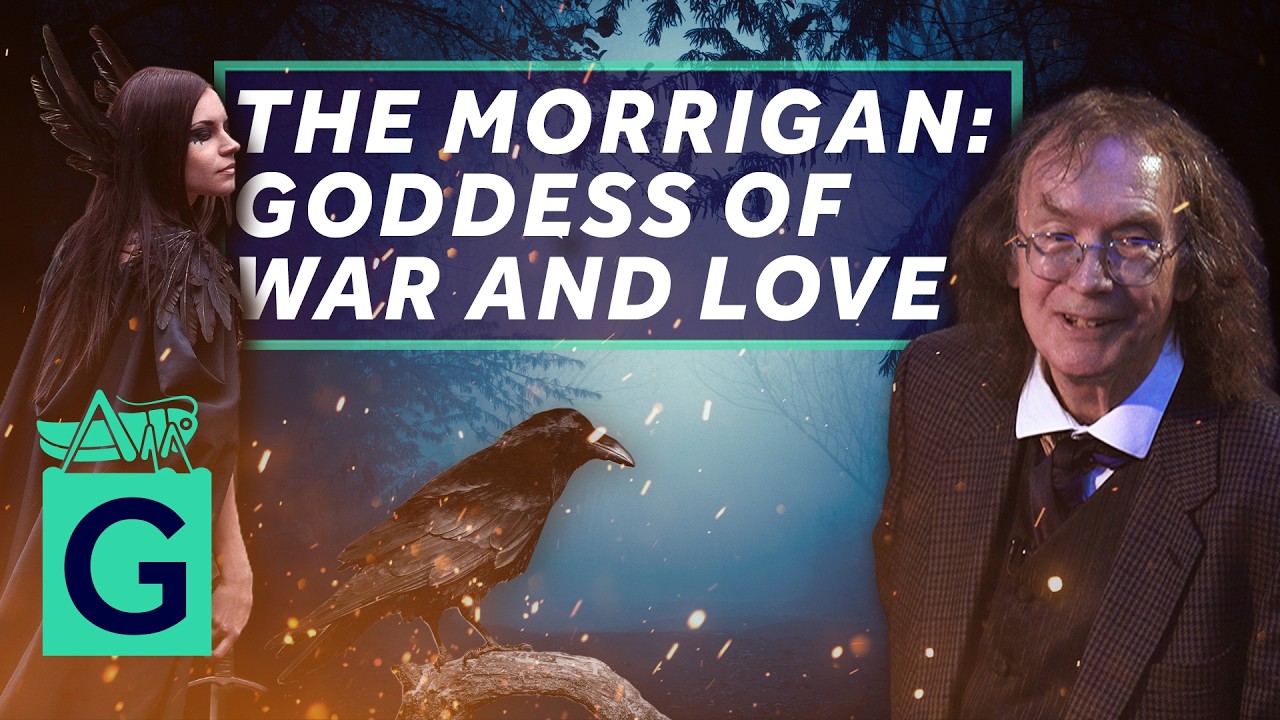
The Morrigan: The Nightmare Queen - Ronald Hutton
Keywords
Summary
180 words
Critical Evaluation
Ronald Hutton delivers a masterful and nuanced lecture on the Morrigan, demonstrating his expertise in medieval Irish history and mythology. The talk is meticulously researched, drawing on primary sources such as the Book of Invasions, the Dindshenchas, and the Táin Bó Cúailnge, and it engages critically with the existing scholarly literature. Hutton’s central thesis—that medieval Irish mythology was a collection of building blocks rather than a coherent structure—is compelling and well-argued. He supports this by comparing the Irish situation with that of ancient Greece and Mesopotamia, where political unification facilitated the synthesis of local deities into a pantheon. In contrast, Ireland’s extreme political fragmentation prevented such a process, resulting in a ’total chaos’ of relationships and attributes for the goddesses. This framework elegantly explains the contradictory portrayals of the Morrigan in different texts and the disagreements among modern scholars. Hutton is transparent about the uncertainties in etymology and interpretation, acknowledging the difficulty of pronouncing medieval Irish and the lack of consensus on the goddess’s name. He also carefully distinguishes between the generic battle spirits and the named goddesses, showing how the latter are ‘writ large’ versions of the former. The lecture’s strength lies in its balanced approach: it neither overstates the evidence nor dismisses the Morrigan’s significance. Hutton’s comparisons with other cultures, such as the parallels with Athena and Ishtar, are insightful and help contextualize the Morrigan’s role. The only minor weakness is that some of his speculations, such as the natural history explanation for the association of crows with battle, are intriguing but not fully substantiated. However, he presents them as suggestions rather than definitive conclusions. Overall, this is an exemplary piece of scholarly communication, accessible to a general audience while maintaining academic rigor. The lecture also touches on the modern reception of the Morrigan, noting her popularity in pop culture and among modern devotees, which adds a contemporary relevance. Hutton’s final reflection on the freedom of reinterpretation is a fitting conclusion to his tenure as Gresham Professor, emphasizing the living nature of mythology.
335 words
Title / Content Match
The title accurately reflects the content: a focused examination of the Morrigan as a 'nightmare queen', exploring her terrifying aspects and historical roots.
Quality & Reliability
9/10
Lecture by a renowned historian (Ronald Hutton, Professor of History at the University of Bristol) based on primary medieval Irish sources, with careful analysis of etymology and scholarly debates. The talk is well-structured, transparent about uncertainties, and avoids overgeneralizations. Minor caveat: some interpretations are speculative, but clearly flagged as such.
Chapters
- | Introduction: Hutton's Final Lecture as Gresham Professor
- | The Morrigan: Bridget's Dark Alter Ego
- | A Modern Icon: Global Fame & Worship
- | Pop Culture: Madonna, Villains & Modern Devotees
- | What Does "The Morrigan" Mean? A Name in Dispute
- | Nightmare Queen: Tracing Her Terrifying Etymology
- | Decades of Scholarly Disagreement Over Her Identity
- | Building Blocks, Never a Structure: The Lecture's Thesis
- | Battle Spirits: Generic Terrors & Named Goddesses
- | Meet the Big Five War Goddesses
- | Magic as a Neutral Cosmic Power
- | Macha's Three Contradictory Origin Stories
- | The Badb: Crow Spirit and Doom-Prophet
- | At Last, The Morrigan: What Makes Her Distinct
- | Three Distinguishing Features & Cosmic Prophecy
- | Propositioning Cú Chulainn: Rejection & Revenge
- | Global Parallels: Athena, Ishtar & Gilgamesh
- | The Death of Cú Chulainn & the Raven on the Shoulder
- | What She Is: A War Goddess of Love and Combat
- | Reclaiming The Morrigan: Freedom in Reinterpretation
Cited Sources
- Gresham College — Official website of Gresham College, the institution hosting the lecture.
- Support Gresham College — Page for supporting Gresham College, mentioned in the description.
- The Goddess Morrigan - Lecture Page — Dedicated page for this lecture on the Gresham College website.
- Q&A Session — Link to the Q&A session following the lecture, mentioned in the description.
Concurring Sources
- The Morrigan - Wikipedia — General information on the Morrigan, consistent with Hutton's description.
Dissenting Sources
- Alternative interpretations by scholars — Hutton mentions various scholars (e.g., John Carey, Rosalind Clark) who have proposed different interpretations of the Morrigan, but he does not provide specific URLs. These differing views are discussed in the lecture.
Contribution & Novelties
This lecture offers a fresh perspective on the Morrigan by arguing that medieval Irish mythology was never a coherent system but a collection of diverse traditions. Hutton’s synthesis of primary sources and scholarly debates provides a comprehensive overview, while his comparative approach with Greek and Mesopotamian mythologies adds depth. The lecture also highlights the Morrigan’s modern relevance, explaining her popularity in contemporary culture.
Pour aller plus loin :
- The Morrigan - Wikipedia — Provides a general overview and additional references.
- Táin Bó Cúailnge - Wikipedia — Key source text mentioned in the lecture.
- Book of Invasions - Wikipedia — Another primary source referenced.
- Ronald Hutton - Wikipedia — Background on the lecturer’s expertise.
113 words
Radar Profile
The radar profile shows high scores across all dimensions, indicating a well-rounded and reliable lecture. The strong scores in information quantity and quality reflect the depth of research and clarity of presentation, while the technical level is appropriate for a general audience without oversimplifying.