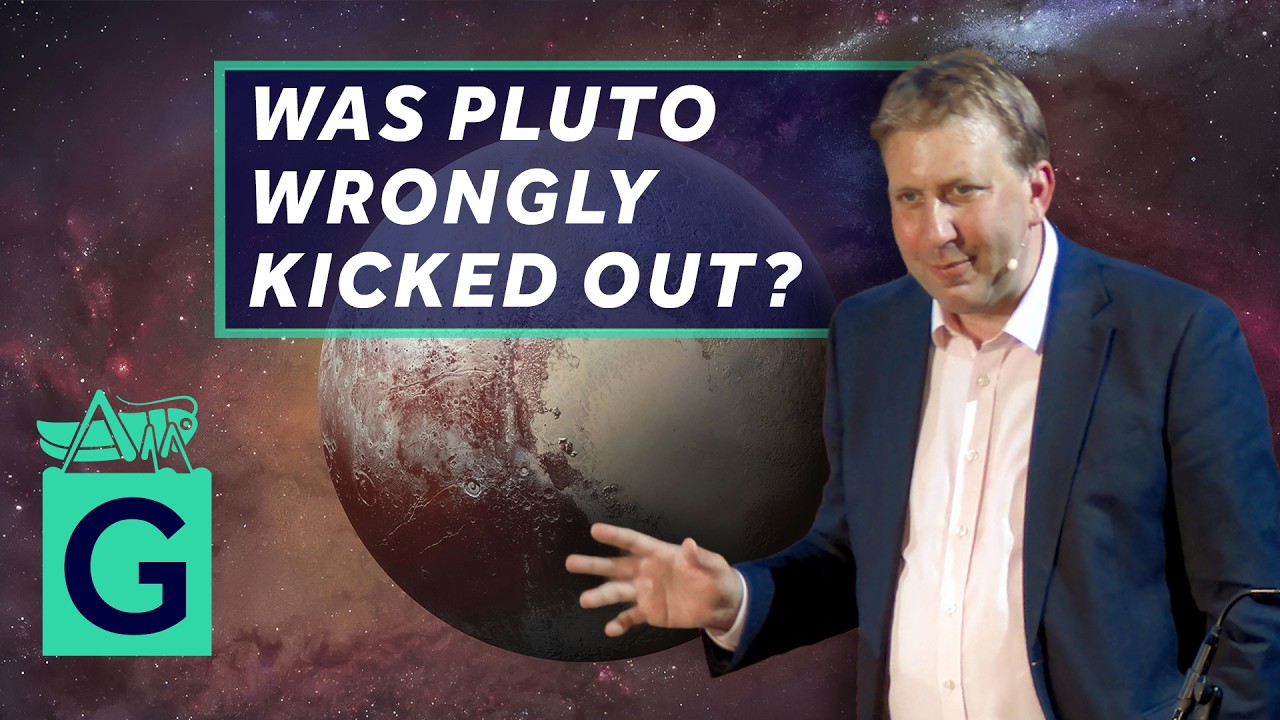
Pluto Isn’t a Planet - Chris Lintott
Keywords
Summary
173 words
Critical Evaluation
The lecture provides a comprehensive and engaging account of the Pluto controversy, blending historical narrative with scientific explanation. Lintott’s expertise is evident, and he presents the material in an accessible yet rigorous manner. The argumentation is solid: he traces the discovery of Pluto, the doubts about its status, and the eventual IAU definition, explaining the scientific rationale behind the decision. He acknowledges the emotional attachment to Pluto but defends the classification based on the criterion of clearing the orbital neighborhood. The lecture is well-structured, with clear chapters and a logical flow. The sources cited are primarily historical and institutional, such as the IAU and the New Horizons mission, which are reliable. The title accurately reflects the content, and the lecture does not oversimplify the complexities of planetary classification. The only minor weakness is that the lecture could have delved deeper into the ongoing debates about the definition, but overall it is an excellent scientific communication. The public comments reflect a mix of agreement and nostalgia, with some technical critiques, but the lecture’s quality is high.
175 words
Title / Content Match
The title accurately reflects the content: the lecture explains why Pluto is not a planet, covering the historical context and the scientific reasoning.
Quality & Reliability
9/10
Lecture by a professor of astrophysics at Oxford, with historical accuracy and scientific rigor, based on established facts and IAU decisions.
Chapters
- // Introduction: Why Pluto Isn't a Planet
- // Discovery of Uranus & a Mysterious Orbit
- // How Neptune Was Found Through Math
- // Percival Lowell's Hunt for "Planet X"
- // Clyde Tombaugh Discovers Pluto (1930)
- // A Brief History of Counting the Planets
- // Pluto's Odd Orbit Raises Early Doubts
- // The Kuiper Belt Theory Takes Shape
- // Discovering Pluto's Moon, Charon
- // Eris and the Rise of the Trans-Neptunian Objects
- // The IAU's Chaotic 2006 Vote
- // New Horizons: Pluto Up Close at Last
- // The Verdict — Why Pluto Isn't a Planet
Cited Sources
- Gresham College Lecture Page — Official page for the lecture, providing additional resources and information.
- Q&A Session — Follow-up Q&A session with Chris Lintott, offering further discussion.
- Gresham College Website — Institution hosting the lecture, known for public education.
- Gresham College on Bluesky — Social media profile for updates and engagement.
Concurring Sources
- IAU Definition of a Planet — The IAU's official definition, which the lecture discusses.
- New Horizons Mission — NASA's mission that provided close-up images of Pluto, supporting the lecture's discussion.
Dissenting Sources
- Planetary Society's stance on Pluto
Contribution & Novelties
The lecture offers a historical perspective on the discovery and classification of Pluto, synthesizing known facts into a coherent narrative. It emphasizes the scientific process and the importance of definitions in astronomy. The lecture also highlights the role of citizen science and public engagement in astronomy, as Lintott is a founder of Zooniverse.
Pour aller plus loin :
- IAU definition of a planet — Official IAU statement on the definition.
- New Horizons mission — NASA’s mission that flew by Pluto, providing close-up images.
- Kuiper Belt — Overview of the region beyond Neptune where Pluto resides.
95 words
Radar Profile
The radar profile shows high scores in information quantity, quality, and reliability, with a slightly lower technical level, indicating a lecture that is both informative and accessible.
💬 The comments are generally positive and engaged, with a mix of nostalgia and scientific curiosity. Some users express disagreement with the IAU decision, but the overall tone is respectful and appreciative of the lecture. Sur les 30 commentaires analysés, la tendance est équilibrée, avec des éloges pour la clarté et des débats sur la définition.