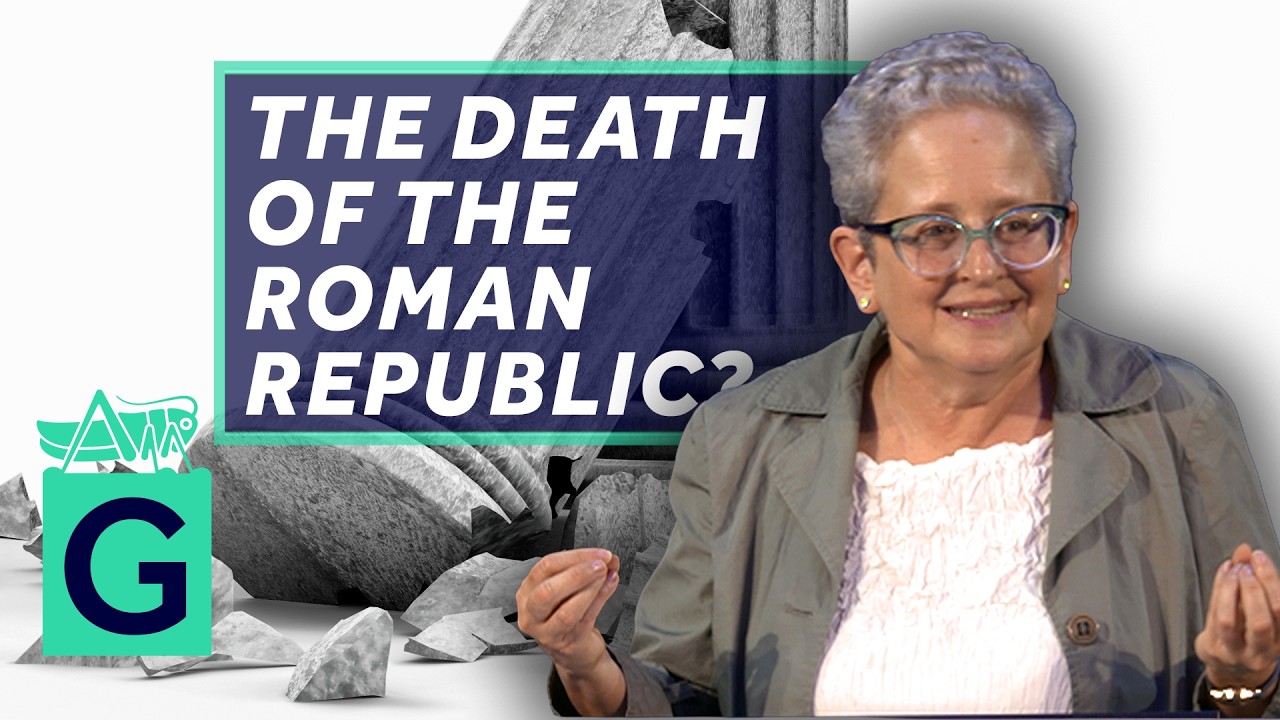
The Death of the Roman Republic? - Melissa Lane
Keywords
Summary
145 words
Critical Evaluation
Value of the Information & Strength of the Argument
The lecture offers a sophisticated and original argument that the Roman Republic did not simply ‘fall’ but was gradually subverted from within through legal means. Lane’s use of the modern concept of ‘autocratic legalism’ provides a powerful analytical lens, and she supports her claims with close readings of primary sources (Augustus’s Res Gestae, Tacitus’s Annals) and engagement with modern scholarship (e.g., John Rich, Kim Scheppele). The argumentation is rigorous and well-structured, moving from Augustus to his successors and then to Tacitus as a writer. Lane is careful to acknowledge alternative interpretations and the ambiguity of the evidence, making her case persuasive.
Scientific Rigor, Source Quality, Title Accuracy
The lecture demonstrates high scholarly rigor. Lane cites primary sources (Ovid, Horace, Tacitus, Augustus’s Res Gestae) and engages with modern historians (e.g., David Stockton, John Rich, Robert Morstein-Marx, Nathan Rosenstein). She also introduces theoretical frameworks from political science (autocratic legalism, exit-voice-loyalty) to illuminate the historical material. The title accurately reflects the lecture’s focus, though the lecture argues for a more nuanced view than a simple ‘death.’ The description and transcript are consistent with the content.
191 words
Title / Content Match
The title accurately reflects the lecture's central question about the end of the Roman Republic, though the lecture argues for a gradual transformation rather than a single death.
Quality & Reliability
9/10
Lecture by a distinguished Princeton professor, based on primary sources (Tacitus, Augustus' Res Gestae) and modern scholarship (e.g., John Rich, Kim Scheppele). The argument is nuanced and well-supported, though it presents a particular interpretive framework.
Chapters
- // Welcome and Introduction
- // Ovid's Claim: "Caesar Is the Republic"
- // Exile: The Danger of Writing Under Augustus
- // Tonight's Question: Charting Roman Autocracy
- // Tacitus and the Timeline of Roman History
- // Tacitism: Tacitus's Legacy in Early Modern Europe
- // Republic vs Empire: A Terminological Clarification
- // When Did the Roman Republic Really End?
- // Rethinking the Republic's "Fall"
- // Lecture Roadmap: Three Parts
- // Princeps: Augustus's Ambiguous Title
- // "Making the Emergency Permanent"
- // Did Augustus Really Limit His Own Power?
- // The 23 BCE Conspiracy and Constitutional Change
- // Autocratic Legalism: Law as a Tool of Power
- // From Tiberius to Nero: Eroding the Republic
- // Tacitus's Verdict on Tiberius and Nero
- // Seneca, Nero, and the Choice of Exit, Voice, or Loyalty
- // Tacitus as Author: Writing Truth Under Tyranny
- // Agricola: Survival and Courage Under Domitian
Cited Sources
- Gresham College Lecture Page — Official page for the lecture, including transcript and related materials.
- Q&A Session — Link to the Q&A session following the lecture.
- Gresham College Website — General website of Gresham College, which hosts free public lectures.
Concurring Sources
- Res Gestae Divi Augusti — Augustus's own account of his achievements, cited in the lecture as evidence for his self-presentation.
- The Annals (Tacitus) — Tacitus's historical work, which Lane uses to illustrate the erosion of the republic under Tiberius and Nero.
Dissenting Sources
- Encyclopaedia Britannica Timeline
Contribution & Novelties
The lecture provides a fresh perspective on the fall of the Roman Republic by applying the modern concept of ‘autocratic legalism’ to ancient Rome, showing how Augustus used legal means to consolidate power while maintaining republican facades. It also integrates the ’exit, voice, and loyalty’ framework to analyze the choices of political actors under tyranny. The lecture’s emphasis on the gradual and imperceptible nature of the transformation challenges simplistic narratives.
Pour aller plus loin :
- Autocratic Legalism (Kim Scheppele) — Wikipedia article on the concept, directly relevant to Lane’s argument.
- Exit, Voice, and Loyalty (Albert Hirschman) — Wikipedia article on Hirschman’s framework, used to analyze Seneca’s choices.
- Tacitus — Wikipedia article on the historian, whose works are central to the lecture.
121 words
Radar Profile
The radar profile shows high scores across all dimensions, indicating a lecture that is both information-dense and methodologically rigorous. The balance between quantity and quality of information, along with a high technical level, suggests a scholarly yet accessible presentation.
💬 No comments were provided for analysis.