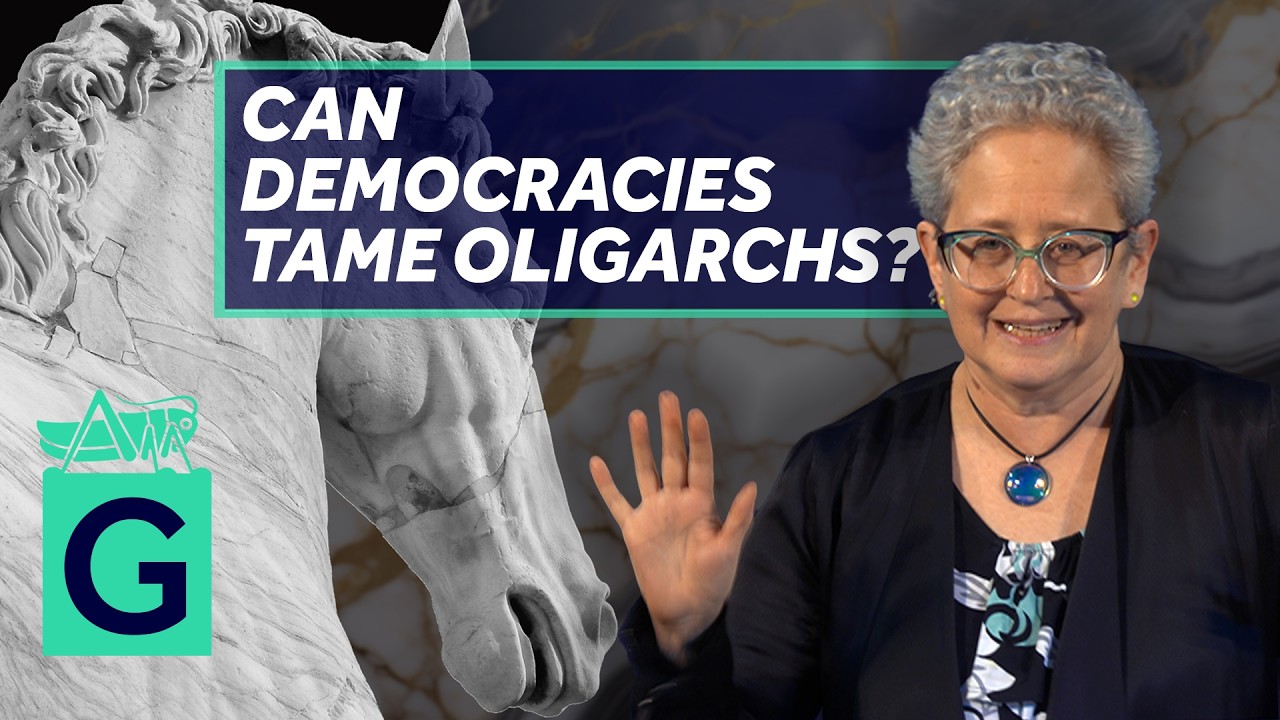
Oligarchs and Their Discontents - Melissa Lane
Keywords
Summary
165 words
Critical Evaluation
The lecture provides a rigorous and insightful analysis of oligarchic power in ancient democracies, drawing on primary sources and modern scholarship. Lane’s conceptual framework of accommodationism and irredentism is valuable for understanding elite behavior in democratic systems. She effectively contrasts the Roman and Athenian models, showing how institutional structures shape oligarchic strategies. The historical narrative is well-supported by evidence, including specific events like the secession of the plebs and the oligarchic coups in Athens. The lecture is balanced, acknowledging the complexity of these dynamics and avoiding oversimplification. The sources cited are credible, including Thucydides, Livy, and contemporary historians like T.J. Cornell and Matthew Simonton. The argumentation is logical and clear, with a coherent structure that builds from definitions to historical examples to modern implications. The lecture’s relevance to contemporary politics is thoughtfully addressed, without forcing parallels. Overall, this is a high-quality academic lecture that offers both depth and accessibility.
149 words
Title / Content Match
The title accurately reflects the content, focusing on the dynamics of oligarchic power in ancient Athens and Rome and the resistance to it.
Quality & Reliability
9/10
Lecture by a recognized professor of politics at Princeton, based on historical sources (Thucydides, Livy, Aristotle) and contemporary scholarship (Cornell, Simonton). The argument is well-structured, with clear definitions and historical examples. The lecture is part of a series at Gresham College, a reputable institution. The content is scholarly but accessible, with no evident bias or misinformation.
Chapters
- // Introduction: Oligarchs & Their Discontents
- // Roman Patricians vs. Plebeians: The First Secession
- // What Is Oligarchy? Defining the Rule of the Few
- // Two Models of Oligarchic Power: Accommodation vs. Irredentism
- // The Accommodation Model: Menenius Agrippa's Body Politic Speech
- // The Irredentist Model: Coriolanus & Reactionary Resistance
- // Rome's Elitist Constitution: Why Accommodation Had Limits
- // Athens vs. Rome: Bottom-Up vs. Top-Down Power Structures
- // Athenian Democracy & Popular Accountability of Elites
- // Oligarchy as a Reaction to Democracy: The Greek World
- // The Peloponnesian War & The Rise of Oligarchic Revolts
- // The First Oligarchic Coup: The Council of 400 (411 BCE)
- // How the 400 Seized Power & Dismantled Democracy
- // The Fall of the 400 & Restoration of Democracy
- // The Second Oligarchic Takeover: The Thirty Tyrants (404 BCE)
- // How the Thirty Ruled Without Office: Unchecked Power
- // The Fall of the Thirty & The Restoration of Athenian Democracy
- // Amnesty & Accountability: Athens' Third Way
- // Lessons for Modern Democracies: Poland & Post-Populist Regimes
- // Conclusion: Taming Oligarchs — An Enduring Democratic Challenge
Cited Sources
- Gresham College — Institution hosting the lecture
- Support Gresham College — Support page for the college
- Lecture page on Gresham College website — Official page for this lecture
- Q&A session — Follow-up Q&A session for this lecture
Concurring Sources
- Gresham College — Institution hosting the lecture
- Lecture page on Gresham College website — Official page for this lecture
Contribution & Novelties
The lecture offers a novel comparative framework for understanding oligarchic behavior in ancient democracies, distinguishing between accommodationist and irredentist strategies. It synthesizes historical evidence from Athens and Rome to illuminate patterns of elite resistance to democratic accountability. The application of these ancient lessons to modern democratic challenges, such as populist and oligarchic tendencies, provides a fresh perspective.
Pour aller plus loin :
- Oligarchy - Wikipedia — Provides a general overview of oligarchy as a concept.
- Athenian democracy - Wikipedia — Background on the democratic institutions of ancient Athens.
- Coriolanus - Wikipedia — Details on the historical figure and Shakespeare’s play.
100 words
Radar Profile
The radar profile shows high scores in quantity and quality of information, with a slightly lower but still strong score in technical level, reflecting the lecture's academic depth. The overall reliability is high, indicating a trustworthy and well-sourced presentation.