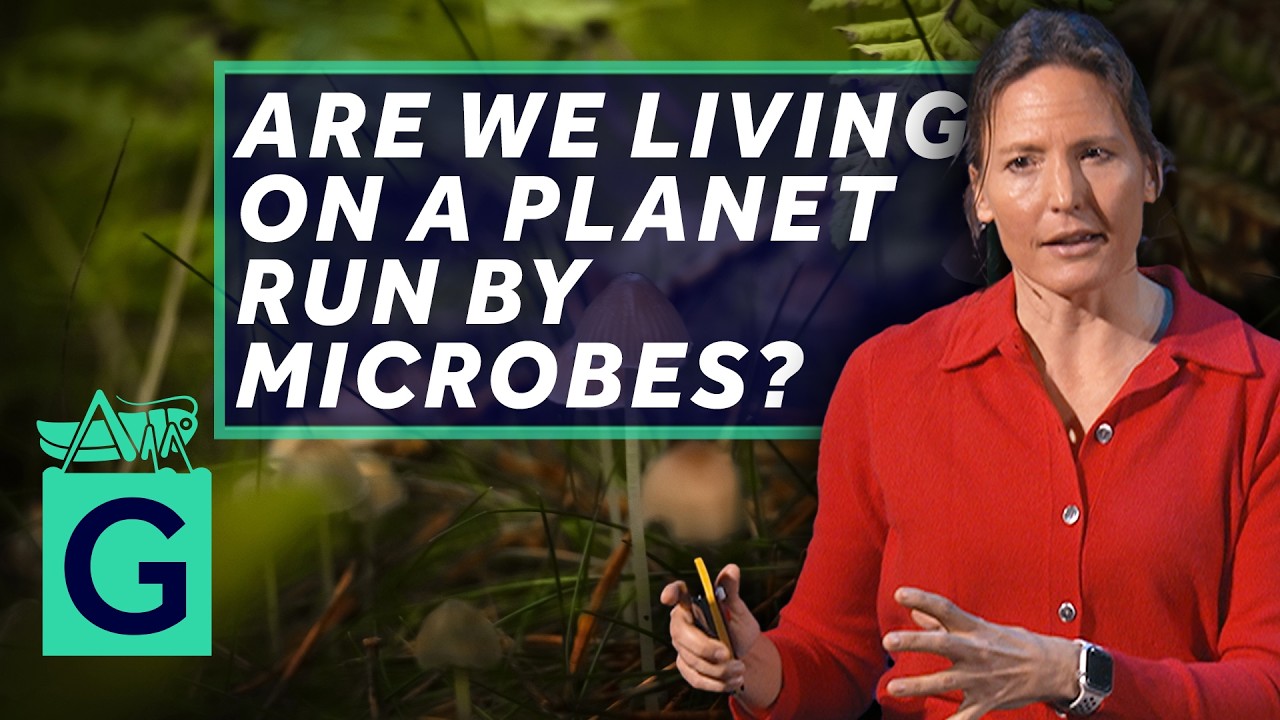
A Living Planet - Helen Czerski
Keywords
Summary
175 words
Critical Evaluation
The lecture is a masterful synthesis of ecological and oceanographic knowledge, delivered with clarity and scientific rigor. Czerski, a physicist and oceanographer, brings a unique perspective that bridges disciplines, effectively communicating complex concepts to a general audience without oversimplifying. The use of quantitative data, such as the 2018 biomass study, grounds the discussion in empirical evidence, and she appropriately contextualizes limitations, such as the uncertainty in biomass estimates. The argumentation is solid, building from a global survey of life to specific examples of life’s functional roles, and finally to the implications of human activity. The inclusion of the PACE satellite data adds a cutting-edge element, showcasing recent technological advances in Earth observation. The lecture’s strength lies in its ability to shift the viewer’s perspective from a human-centric view of nature to a systems-level understanding, emphasizing the interconnectedness of life and planetary processes. The discussion of the IUCN Red List and the concept of ’least concern’ is particularly insightful, highlighting the inadequacy of current conservation metrics. The only minor weakness is the occasional reliance on anecdotal examples, but these serve to illustrate broader points effectively. Overall, the lecture is an excellent contribution to science communication, with high informational value and a compelling narrative.
202 words
Title / Content Match
The title accurately reflects the content, which focuses on Earth as a living system and the role of life in planetary processes.
Quality & Reliability
8/10
Lecture by a professor of mechanical engineering and oceanographer, based on peer-reviewed data (e.g., biomass study 2018, PACE satellite data). Clear presentation of scientific concepts with appropriate caveats. No commercial bias detected.
Chapters
- // Introduction
- // Earth seen from space
- // The PACE satellite & the living planet
- // How much life is there? Biomass by the numbers
- // Inside the animal kingdom
- // Where is life living?
- // Land vs ocean: productivity & turnover
- // We live in a microbial world
- // Vitamin B12 and our dependency on bacteria
- // Parrotfish and the white sand beaches
- // Phytoplankton, DMS, and cloud formation
- // Animals as ecosystem engineers
- // Humpback whales as nutrient conveyors
- // What humans have already removed from the ocean
- // The IUCN Red List — and what "least concern" doesn't mean
- // Conclusion: life is not a luxury, it's a life support system
Cited Sources
- Gresham College Lecture Page — Official page for the lecture, providing additional resources and information.
- Q&A Session — Follow-up Q&A session related to the lecture.
Concurring Sources
- Bar-On et al. 2018, PNAS — The biomass distribution paper cited in the lecture.
Contribution & Novelties
The lecture provides a comprehensive and accessible synthesis of current knowledge on global biomass distribution and the functional roles of life in Earth’s systems. It highlights recent satellite data (PACE) and emphasizes the importance of microbes and marine life in planetary processes, offering a fresh perspective on biodiversity’s significance.
Pour aller plus loin :
- Biomass distribution paper (Bar-On et al., 2018) — The foundational study on global biomass distribution.
- PACE satellite mission — NASA’s Plankton, Aerosol, Cloud, ocean Ecosystem mission.
- IUCN Red List — The global standard for assessing species extinction risk.
92 words
Radar Profile
The radar profile shows high scores in information quantity and quality, with moderate technical level and reliability, reflecting a well-balanced and informative lecture.