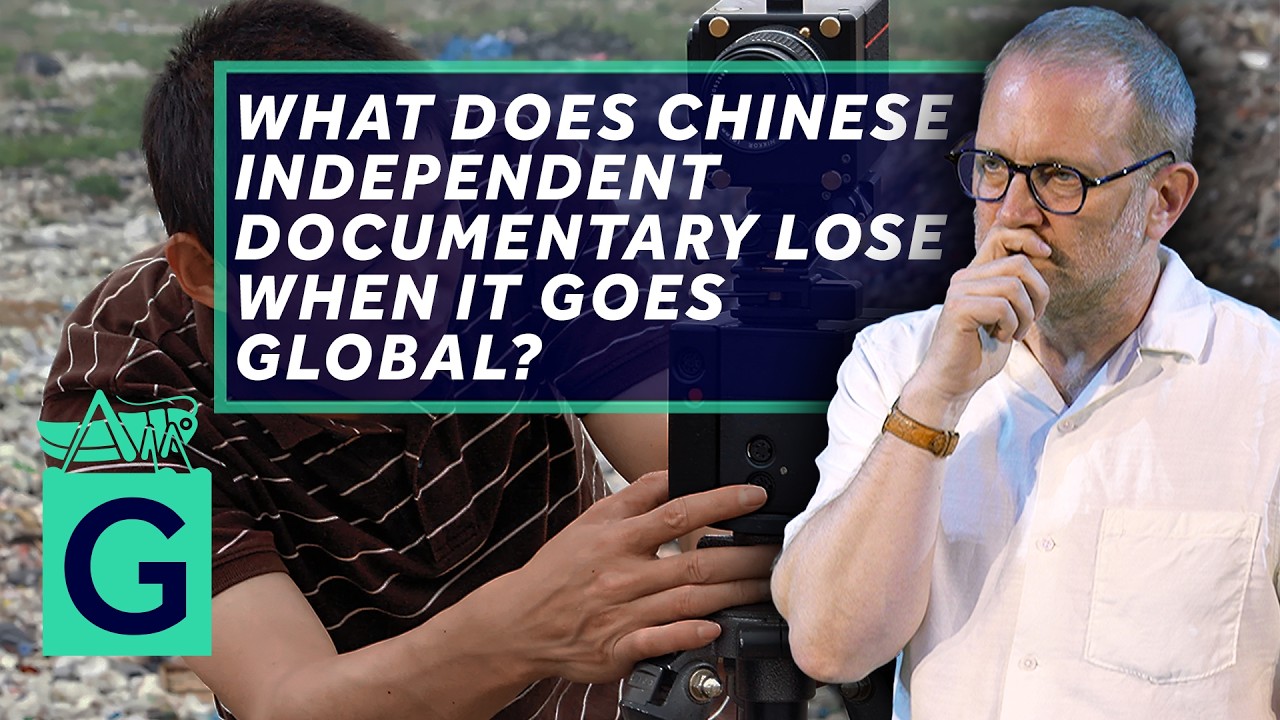
Going Global: Chinese Independent Documentary - Luke Robinson
Keywords
Summary
181 words
Critical Evaluation
The lecture offers a rigorous and insightful analysis of the intersection between documentary production, form, and reception in the context of globalization. Robinson draws on original research, including interviews with industry professionals and audience reception data, to construct a compelling argument about the influence of Western narrative conventions on Chinese independent documentaries. The strength of the lecture lies in its critical examination of the ‘character-driven story’ format, which he traces from its roots in humanitarian and NGO logics to its manifestation in films like Plastic China. He effectively demonstrates how this format, while facilitating international circulation, also shapes viewer responses in ways that privilege individual empathy over structural critique. The concept of ‘worrying about China’ is a valuable contribution, capturing the liberal anxiety and desire to integrate China into the global order through familiar frameworks. However, the lecture could be critiqued for its limited engagement with alternative perspectives, such as the agency of Chinese filmmakers in negotiating these formats or the potential for subversion within the constraints. Additionally, while the audience reception study is insightful, it is based on a specific UK context and may not be generalizable. The lecture is well-structured and accessible, but it assumes some familiarity with film studies terminology. Overall, it provides a thought-provoking analysis that contributes to debates on documentary ethics, globalization, and cultural exchange.
220 words
Title / Content Match
The title accurately reflects the content, which examines how Chinese independent documentaries enter global markets, using Plastic China as a case study.
Quality & Reliability
8/10
The lecture is based on original research, including interviews with key figures and audience reception studies, and is delivered by an academic expert. It references specific sources and provides a nuanced critical analysis, though it is a single perspective and not peer-reviewed.
Chapters
- // Introduction — Chinese independent documentary and the question of going global
- // The Sundance-K'Nex workshops — training Chinese filmmakers for overseas markets
- // Story as commodity — character-driven narrative and the three-act structure
- // The humanitarian industrial logic — NGOs, storytelling and the Open Society Foundation
- // Plastic China — the film, its subjects and its international success
- // How the film works — two families, a child's right to education and formal choices
- // The narrowing of focus — from structural critique to personal story
- // What the format does — harmonising contradiction rather than confronting it
- // Screening Plastic China in the UK — what audiences actually felt
- // Audience responses — moving, shocking, overwhelming
- // What viewers said they would do next — individual action over structural change
- // Political mimesis and its limits — affect that short-circuits critique
- // Worrying about China — liberal frameworks and the problem of difference
- // Conclusion — the compromises Chinese independent documentary makes to go global
Cited Sources
- Gresham College - Chinese Documentary — Official page for the lecture, likely containing further resources.
- Q&A Session — Follow-up discussion with the audience.
- Gresham College Website — Institutional homepage.
- Gresham College on Bluesky — Social media presence.
- Donate to Gresham College — Support page.
Concurring Sources
- Gresham College - Chinese Documentary — Official page for the lecture, likely containing further resources.
Contribution & Novelties
The lecture provides a novel framework for understanding the globalization of Chinese independent documentaries, particularly through the concept of ‘worrying about China’ and the analysis of the character-driven format as a product of humanitarian industrial logic. It offers empirical evidence from audience reception studies, which is rare in this field.
Pour aller plus loin :
- Documentary film — Provides background on the genre and its conventions.
- Three-act structure — Explains the narrative structure discussed in the lecture.
- Open Society Foundations — Details the funder’s role and mission.
- Sundance Institute — Overview of the organization and its programs.
97 words
Radar Profile
The radar profile shows high scores in information quantity, quality, and reliability, with a slightly lower technical level, indicating a lecture that is well-researched and credible but accessible to a general audience.