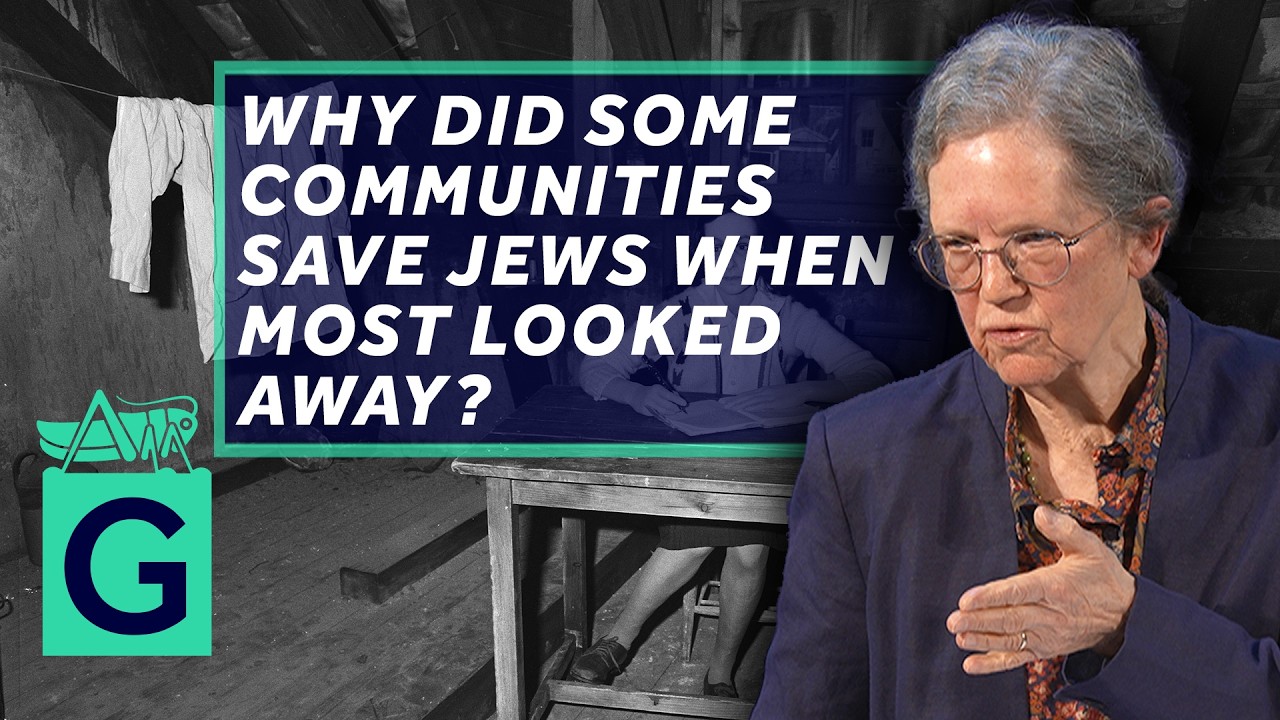
Society and Survival During the Holocaust - Mary Fulbrook
Keywords
Summary
143 words
Critical Evaluation
The lecture offers a nuanced and well-argued analysis of the role of surrounding societies in Holocaust survival. Professor Fulbrook, a leading historian, draws on extensive research and a comparative European perspective, which is a significant strength. She effectively critiques national myths and the ‘ghettoization’ of Jewish history in museums, using examples like the Museum of the Occupation of Latvia to illustrate how local complicity is often obscured. The theoretical framework of ‘ignorance, indifference, impotence’ versus ‘comprehension, compassion, capacity to act’ provides a clear lens for understanding both passivity and active help. The lecture is rich in specific case studies, from the Warsaw Ghetto Uprising to Le Chambon-sur-Lignon, which ground the analysis in concrete historical events. However, as the speaker notes, the research is ongoing, and some conclusions are preliminary. The lecture focuses on qualitative analysis rather than quantitative data, which may limit generalizability. The discussion of Jewish survival strategies, particularly hiding and passing, is insightful, but the psychological costs are only briefly touched upon. The lecture’s strength lies in its comparative approach, which challenges simplistic national narratives and highlights the complexity of human behavior under extreme circumstances. The sources cited are primarily the speaker’s own work and the collaborative project, but the lecture is well-referenced in terms of historical examples. The title accurately reflects the content, and the lecture is accessible to a general audience while maintaining academic rigor. Overall, this is an excellent contribution to Holocaust historiography, offering fresh perspectives on the role of bystanders and rescuers.
248 words
Title / Content Match
The title accurately reflects the lecture's focus on the role of surrounding societies in Jewish survival during the Holocaust, with a comparative European perspective.
Quality & Reliability
9/10
Lecture by a renowned historian (Professor Mary Fulbrook, UCL) based on ongoing research funded by AHRC and DFG. The content is well-structured, draws on comparative historiography and specific case studies, and is delivered in an academic context (Gresham College). The speaker is an expert in German history and Holocaust studies. The lecture is part of a larger research project, and the speaker acknowledges the preliminary nature of some findings. The quality is high, with clear argumentation and use of examples.
Chapters
- // Introduction — why surrounding societies disappear from Holocaust history
- // The ghettoization of Jewish history in European museums
- // The three conditions for passivity — ignorance, indifference, impotence
- // Who helped Jews — rescuers, opportunists and small gestures that saved lives
- // Jewish survival strategies — ghetto uprisings, fleeing and passing
- // Hiding and passing under false identity — the psychological cost
- // Islands of compassion — exceptional communities across Europe
- // Le Chambon-sur-Lignon — a pastor's sermon and a mountain refuge
- // Nieuwlande and Villa Emma — 1-to-1 rescue ratios and children's networks
- // Full here — Baptist minorities and religious belief as motivation for rescue
- // Volos, Greece — bishop, rabbi and communist partisans cooperating
- // Hospitable vs hostile environments — local police, partisans and social topography
- // Conditions for rescue — inclusive community identity and the capacity to act
- // Conclusion — small gestures matter alongside the wider structures of survival
Cited Sources
- Gresham College Lecture Page — Official page for the lecture, likely containing additional resources.
- Q&A Session — Follow-up Q&A session related to the lecture.
Concurring Sources
- Gresham College Lecture Page — Official page for the lecture, likely containing additional resources.
Contribution & Novelties
The lecture provides a comparative analysis of rescue and survival across Europe, moving beyond individual rescuers to examine the role of surrounding societies. It introduces the concept of ‘islands of compassion’ and emphasizes the importance of local power structures and community identity. The research is part of a collaborative project funded by AHRC and DFG, offering new insights into the conditions that enable or hinder rescue efforts.
Pour aller plus loin :
- Righteous Among the Nations — Relevant for understanding the recognition of individual rescuers.
- Le Chambon-sur-Lignon — A key case study of communal rescue.
- Holocaust studies — Academic field that contextualizes this research.
104 words
Radar Profile
The radar profile shows high scores in quantity and quality of information, with a moderate technical level. The fiabilite_globale is high, reflecting the speaker's expertise and the academic context. The lecture is information-dense and well-supported, but the technical level is accessible to a general audience.