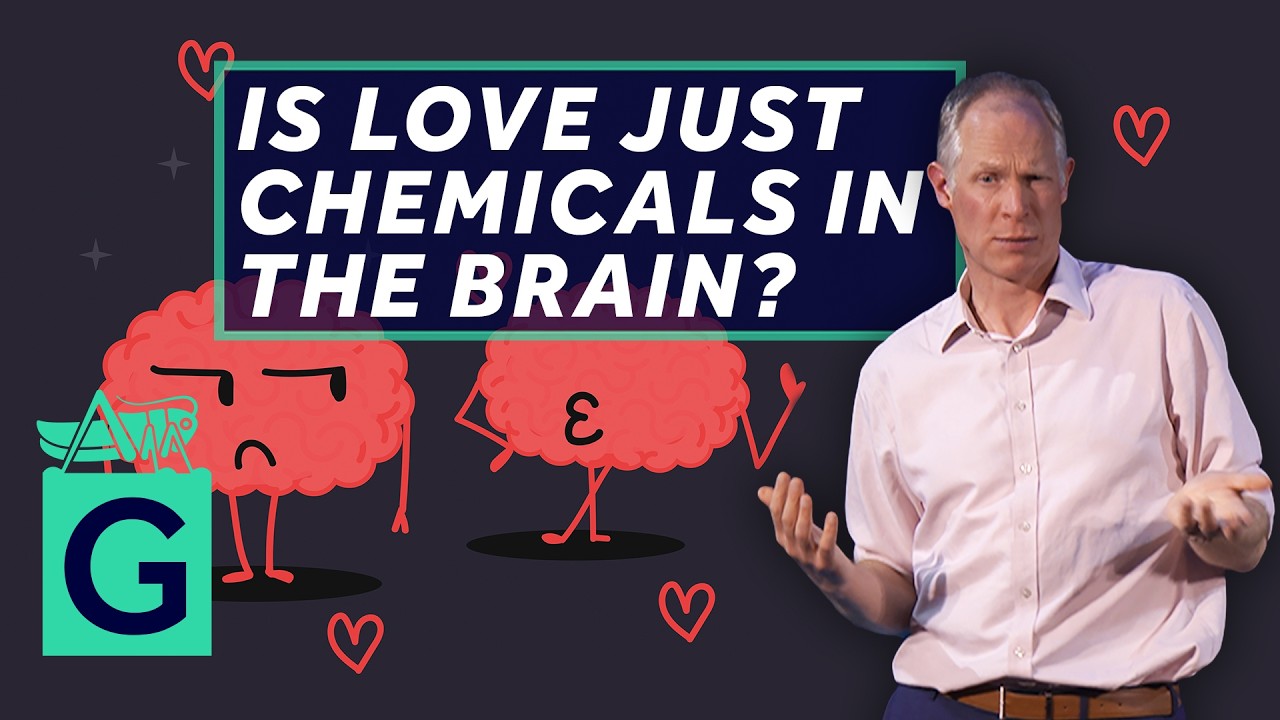
Why Do We Love? - Robin May
Keywords
Summary
196 words
Critical Evaluation
The lecture provides a comprehensive and engaging overview of the neuroscience of romantic love, grounded in established research. May effectively communicates complex concepts such as the HPA axis and amygdala function in an accessible manner, using relatable examples and analogies. The argumentation is generally solid, building from physiological symptoms to brain mechanisms and evolutionary explanations. However, the lecture lacks formal citations, which limits the ability to verify specific claims. While May references studies on prairie voles and oxytocin, he does not provide specific sources, which is a weakness for a scientific audience. The evolutionary arguments, such as the role of concealed ovulation, are presented as plausible but not critically examined. The discussion of love as an addiction is intriguing but could benefit from more nuance regarding the differences between love and pathological addiction. The lecture’s strength lies in its synthesis of multiple perspectives, including endocrinology, neuroscience, and evolutionary psychology. The inclusion of Darwin’s personal dilemma adds a humanizing element. The Q&A session is mentioned but not included in this video, which may leave some questions unanswered. Overall, the lecture is informative and thought-provoking, but its reliance on anecdotal evidence and lack of citations prevent it from being a rigorous scientific review.
201 words
Title / Content Match
The title accurately reflects the content, which explores the biological and evolutionary basis of romantic love.
Quality & Reliability
8/10
Lecture by a professor of infectious disease, drawing on established neuroscience and psychology, with references to specific brain regions and hormones. However, no formal citations are provided in the video, and some claims are simplified for a general audience.
Chapters
- | Introduction: What Do We Mean by Love?
- | The Hallmarks of Infatuation
- | Physiological Symptoms: Sweat, Heart Rate & Anxiety
- | Love and the Brain: The HPA Axis Explained
- | The Amygdala: Why Love Turns Off Your Fear Response
- | Butterflies, Gut Responses & Autonomic Consequences
- | How Long Does Infatuation Last?
- | Long-Term Love: Companionship vs. Obsession
- | Why Does Romantic Love Exist? The Evolutionary Puzzle
- | Darwin's Personal Dilemma: To Marry or Not to Marry
- | The Role of Concealed Ovulation & Attachment Theory
- | The Overlap Between Parental and Romantic Love
- | Oxytocin: The Bonding Hormone
- | Prairie Voles: The Romantic Rodents of Science
- | Does Oxytocin Actually Drive Human Romance?
- | Love as Addiction: The Ventral Tegmental Area
- | Abusive Relationships: When Addiction Turns Harmful
- | Can Drugs or Therapy Break a Damaging Bond?
- | Conclusion: Romance Is Good for Your Health
Cited Sources
- Gresham College — Official website of the institution hosting the lecture.
- Support Gresham College — Page for supporting the college's educational mission.
- Music and the Mind — Related lecture series on emotions, possibly referenced in the series.
- Q&A Session — Follow-up Q&A session for this lecture.
Concurring Sources
- Gresham College — Institution hosting the lecture, known for public education.
Contribution & Novelties
The lecture offers a synthesis of current knowledge on the neuroscience of romantic love, integrating physiological, neurobiological, and evolutionary perspectives. It emphasizes the role of the HPA axis and cortisol in early romance, and discusses the amygdala’s involvement in modulating fear. The comparison between romantic and parental love, and the discussion of oxytocin and prairie voles, provide a comprehensive view. The lecture also touches on the addictive nature of love and its implications for abusive relationships.
Pour aller plus loin :
- HPA axis — Detailed explanation of the stress response system.
- Amygdala — Overview of the brain region involved in fear and emotion.
- Oxytocin — Information on the ’love hormone’ and its effects.
- Prairie vole — Species used in studies of pair bonding.
- Attachment theory — Psychological framework for understanding relationships.
131 words
Radar Profile
The radar profile shows high scores in quantity and quality of information, with a moderate technical level and high reliability. This indicates a well-structured lecture that is accessible yet informative, with a strong scientific foundation.