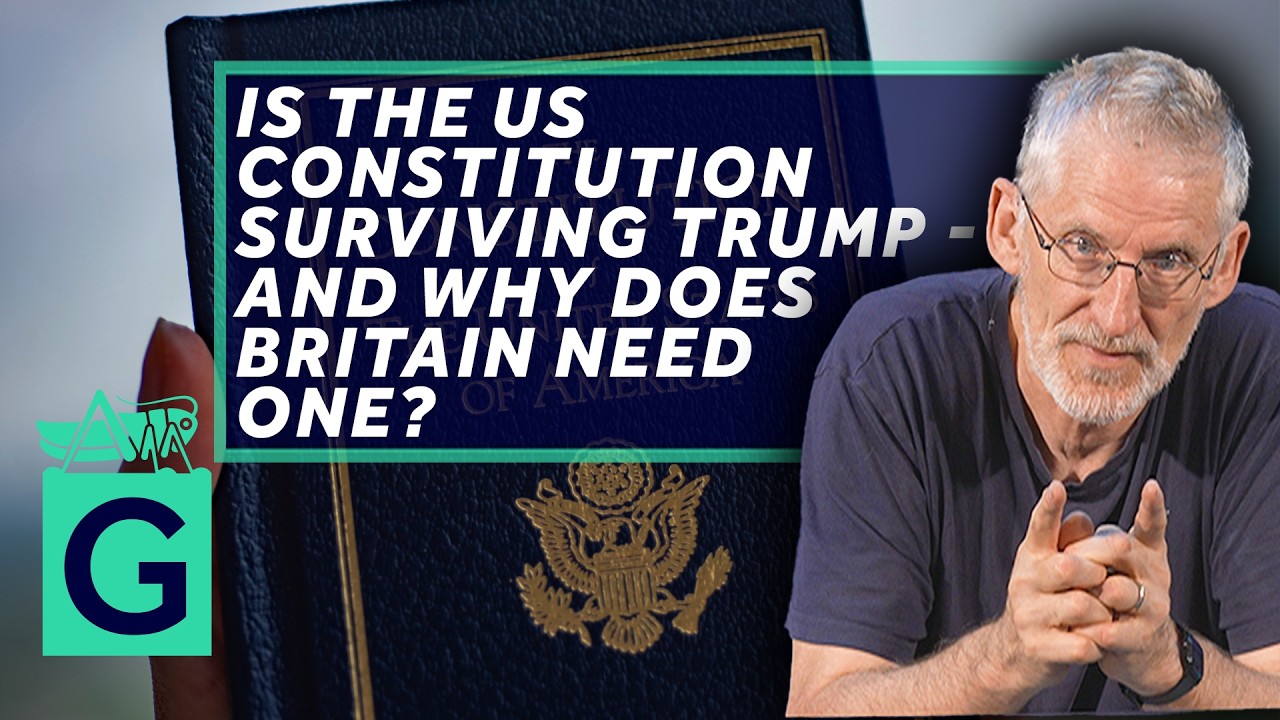
Current Challenges to the US Constitution - Clive Stafford Smith
Keywords
Summary
166 words
Critical Evaluation
The lecture offers a compelling and insightful analysis of the US Constitution’s resilience under political pressure, drawing on the speaker’s extensive legal experience. Stafford Smith’s argument is well-structured, moving from historical precedents to contemporary cases, and he effectively uses personal anecdotes to illustrate broader points. The discussion of the five worst Supreme Court decisions is particularly effective in setting the stage for evaluating the current Court’s performance. However, the lecture is not without limitations. As an advocate, Stafford Smith presents a clear perspective, and his selection of cases and interpretations may reflect his own biases. For instance, his characterization of the Court’s conservative majority as potentially dismantling the Constitution is a subjective stance. Additionally, while he references specific cases and events, he does not provide detailed citations or sources, which limits the verifiability of his claims. The lecture also focuses heavily on civil liberties and human rights, which, while important, may overshadow other constitutional issues. The adéquation between title and content is strong, as the lecture directly addresses current challenges to the Constitution. Overall, the lecture is valuable for its expert perspective and engaging narrative, but it should be viewed as an opinion piece rather than a comprehensive academic analysis.
200 words
Title / Content Match
The title accurately reflects the content, which focuses on current challenges to the US Constitution during Trump's second term, with historical context and analysis of recent Supreme Court decisions.
Quality & Reliability
8/10
The lecture is delivered by a highly experienced human rights lawyer with direct involvement in several landmark cases (e.g., Rasul v. Bush, Bowers v. Hardwick). The content is well-structured, historically grounded, and draws on personal expertise. However, it is primarily an opinion-based lecture with limited citations to external sources, and the speaker's advocacy perspective may introduce bias.
Chapters
- // Introduction — Trump versus the Constitution after 16 months
- // The five worst Supreme Court decisions of all time
- // Dred Scott 1857 — the case that helped start a civil war
- // Plessy v Ferguson 1896 — separate but equal and Angola prison
- // Buck v Bell 1927 — eugenics, sterilisation and echoes in the present
- // Korematsu 1944 — Japanese internment and the road to Guantanamo
- // Bowers v Hardwick — criminalising sodomy and how Stafford Smith fought it
- // Lawrence v Texas — how the Supreme Court finally overruled Bowers
- // The current court — immunity for presidents and the 22 unanimous decisions
- // Roberts versus Clarence Thomas — two very different conservatives
- // The biggest decision of this term — Trump's tariffs struck down 6 to 3
- // Why Britain needs a constitution — prisoners' votes and Cameron's contempt
- // Criminal cases — death row, mental disability and the court doing its job
- // First Amendment cases — conversion therapy, gender and street preaching
- // Louisiana v Calais — gerrymandering, affirmative action and why it will backfire
- // Conclusion — the Constitution is surviving, but Britain has no such protection
Cited Sources
- Gresham College Lecture Page — Official page for the lecture, providing additional context and possibly transcript.
- Q&A Session — Follow-up Q&A session related to the lecture.
- Gresham College Website — Institution's main website, offering information about lectures and programs.
- Gresham College on Bluesky — Social media profile for updates and engagement.
Concurring Sources
- Gresham College Lecture Page — The official page corroborates the lecture's existence and provides context.
Contribution & Novelties
The lecture provides a unique insider perspective on recent Supreme Court decisions and their implications for constitutional rights, particularly through the lens of a lawyer who has litigated landmark cases. It offers a critical assessment of the current Court’s behavior, highlighting both its potential dangers and its occasional adherence to constitutional principles. The historical comparisons enrich the analysis, showing patterns in the Court’s role in times of political stress.
Pour aller plus loin :
- Dred Scott v. Sandford — The landmark 1857 case on citizenship and slavery, foundational to understanding constitutional failures.
- Plessy v. Ferguson — The ‘separate but equal’ doctrine, later overturned by Brown v. Board of Education.
- Buck v. Bell — The 1927 eugenics case that upheld forced sterilization, with lasting ethical implications.
- Korematsu v. United States — The 1944 decision on Japanese internment, later formally repudiated.
- Bowers v. Hardwick — The 1986 case on sodomy laws, overruled by Lawrence v. Texas.
- Lawrence v. Texas — The 2003 decision that struck down sodomy laws, a major victory for LGBTQ rights.
- Rasul v. Bush — The 2004 case on Guantanamo detainees’ habeas corpus rights, in which the speaker was involved.
- Presidential immunity — Concept relevant to the discussion of Trump’s immunity claims.
- Gerrymandering — The manipulation of electoral boundaries, discussed in the context of Louisiana v. Calais.
218 words
Radar Profile
The radar profile shows high scores in quantity and quality of information, reflecting the lecture's rich content and expert delivery. The technical level is moderately high, suitable for a general audience with some legal background. The overall reliability is strong due to the speaker's credentials, though the subjective nature of the analysis slightly lowers the score.