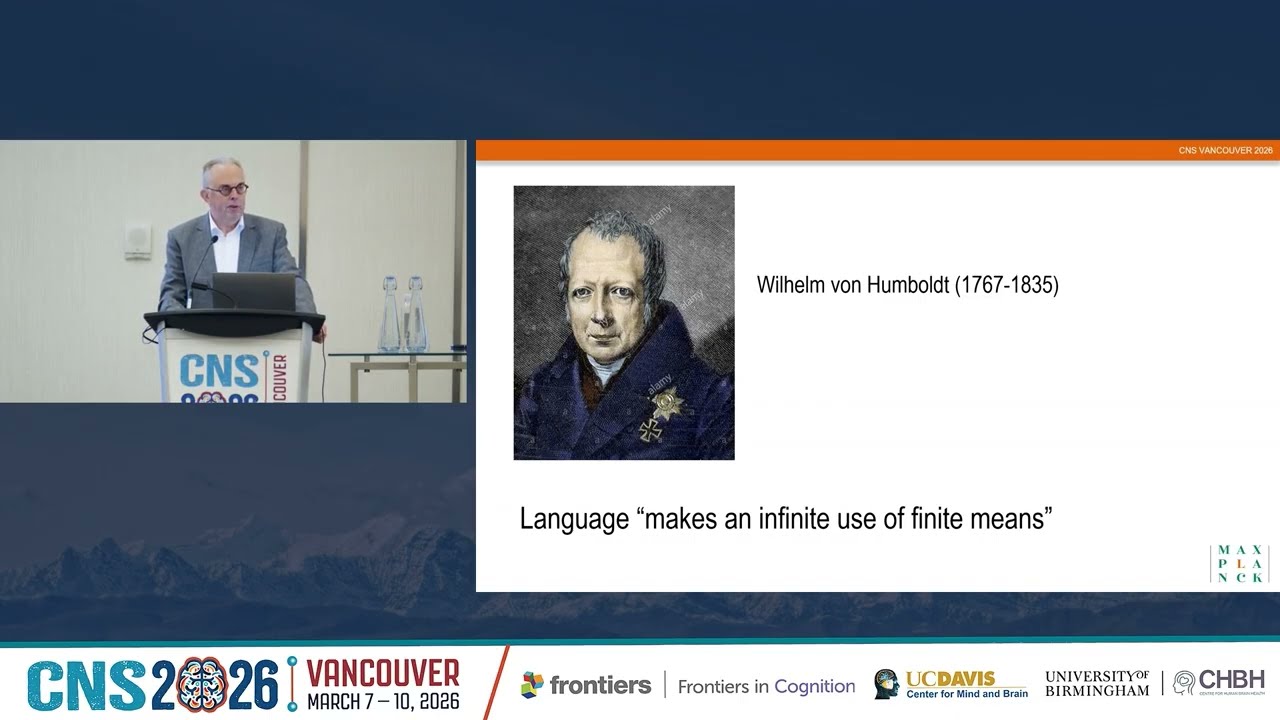
Peter Hagoort, "Our Language Ready Brain"
Keywords
Summary
164 words
Critical Evaluation
Value of the Information & Strength of the Argument
The talk provides a comprehensive and up-to-date overview of the cognitive neuroscience of language, integrating anatomical, functional, and computational perspectives. Hagoort’s argumentation is solid, grounded in decades of research and specific experimental evidence. He effectively challenges classical models and supports the MUC model with meta-analyses and computational modeling. The discussion of the Mirror Neuron Hypothesis and Theory of Mind adds critical depth, showing the complexity of language understanding beyond sensorimotor resonance.
Scientific Rigor, Source Quality, Title Accuracy
Hagoort cites numerous peer-reviewed studies and meta-analyses, including his own work and that of colleagues. He references specific researchers and models (e.g., Levelt, Roelofs, Jackendoff, Joshi, Miller) and mentions the book ‘Foundations of Language’ by Jackendoff. The talk is scientifically rigorous, with clear explanations of methods and findings. The title accurately reflects the content, focusing on the brain’s readiness for language and its neural infrastructure.
151 words
Title / Content Match
The title accurately reflects the content, focusing on the brain's readiness for language and its neural infrastructure.
Quality & Reliability
9/10
Keynote by a leading expert in cognitive neuroscience of language, presenting established models and recent findings, with references to peer-reviewed work and meta-analyses. High credibility and scientific rigor.
Key Moments
Markers derived by PSI from the transcript: the creator did not define chapters.
- Introduction by Sabina Castner, CNS 2026 opening remarks
- Hagoort begins talk, introduces topic and outline
- Classical model vs modern evidence: arcuate fasciculus and extended language areas
- Components of language: declarative memory, speech errors, and production process
- Memory, Unification, and Control (MUC) model introduced
- Hierarchical interpretation experiments and syntactic processing in the brain
- Mirror Neuron Hypothesis critique and Theory of Mind network
- Neuropharmacology and 14 Tesla MRI, take-home messages
Cited Sources
- Foundations of Language — Referenced by Hagoort as a key book by Ray Jackendoff on language structure and complexity.
- Meta-analysis of imaging studies on language — Mentioned as a meta-analysis by Hagoort and colleagues on syntactic processing.
Concurring Sources
- Hagoort, P. (2005). On Broca, brain, and binding: a new framework. — Foundational paper for the MUC model.
- Friederici, A. D. (2011). The brain basis of language processing. — Supports the extended language network and hierarchical processing.
Dissenting Sources
- Rizzolatti, G., & Arbib, M. A. (1998). Language within our grasp. — Proposes mirror neurons as basis for language, which Hagoort argues is insufficient.
Contribution & Novelties
The talk synthesizes current knowledge and presents the MUC model as a framework for understanding language networks. It challenges the Mirror Neuron Hypothesis and emphasizes the role of Theory of Mind. The discussion of neuropharmacology and 14 Tesla MRI points to future directions.
Pour aller plus loin :
- Memory, Unification, and Control model — Overview of language processing models.
- Mirror neuron hypothesis — Background on mirror neurons and their proposed role in language.
- Theory of Mind — Neural basis of understanding others’ intentions.
83 words
Radar Profile
The radar profile shows high scores across all dimensions, indicating a well-rounded and authoritative presentation with strong scientific content, technical depth, and reliability.
💬 No comments were provided for analysis.