Neural signatures of sustained attention across time scales and individuals
Keywords
Summary
164 words
Critical Evaluation
Value of the Information & Strength of the Argument
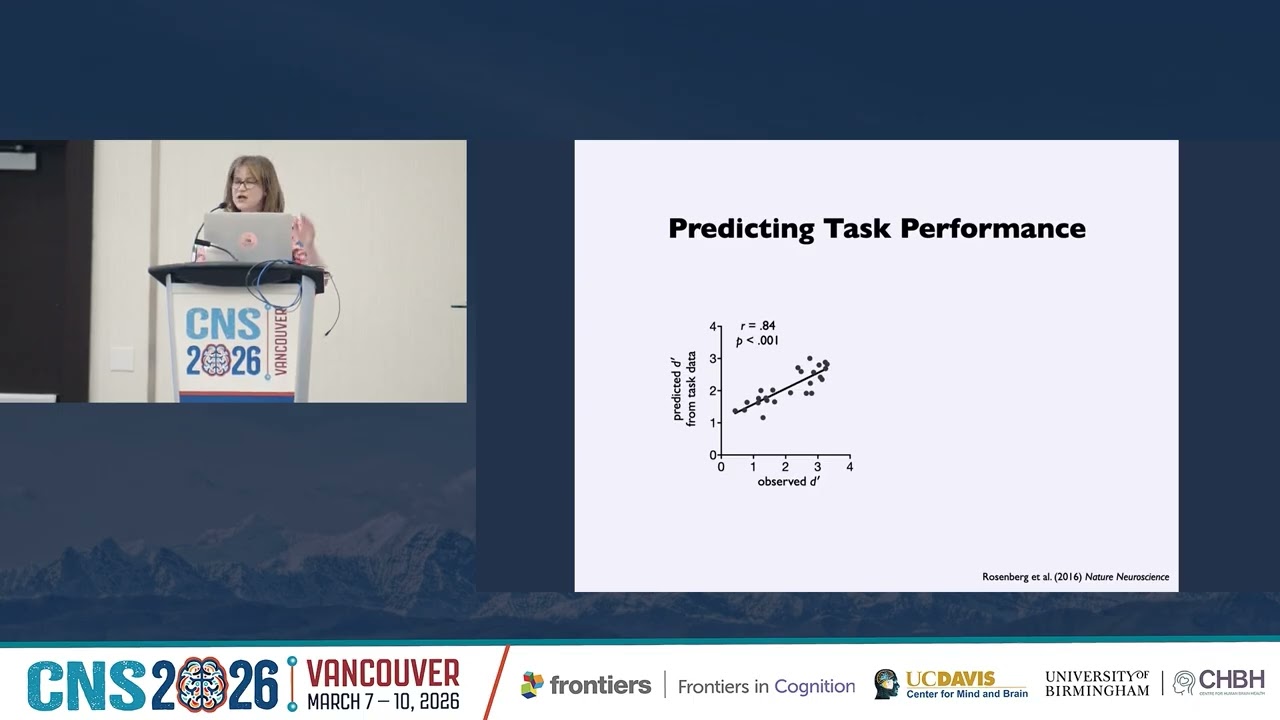
The talk provides valuable insights into the neural basis of sustained attention, offering a robust methodological framework (connectome-based predictive modeling) that has been validated across multiple studies and datasets. The argumentation is solid, building from initial findings to more complex questions about state and trait prediction. The speaker acknowledges limitations and alternative interpretations, which strengthens the credibility. However, some claims are forward-looking and based on preliminary evidence, which is appropriately flagged.
Scientific Rigor, Source Quality, Title Accuracy
The research is rigorous, with careful cross-validation and generalization to large independent datasets (ABCD, HCP). The speaker cites her own and collaborators’ work, and mentions methodological contributions from others (e.g., co-fluctuation method). The title accurately reflects the content. No external sources are provided in the description, but the talk references published work.
138 words
Title / Content Match
The title accurately reflects the content, which focuses on neural signatures of sustained attention across time scales and individuals.
Quality & Reliability
8/10
The talk presents original research from a leading lab, with robust methods (cross-validation, large datasets like ABCD and HCP), and transparent discussion of limitations. However, it is a conference presentation, not peer-reviewed, and some claims are forward-looking.
Key Moments
Markers derived by PSI from the transcript: the creator did not define chapters.
- Introduction and acknowledgments
- Overview of attention dynamics across time scales
- Description of connectome-based predictive modeling approach
- Generalization of models to new datasets (ABCD, HCP)
- Pharmacological manipulations and attention network strength
- Dynamic tracking of attention states with co-fluctuation
- Cross-modal generalization and naturalistic engagement
- Forward-looking argument: predicting traits from states
Contribution & Novelties
The talk presents a novel framework for understanding sustained attention by linking brain connectivity patterns to both trait-like individual differences and dynamic states. It introduces the idea that predictive models can capture states during data collection, which may explain trait prediction. This is a significant conceptual contribution.
Pour aller plus loin :
- Connectome-based predictive modeling — Overview of connectome and its applications.
- Functional connectivity — Explanation of functional connectivity in neuroimaging.
- Sustained attention — Definition and research on sustained attention.
- ABCD Study — Official site of the Adolescent Brain Cognitive Development Study.
- Human Connectome Project — Official site of the Human Connectome Project.
103 words
Radar Profile
The radar profile shows high scores in information quantity, quality, and reliability, with a slightly lower technical level, indicating a well-balanced presentation that is accessible yet scientifically rigorous.