Peter Szendy - “The Readee, or: Reading in the Subjunctive Mood”
Keywords
Summary
181 words
Critical Evaluation
Value of the Information & Strength of the Argument
The lecture offers a novel conceptual framework by introducing the ‘readee’ as a distinct role in reading, supported by historical and literary evidence. Szendy’s argument is coherent and well-developed, using examples from literature, art, and history to illustrate his points. He builds a compelling case for the readee’s structural importance, though some may find the argument more suggestive than definitive. The discussion of Valéry’s ‘My Faust’ and the subjunctive ’lût’ is particularly insightful, adding depth to the analysis.
Scientific Rigor, Source Quality, Title Accuracy
Szendy demonstrates scholarly rigor by citing specific sources, including Prescott’s biography, Nightingale’s notes, Rabelais, Calvino, and Valéry. He also references paintings and historical practices, grounding his argument in concrete examples. The title accurately reflects the content, focusing on the readee and the subjunctive mood. The lecture is well-structured and the sources are appropriately used, though some references are from secondary sources or translations.
156 words
Title / Content Match
The title accurately reflects the content, focusing on the concept of the 'readee' and the subjunctive mood in reading.
Quality & Reliability
8/10
Szendy, a respected philosopher, provides a well-structured argument supported by historical and literary references. The lecture is scholarly, with citations from primary sources, though it is an opinion piece rather than empirical research.
Key Moments
Markers derived by PSI from the transcript: the creator did not define chapters.
- Introduction of the term 'readee' and its historical occurrences.
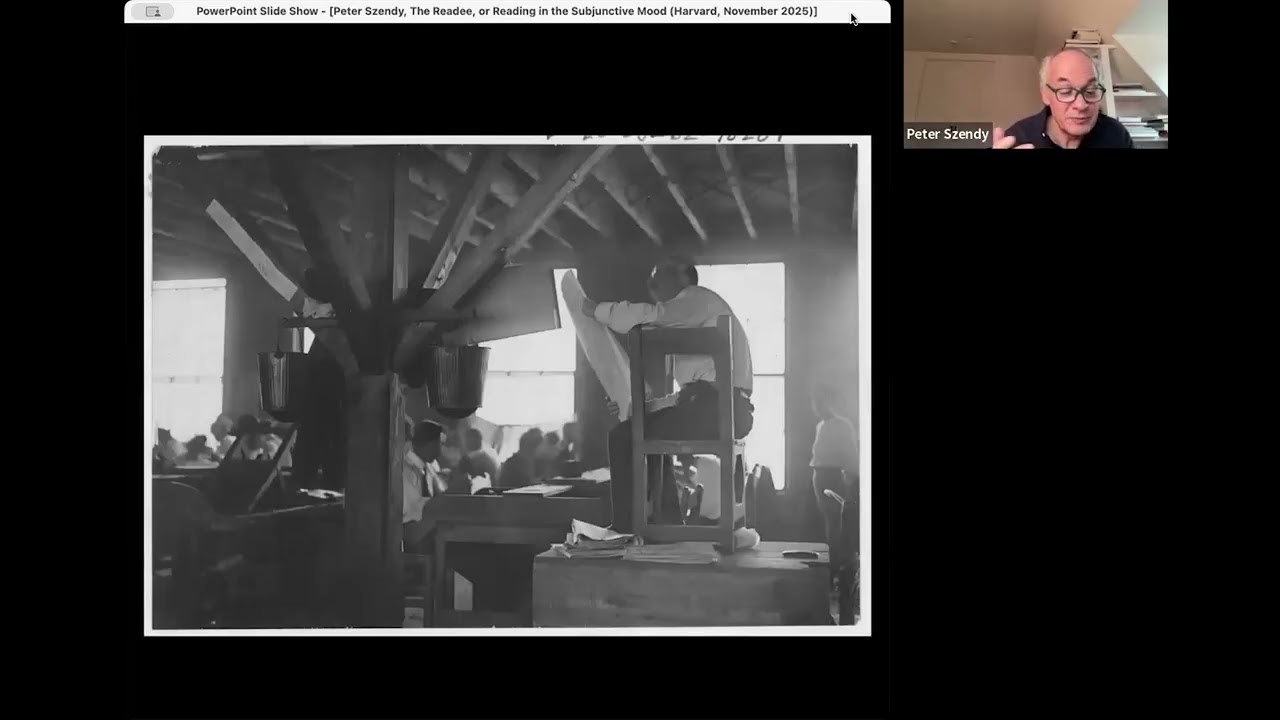
- Discussion of anagnosts in antiquity and lectores in Cuban cigar factories.
- Analysis of Calvino's incipit and the gap between anagnost and readee.
- Examination of paintings by Andrea del Sarto and Manet.
- Exploration of futuristic reading technologies in Cyrano and Uzanne.
- Discussion of Valéry's anxieties about speed reading and vocality.
- Interpretation of Lust as the subjunctive 'lût' and the hidden addressee.
- Conclusion on the readee as the futurity of reading.
Cited Sources
- European Graduate School — Institution hosting the lecture.
Concurring Sources
- Powers of Reading by Peter Szendy — Book by the speaker that elaborates on the concept of the readee.
Contribution & Novelties
The lecture introduces the concept of the ‘readee’ as a distinct agency in reading, arguing that reading always involves a split between the self as reader and as listener. This framework offers a new perspective on the temporality of reading and its futurity. Szendy’s analysis of Valéry’s ‘My Faust’ and the subjunctive ’lût’ provides a fresh interpretation of the character Lust.
Pour aller plus loin :
- Anagnostes - Wikipedia — Historical role of readers in antiquity.
- Subjunctive mood - Wikipedia — Grammatical mood relevant to the lecture’s title.
- Paul Valéry - Wikipedia — Author discussed in the lecture.
98 words
Radar Profile
The radar profile shows high scores in information quantity, quality, and reliability, with a slightly lower technical level, reflecting the lecture's philosophical nature. The balanced scores suggest a well-rounded and credible presentation.