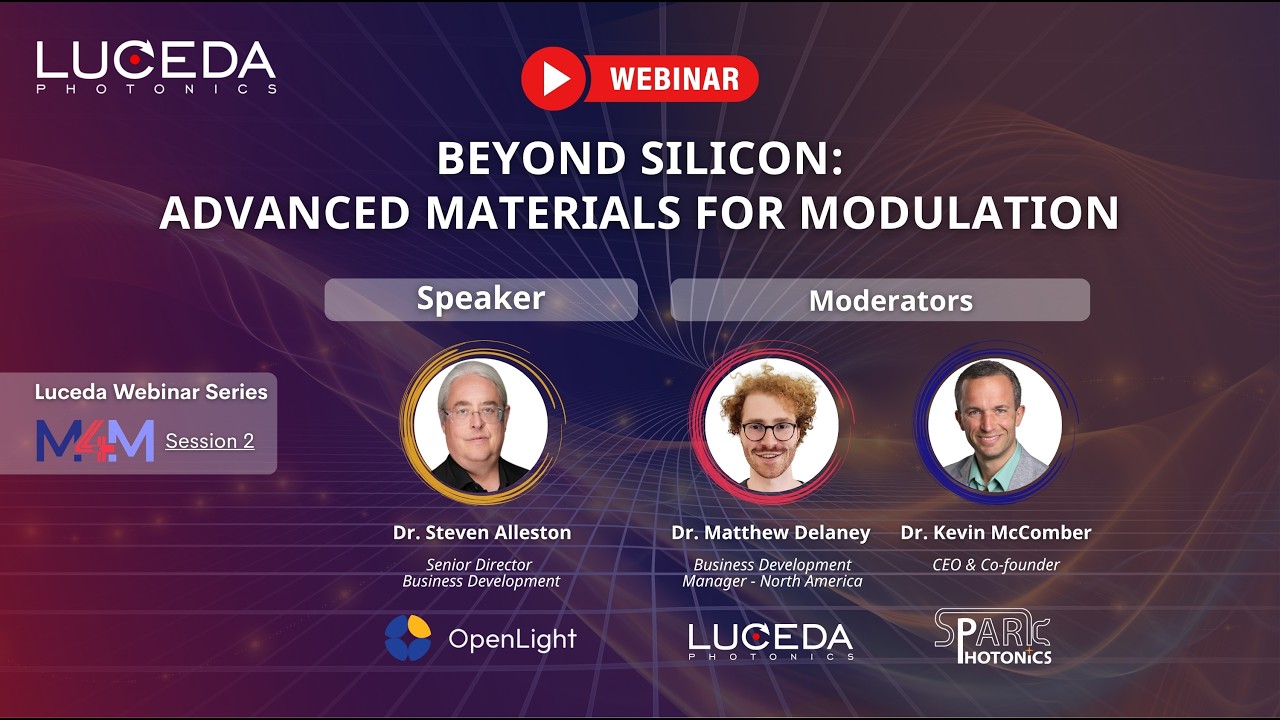
Webinar | Advanced Materials for Modulation - Session 2
Keywords
Summary
168 words
Critical Evaluation
Value of the Information & Strength of the Argument
The webinar provides valuable insights into the state-of-the-art of heterogeneous integration for optical modulators, particularly for AI-driven datacom applications. The argumentation is solid, grounded in measured results and industry experience. Dr. Alleston effectively explains the limitations of silicon photonics and the advantages of III-V integration, supporting claims with data on bandwidth, extinction ratio, and reliability. The presentation also highlights the scalability of the approach, which is crucial for meeting AI’s growing bandwidth demands. However, the argumentation is somewhat promotional, as it focuses on OpenLight’s platform and may not fully address alternative technologies’ trade-offs.
Scientific Rigor, Source Quality, Title Accuracy
The scientific rigor is moderate. The presentation includes measured results and references to industry standards (GR-468), but lacks detailed methodology and independent verification. The sources cited are primarily the company’s own PDK and partnerships, with no external references provided in the description. The title accurately reflects the content, focusing on advanced materials for modulation. The webinar is a technical presentation by an industry expert, but it is not a peer-reviewed study. The adéquation between title and content is good, as it directly addresses the topic.
193 words
Title / Content Match
The title accurately reflects the content, focusing on advanced materials for modulation, specifically heterogeneous III-V-on-silicon integration.
Quality & Reliability
7/10
The webinar presents technical details on heterogeneous integration of III-V materials on silicon for optical modulators, with measured results and references to industry standards (GR-468). However, it is primarily a promotional presentation by a company, lacking independent peer review and detailed methodology.
Chapters
Cited Sources
- OpenLight Photonics — Company website mentioned as the source of the platform and PDK.
- Luceda Photonics — Company website mentioned for EDA tools and design kits.
- Tower Semiconductor — Foundry partner mentioned for the PH18D platform.
Concurring Sources
- OpenLight Photonics — Company website with product information and technical details.
- Luceda Photonics — EDA tools for photonic design, mentioned in the webinar.
Contribution & Novelties
The webinar provides an update on OpenLight’s heterogeneous integration platform, specifically focusing on electro-absorption modulators for 400G and beyond. It presents measured results of 85 GHz bandwidth and a 400G eye diagram, along with plans for 100 GHz devices. The talk also highlights the scalability and reliability of the approach, with a production customer announced. This contributes to the ongoing development of silicon photonics for AI optical networks.
Pour aller plus loin :
- Heterogeneous integration on silicon photonics — Overview of silicon photonics and integration approaches.
- Electro-absorption modulator — Basic principle and applications.
- GR-468 — Telcordia standard for reliability qualification of optoelectronic devices.
103 words
Radar Profile
The radar profile shows high scores in technical level and information quantity, reflecting the specialized content. Quality and reliability are moderate, as the presentation is promotional and lacks independent verification. The overall profile indicates a technically informative but somewhat biased source.