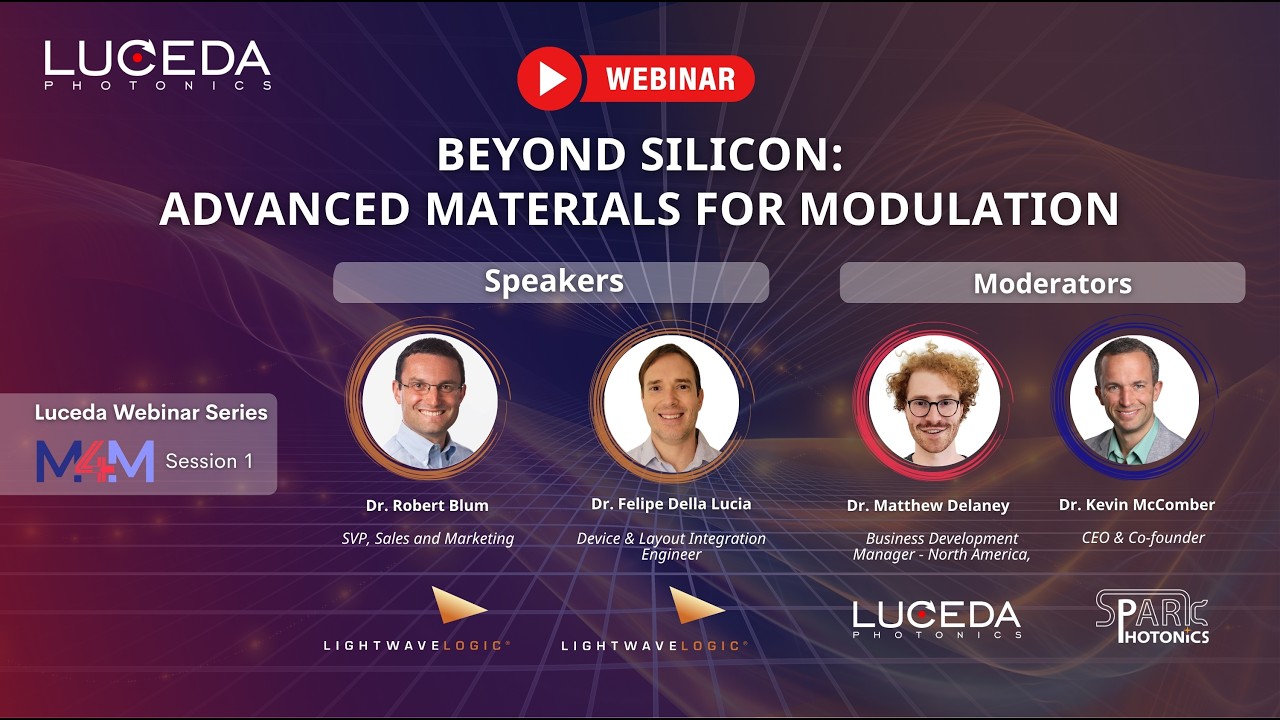
Webinar | Beyond Silicon: Advanced Materials for Modulation
Keywords
Summary
161 words
Critical Evaluation
Value of the Information & Strength of the Argument
The webinar provides valuable insights into the emerging field of electro-optic polymer integration with silicon photonics. The argumentation is solid, backed by simulation data and practical demonstrations. The speakers effectively explain the trade-offs in modulator design, such as doping levels and slot widths, and how they impact performance. The value lies in the detailed technical information and the demonstration of a working PDK, which is directly applicable for designers. The argumentation is persuasive, presenting the technology as a viable path to high-speed, low-power modulators for AI and data center applications.
Scientific Rigor, Source Quality, Title Accuracy
The scientific rigor is high, with technical details and simulation results presented. However, the webinar does not cite specific peer-reviewed sources, relying instead on the speakers’ expertise and company data. The sources mentioned include Lightwave Logic’s own presentations and investor materials, which are not independent. The title accurately reflects the content, focusing on advanced materials for modulation. The webinar is well-structured, with clear chapters and a coherent flow from technology overview to practical demonstration.
179 words
Title / Content Match
The title accurately reflects the content, focusing on advanced materials for modulation beyond silicon.
Quality & Reliability
8/10
The webinar features experts from Lightwave Logic and Luceda Photonics, presenting technical details on electro-optic polymer technology and its integration with silicon photonics. Claims are supported by simulation results and references to published data, but no peer-reviewed sources are cited directly.
Chapters
Cited Sources
- Lightwave Logic Investor Presentation — Referenced by Dr. Blum as a source for company and technology details.
- Luceda Photonics IPKISS — Mentioned as the design tool used for the PDK demonstration.
- SilTerra Silicon Photonics PDK — The PDK used in the demonstration, provided by SilTerra.
Concurring Sources
- Lightwave Logic Technology — Company's official technology page, supporting the claims made in the webinar.
Contribution & Novelties
The webinar presents a novel approach to enhancing silicon photonics with electro-optic polymers, offering a practical path to high-speed, low-power modulators. The demonstration of a PDK for a commercial foundry is a significant contribution, enabling designers to adopt this technology. The presentation of simulation results and design trade-offs provides valuable guidance.
Pour aller plus loin :
- Silicon photonics — Overview of the field and its applications.
- Electro-optic effect — Fundamental physics behind the technology.
- Mach–Zehnder interferometer — Device structure used in the modulators.
83 words
Radar Profile
The radar profile shows high scores in information quantity and technical level, indicating a content-rich and specialized presentation. The lower score in reliability suggests a reliance on company data rather than independent verification, which is typical for industry webinars.