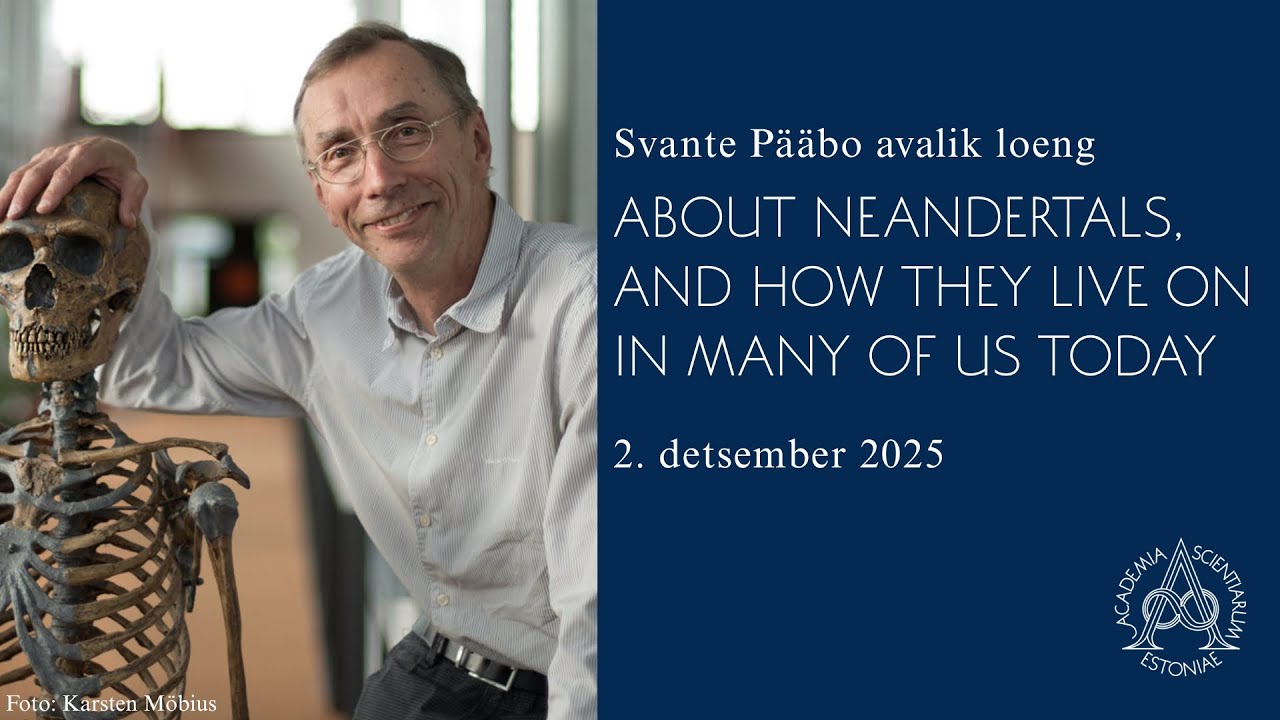
Svante Pääbo loeng „About Neandertals, and how they live on in many of us today“. 2.12.2025
Keywords
Summary
186 words
Critical Evaluation
Value of the Information & Strength of the Argument
The lecture provides a comprehensive overview of paleogenomics, with a strong emphasis on methodological rigor and the importance of avoiding contamination. Pääbo presents a clear narrative from early challenges to recent discoveries, supporting each claim with specific examples and data. He effectively argues for the significance of ancient DNA in understanding human evolution and health, and his explanations are both accessible and scientifically accurate.
Scientific Rigor, Source Quality, Title Accuracy
The lecture is based on decades of peer-reviewed research, and Pääbo references numerous studies and collaborations. The title accurately reflects the content, focusing on Neandertals and their genetic legacy. The presentation is scientifically rigorous, with careful attention to experimental design and interpretation. No comments were provided for analysis.
127 words
Title / Content Match
The title accurately reflects the content, which focuses on Neandertal genetics and their legacy in modern humans.
Quality & Reliability
9/10
Lecture by Nobel laureate Svante Pääbo, presenting original research and established findings in paleogenomics. High credibility due to speaker's expertise and peer-reviewed context.
Key Moments
Markers derived by PSI from the transcript: the creator did not define chapters.
- Opening remarks by Academy president Mart Saarma
- Introduction by Maris Laan
- Svante Pääbo begins his lecture on Neandertals
- Early attempts to extract DNA from mummies
- Contamination issues and development of clean techniques
- Sequencing the first Neandertal genome
- Discovery of Neandertal admixture in non-Africans
- Denisovan genome and its contribution to modern humans
- Functional studies: TKTL1 and brain organoids
- Medical relevance of Neandertal variants and COVID-19
Cited Sources
- Estonian Academy of Sciences — Institution hosting the lecture
- Nobel Prize in Physiology or Medicine 2022 — Award received by Svante Pääbo for his work on ancient DNA
Concurring Sources
- Green et al. (2010) A Draft Sequence of the Neandertal Genome — Key paper presenting the first Neandertal genome sequence.
- Prüfer et al. (2014) The complete genome sequence of a Neanderthal from the Altai Mountains — High-quality Neandertal genome used for comparisons.
Contribution & Novelties
The lecture provides a first-hand account of the development of paleogenomics, from early contamination pitfalls to the latest functional studies. It highlights the importance of rigorous methodology and the surprising findings of admixture between modern humans and archaic hominins. The discussion of Neandertal-derived variants affecting health, such as COVID-19 severity, underscores the relevance of ancient DNA to modern medicine.
Pour aller plus loin :
- Ancient DNA — Overview of the field and its challenges.
- Neanderthal genetics — Summary of genetic research on Neandertals.
- Denisovan — Information on the Denisovan hominins.
- TKTL1 gene — Gene involved in brain development.
- COVID-19 risk and Neanderthal DNA — Study linking Neanderthal DNA to severe COVID-19.
111 words
Radar Profile
The radar profile shows high scores across all dimensions, indicating a lecture that is rich in information, technically detailed, and highly reliable. The balance between quantity and quality of information is excellent, with a strong emphasis on methodological rigor.