2.06 Jüri Lember, Tartu Ülikooli tõenäosusteooria professor
Keywords
Summary
157 words
Critical Evaluation
Value of the Information & Strength of the Argument
The talk provides valuable insights into the research areas of a prominent probabilist, illustrating key concepts with intuitive examples. The argumentation is clear and logically structured, moving from foundational ideas to specific research contributions. The speaker effectively communicates the significance of consistency, the paradox of randomness, and the broad applicability of HMMs. However, the presentation is a high-level overview, and some technical details are glossed over, which is appropriate for a general academic audience.
Scientific Rigor, Source Quality, Title Accuracy
The speaker demonstrates scientific rigor by accurately describing mathematical concepts and referencing his own work and that of colleagues. He mentions specific results, such as the Chvátal–Sankoff constant and the work of van der Vaart, but does not provide formal citations. The title accurately reflects the content, and the presentation is well-structured. The talk is part of a conference for academic candidates, so the audience is likely familiar with the field.
160 words
Title / Content Match
The title accurately reflects the content: a presentation by Jüri Lember, professor of probability theory at the University of Tartu.
Quality & Reliability
8/10
The speaker is a professor of probability theory at the University of Tartu, with a long research career. The talk is a personal overview of his research areas, including consistency, Bayesian nonparametrics, and hidden Markov models. The content is scientifically sound, but as a conference presentation, it lacks detailed proofs and references.
Key Moments
Markers derived by PSI from the transcript: the creator did not define chapters.
- Introduction by the moderator and start of Jüri Lember's talk.
- Lember introduces his research field: stochastics, and his career path.
- Discussion of generalized means and consistency, with the Cauchy distribution counterexample.
- Transition to Bayesian nonparametrics and his postdoctoral work in the Netherlands.
- Introduction to the coloring reconstruction problem and the work of Heinrich Matzinger.
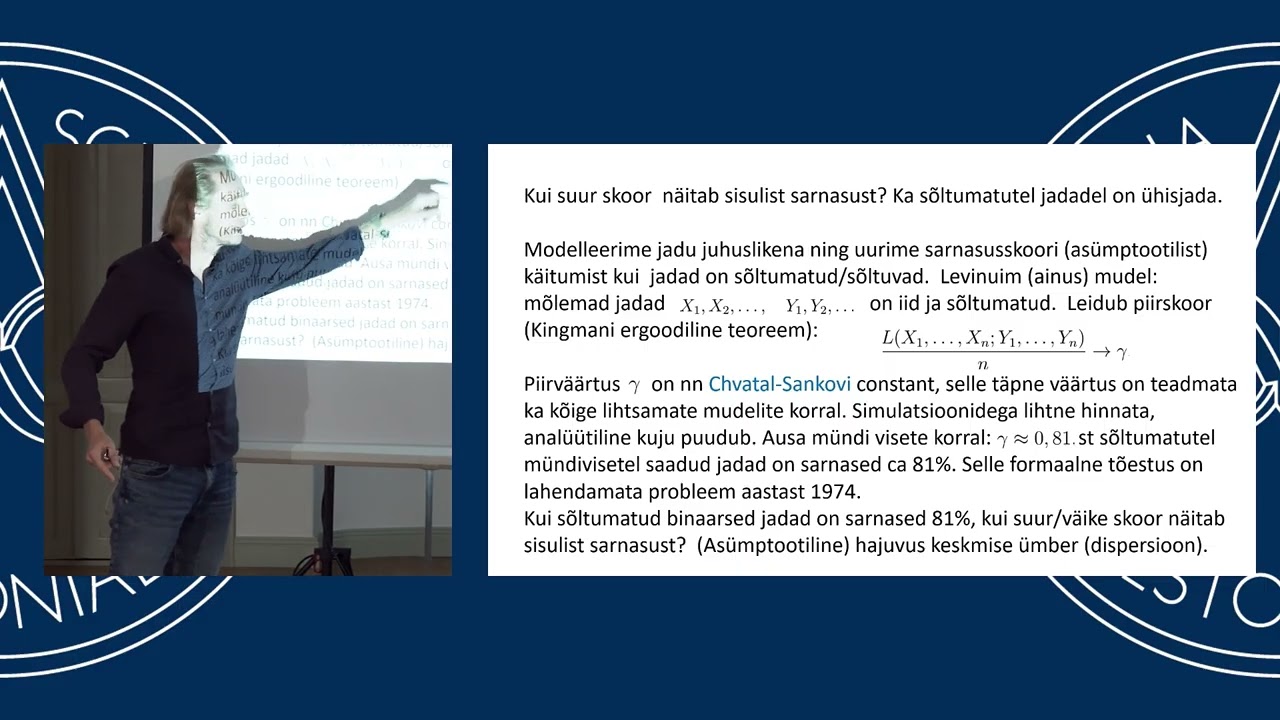
- Application of probability to sequence similarity, longest common subsequence, and the Chvátal–Sankoff constant.
- Introduction to hidden Markov models (HMMs) and their applications.
- Q&A session: discussion on the development of mathematics in Estonia and textbook writing.
Cited Sources
- Eesti Teaduste Akadeemia — The channel and organizer of the conference.
Concurring Sources
- University of Tartu — The institution where Jüri Lember is a professor.
Contribution & Novelties
The talk provides a personal perspective on a career in probability theory, highlighting the diversity of research topics and the importance of consistency. It offers insights into open problems, such as the exact value of the Chvátal–Sankoff constant, and the broad applicability of HMMs.
Pour aller plus loin :
- Hidden Markov model — A fundamental concept discussed in the talk, with applications in speech recognition and bioinformatics.
- Chvátal–Sankoff constant — The open problem of determining the constant for the longest common subsequence of random sequences.
- Bayesian nonparametrics — The field of Bayesian statistics with infinite-dimensional parameter spaces, relevant to Lember’s postdoctoral work.
102 words
Radar Profile
The radar profile shows high scores in quality and reliability, reflecting the speaker's expertise and the scientific rigor of the content. The quantity of information is moderate, as the talk is a concise overview. The technical level is high, suitable for an academic audience.