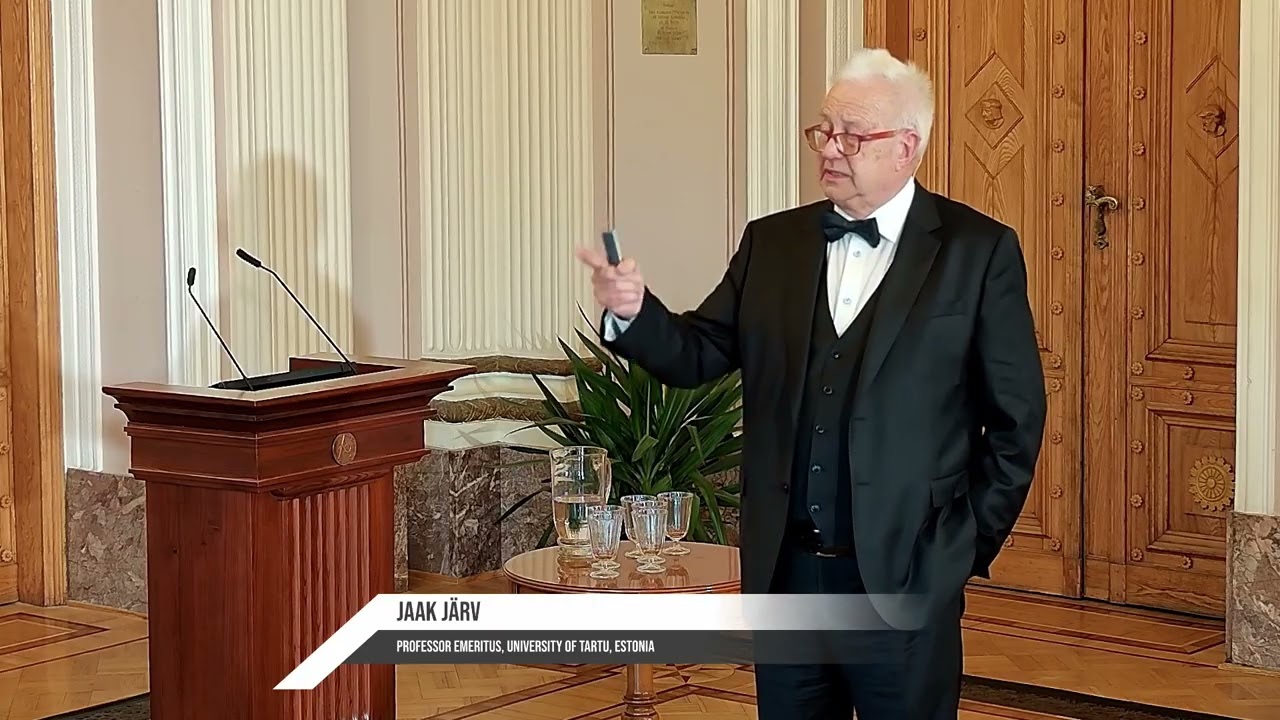
Jaak Järv - Professor Emeritus, University of Tartu, Estonia
Keywords
Summary
189 words
Critical Evaluation
Value of the Information & Strength of the Argument
The talk provides valuable insights into the practical challenges of aza-peptide synthesis, drawing on the speaker’s personal experience. The argumentation is based on chemical principles, such as the reduced nucleophilicity of aza-nitrogen, and is supported by specific examples from literature and his own research. However, the presentation is somewhat informal and lacks quantitative data in some parts, relying on anecdotal evidence. The speaker effectively communicates the gap between theoretical ease and practical difficulty, which is a key takeaway.
Scientific Rigor, Source Quality, Title Accuracy
The speaker cites several sources, including a 1974 paper on chymotrypsin inhibitors and a textbook on peptidomimetics, but does not provide full references. He mentions a recent paper in ‘Archives’ that claims automated synthesis, but the exact citation is missing. The title is simply the speaker’s name and affiliation, which is appropriate for a conference talk but does not convey the specific topic. The content is consistent with the title, as it is a scientific presentation. No comments were provided for analysis.
175 words
Title / Content Match
The title is a simple name and affiliation, which is appropriate for a conference talk but does not convey the specific topic.
Quality & Reliability
7/10
The speaker is an emeritus professor with direct research experience in the topic, providing a credible expert perspective. However, the talk is largely anecdotal and lacks detailed experimental data or citations to specific publications, limiting its verifiability.
Key Moments
Markers derived by PSI from the transcript: the creator did not define chapters.
- Introduction: the dream of pharmacologists for specific molecules, peptides as potential drugs, and the problem of stability.
- Introduction of aza-peptides: replacing alpha carbon with nitrogen to increase stability.
- Historical background: aza-peptides known since 1950s, but named later; 1974 paper on chymotrypsin inhibitor.
- Synthesis of aza-peptides: precursors from hydrazines, use of triphosgene, and standard peptide coupling.
- Literature survey: only 241 papers on aza-peptides from 1986 to 2025, with low yields reported.
- Challenges in synthesis: reduced nucleophilicity of aza-nitrogen, leading to very low yields.
- Research on galanin fragment: incorporation of aza-alanine, affinity loss, and receptor subtype selectivity.
- Funding difficulties due to misconceptions about synthesis ease.
- Recent paper on automated aza-peptide synthesis, which may revive interest.
- Q&A: clarification on FDA approval and the need to prove activity of aza-analogs.
Cited Sources
- 1974 paper on aza-analog as chymotrypsin inhibitor — Mentioned as a key early example of aza-peptide stability and use as an inhibitor.
- Textbook on peptidomimetics in organic and medicinal chemistry — Cited for the claim that aza-peptides can be synthesized easily from hydrazines.
- Recent paper in 'Archives' on automated aza-peptide synthesis — Mentioned as a continuation of the speaker's work, claiming automated synthesis.
Concurring Sources
- Aza-peptides: a comprehensive review — The speaker's claims about stability and synthesis challenges are consistent with general knowledge in the field.
Dissenting Sources
- Textbook claim of easy synthesis — The textbook suggests aza-peptides can be synthesized easily, but the speaker's experience shows very low yields, indicating a discrepancy.
Contribution & Novelties
The talk provides a personal perspective on the challenges and potential of aza-peptides, highlighting the discrepancy between theoretical ease and practical difficulty. It emphasizes the need for more research and funding in this area. The speaker’s experience with galanin analogs offers specific data on affinity and selectivity.
Pour aller plus loin :
- Peptidomimetics — Overview of peptidomimetics, including aza-peptides.
- Aza-peptides — Specific page on aza-peptides, their synthesis and applications.
- Peptide synthesis — General methods for peptide synthesis, relevant to understanding the challenges.
- Galanin — Neuropeptide mentioned in the talk, relevant to the example used.
94 words
Radar Profile
The radar profile shows high scores in technical level and information quality, reflecting the speaker's expertise and detailed discussion. The lower score in information quantity is due to the limited scope of the talk, focusing on a specific aspect of aza-peptides. Overall, the talk is technically strong but may not provide a broad overview.