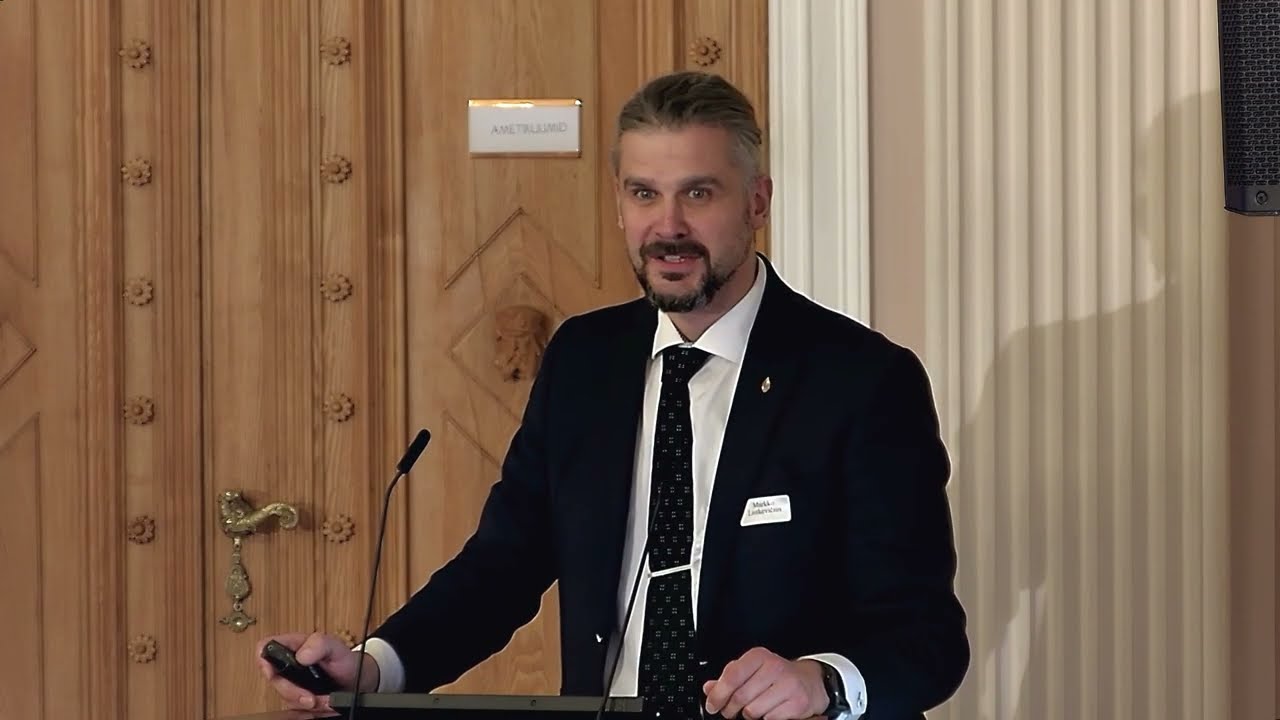
Läbipaistvad ja privaatsed TI-assistendid riigisüsteemides. Markko Liutkevičius, RIA
Keywords
Summary
156 words
Critical Evaluation
Value of the Information & Strength of the Argument
The presentation provides valuable insights into the practical implementation of AI in government, highlighting real-world challenges and solutions. The argumentation is solid, grounded in the speaker’s direct experience with deployed systems. He convincingly argues for a decentralized, privacy-preserving approach that leverages official data sources to ensure reliability and trust. The roadmap is logical and ambitious, with clear differentiation between stages. The speaker also addresses potential pitfalls, such as the risk of over-reliance on commercial AI models and the need for interoperability across agencies.
Scientific Rigor, Source Quality, Title Accuracy
The presentation demonstrates scientific rigor by referencing specific technical components (vector databases, agentic search, symbolic ontology) and regulatory frameworks (AI Act, GDPR). The speaker cites two sources: the ‘Agentic State’ concept by Luukas Ilves and Ott Velsberg, and a doctoral thesis on symbolic ontology. The title accurately reflects the content, focusing on transparency and privacy in AI assistants. The talk is part of a conference organized by the Estonian Academy of Sciences and RIA, adding credibility. No comments were provided for analysis.
180 words
Title / Content Match
The title accurately reflects the content, focusing on transparent and privacy-preserving AI assistants in government systems.
Quality & Reliability
8/10
The speaker is a representative of the Estonian Information System Authority (RIA), presenting an operational system with concrete technical details and references to ongoing projects. The presentation is grounded in practical experience and aligns with regulatory frameworks (AI Act, GDPR).
Key Moments
Markers derived by PSI from the transcript: the creator did not define chapters.
- Introduction: speaker sets expectations, discusses the definition of AI agents.
- Current state: Bürokrati chatbot deployed in one agency, answering 95% of questions.
- Privacy and hosting: each agency's chatbot is hosted in its own cloud, GDPR compliance.
- Network of chatbots: routing questions between agencies with user consent.
- Technical architecture: vectorization, retrieval, and answer generation from official sources.
- Stage 2: domain-specific assistants with agentic search over large document sets.
- Stage 3: service creation via symbolic ontology, natural language interface.
- Stage 4: personalized services using X-Road data.
- Vision: interoperable assistants, avoiding siloed portals.
- Example: weekend garage sale microservice created and deleted after the event.
Cited Sources
- Agentic State concept — Mentioned as a concept by Luukas Ilves and Ott Velsberg.
- Doctoral research on symbolic ontology — A doctoral student working at RIA is researching symbolic ontology for service creation.
Concurring Sources
- Estonian Information System Authority (RIA) — The agency responsible for the described AI assistants, providing credibility.
Contribution & Novelties
The presentation offers a unique perspective on implementing AI in government, emphasizing a decentralized network of chatbots that respect privacy and use official data sources. The roadmap from simple chatbots to agentic service creation is innovative and practical. The speaker highlights the importance of transparency (citations) and user consent in routing queries.
Pour aller plus loin :
- AI Act — The EU regulation governing AI, relevant to the risk-based approach mentioned.
- X-Road — The decentralized data exchange layer used in Estonia, enabling secure data sharing.
- Symbolic ontology — The concept underlying the service creation approach.
95 words
Radar Profile
The radar profile shows high scores in information quantity, quality, and reliability, with a slightly lower technical level, indicating a well-balanced presentation accessible to a broad audience while maintaining depth.