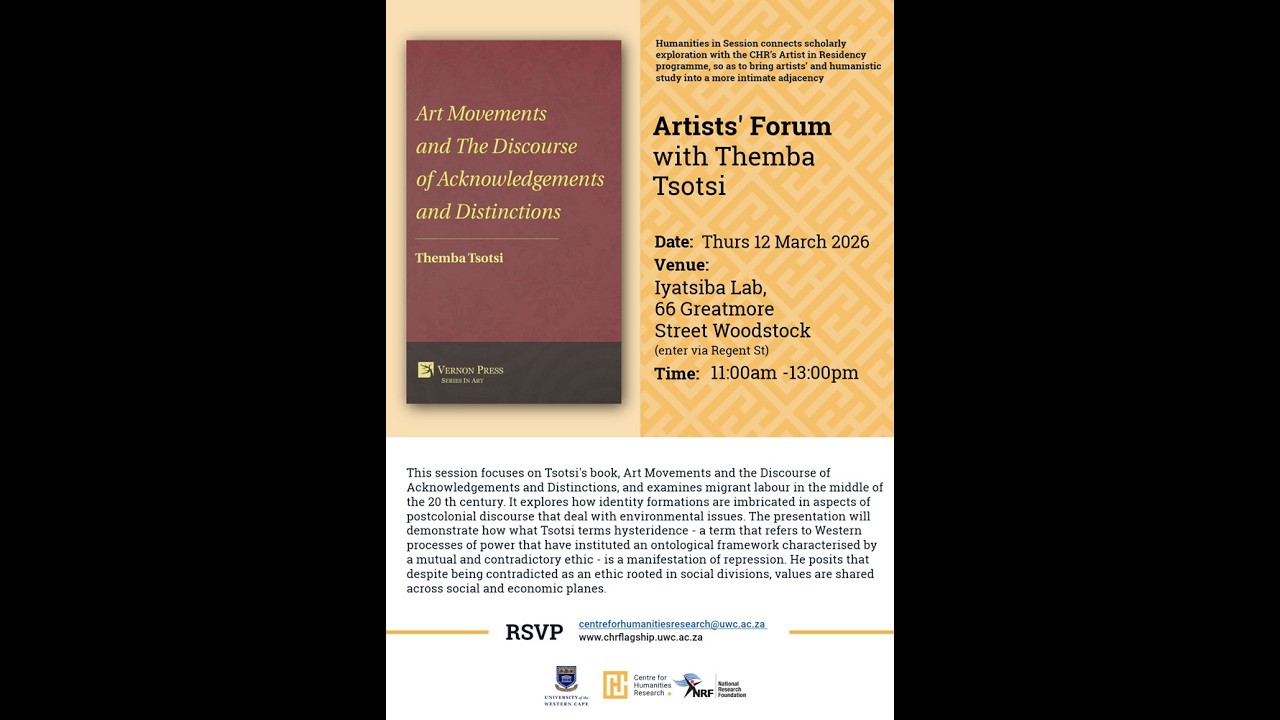
Humanities In Session | Themba Tsotsi: Artists' Forum | 12 March 2026
Keywords
Summary
198 words
Critical Evaluation
Value of the Information & Strength of the Argument
The value of the information lies in its nuanced exploration of postcolonial theory and its application to contemporary South African art and identity. Tsotsi’s argument that ‘hysteridence’ is a manifestation of the repression of the Id offers a novel psychoanalytic lens on postcolonial discourse. The discussion of the Gugulective collective provides concrete examples of how artists have challenged spatial and intellectual marginalization. The argumentation is solid, grounded in theoretical references (e.g., psychoanalysis, postcolonialism) and personal experience, though it remains conversational and lacks systematic evidence. The moderator’s contributions add historical depth, connecting the discussion to broader debates on apartheid’s legacy.
Scientific Rigor, Source Quality, Title Accuracy
The session demonstrates intellectual rigor through its engagement with theoretical concepts and historical context. However, sources are not formally cited; references are made to thinkers like Edward Said, Steve Biko, and Mella Ramphele, but without specific citations. The title accurately reflects the content, and the discussion is well-structured despite its conversational nature. The lack of formal citations and the informal setting slightly reduce the scientific rigor, but the depth of analysis and the credibility of the speakers compensate.
192 words
Title / Content Match
The title accurately reflects the content: a session in the Humanities series featuring Themba Tsotsi in an artists' forum.
Quality & Reliability
7/10
The session is a scholarly discussion with a recognized academic institution, featuring a writer and critic with a background in art criticism and postcolonial theory. The arguments are grounded in theoretical frameworks (psychoanalysis, postcolonialism) and historical context, but the format is conversational and lacks formal citations or peer review.
Key Moments
Markers derived by PSI from the transcript: the creator did not define chapters.
- Introduction by moderator, welcoming Themba Tsotsi and setting the context.
- Tsotsi begins with an anecdote about his first year at UWC and his intellectual formation.
- Discussion of the concept of 'hysteridence' and its psychoanalytic roots.
- Tsotsi talks about his involvement with the Gugulective art collective and its goals.
- Exploration of the politics of space and the township-city divide.
- Discussion of the terms 'acknowledgement' and 'distinction' in Tsotsi's book.
- Moderator connects the discussion to historical segregationist policies.
- Further elaboration on the concept of 'hysteridence' and its implications.
- Open discussion begins, with audience questions.
Cited Sources
- Centre for Humanities Research, UWC — The center's website, mentioned in the video description.
- Centre for Humanities Research, UWC on Facebook — The center's Facebook page, mentioned in the video description.
Concurring Sources
- Centre for Humanities Research, UWC — The center's website, which hosts similar academic discussions.
Contribution & Novelties
The session offers a unique perspective on postcolonial theory by introducing the concept of ‘hysteridence’ as a psychoanalytic framework for understanding Western ontological dominance. Tsotsi’s discussion of the Gugulective collective provides a concrete case study of artistic resistance and spatial politics. The conversation also contributes to debates on acknowledgment versus recognition in postcolonial contexts.
Pour aller plus loin :
- Postcolonialism — Overview of the field.
- Psychoanalysis — Theoretical background for the concept of the Id.
- Edward Said — Key thinker in postcolonial studies, referenced in the discussion.
87 words
Radar Profile
The radar profile shows high scores in quality of information and fiabilite, reflecting the depth of the discussion and the credibility of the speakers. The lower score in quantity of information is due to the conversational format, which limits the amount of factual data presented. The technical level is moderate, accessible to a general audience with some background in theory.