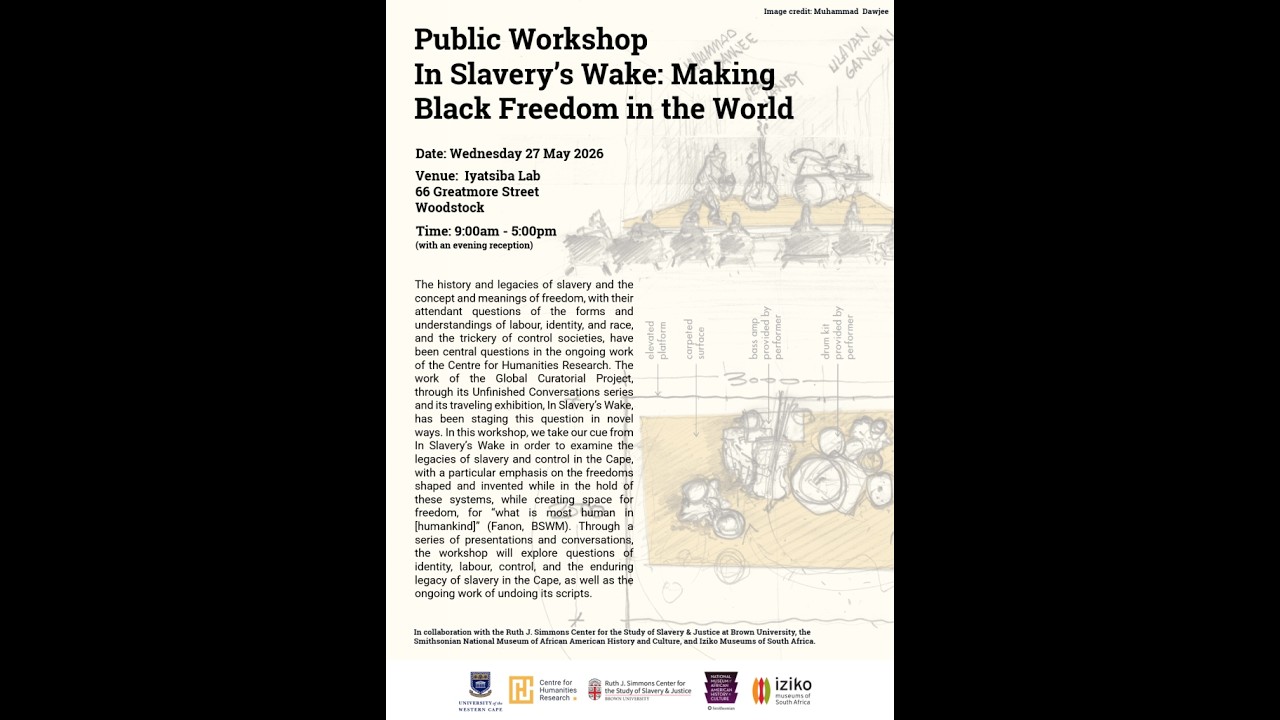
In Slavery's Wake | Dawjee Trio In Conversation with Valmont Layne & Lindelwa Dalamba | 27 May 2026
Keywords
Summary
120 words
Critical Evaluation
Value of the Information & Strength of the Argument
The video provides valuable insights into the intersection of music, history, and social justice. The argumentation is strong, drawing on personal experiences, scholarly references, and the musicians’ creative process. The speakers effectively argue for the importance of sound and jazz in understanding and addressing the legacies of slavery. The discussion is nuanced and avoids oversimplification, acknowledging the limits of academic and museum spaces. The value lies in its interdisciplinary approach and the integration of performance with critical thought.
Scientific Rigor, Source Quality, Title Accuracy
The scientific rigor is moderate; while the speakers reference academic works and concepts, the format is conversational and lacks formal citations. The quality of sources is good, with mentions of scholars like A.M. Mensah, Tsitsi Dangarembga, and Amiri Baraka. The title accurately reflects the content, and the video is well-produced. The discussion is coherent and stays on topic, though it is more of a dialogue than a structured presentation.
162 words
Title / Content Match
The title accurately reflects the content: a conversation about slavery's legacy and freedom, featuring the Dawjee Trio and scholars.
Quality & Reliability
7/10
The video is a recorded academic workshop featuring expert speakers and musicians. The discussion is nuanced and references scholarly works, but it is primarily a conversational exchange rather than a peer-reviewed presentation. The production quality is adequate, and the content is coherent.
Key Moments
Markers derived by PSI from the transcript: the creator did not define chapters.
- Introduction by Valmont Layne, framing the workshop and the role of sound.
- Musical performance by the Dawjee Trio begins.
- Performance ends; conversation begins with Valmont Layne's reflections.
- Lindelwa Dalamba discusses jazz's global circulation and references to literature.
- Audience questions on vernacular and reading sound.
- Muhammad Dawjee explains the concept of 'otherwise' and embodied thought.
Cited Sources
- Jazz the Roundtrip — Referenced by Lindelwa Dalamba as a classic paper on jazz's global circulation.
- This Mournable Body — Referenced by Lindelwa Dalamba as part of Tsitsi Dangarembga's trilogy.
- Slave Ship — Referenced by Lindelwa Dalamba as a play by Amiri Baraka.
Concurring Sources
- In Slavery's Wake: Making Black Freedom in the World — The exhibition referenced in the video, co-hosted by the Smithsonian.
Contribution & Novelties
The video contributes to the discourse on slavery’s legacies by centering sound and music as forms of knowledge and resistance. It offers a unique perspective on jazz as a tool for restitution and understanding freedom. The conversation highlights the importance of vernacular and embodied thought, challenging traditional academic hierarchies.
Pour aller plus loin :
- The Wake of Slavery — Provides context on the concept of the wake in slavery studies.
- Jazz in South Africa — Offers background on the history and significance of jazz in the region.
- Restitution of Cultural Property — Discusses the broader context of restitution debates mentioned in the video.
103 words
Radar Profile
The radar profile shows high scores in quality of information and fiability, with moderate scores in quantity and technical level. This indicates a focused, expert discussion rather than a broad overview, with a strong emphasis on depth over breadth.
💬 Sur les 0 commentaires analysés, aucune tendance n'est disponible.