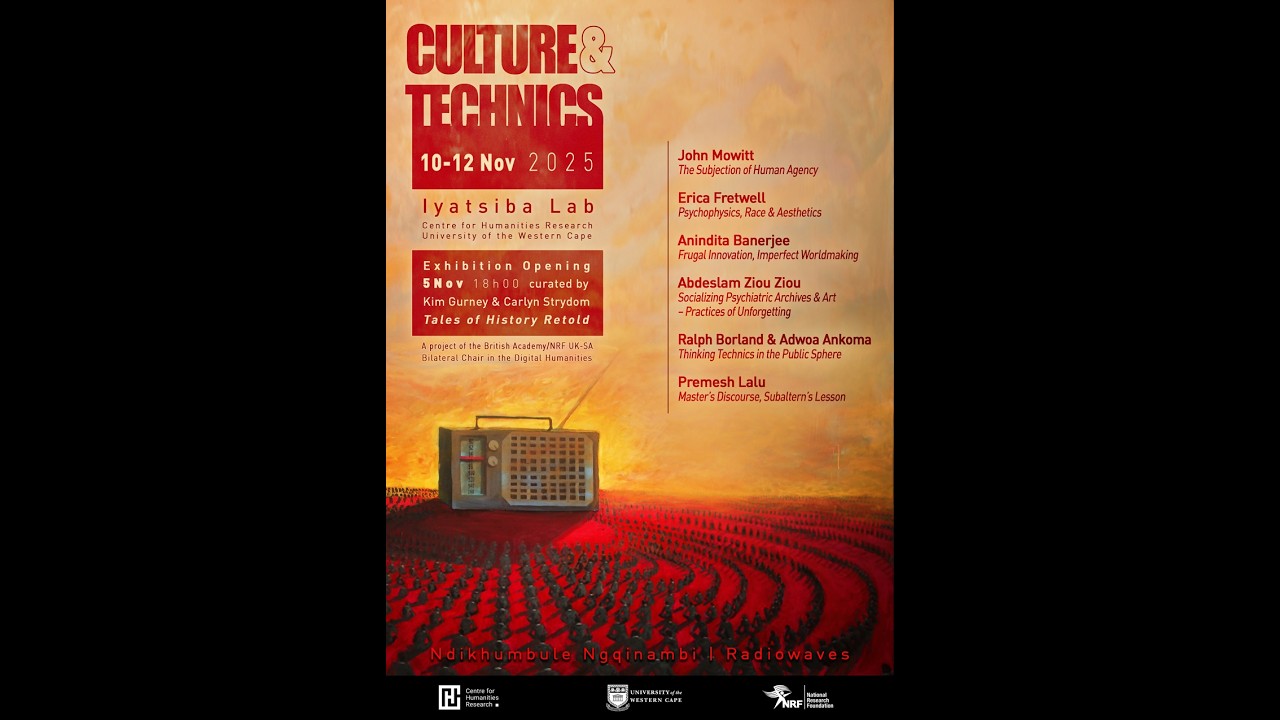
Digital Humanities Chair | Abdeslam Ziou Ziou: Culture & Technics Workshop | 10-12 November 2025
Keywords
Summary
195 words
Critical Evaluation
Value of the Information & Strength of the Argument
The presentation offers valuable insights into the intersection of art, psychiatry, and postcolonial history, drawing on personal experience and a wide range of historical examples. The argumentation is coherent and passionate, but it is largely anecdotal and lacks systematic evidence. The speaker’s position as an insider provides unique perspectives, but the lack of formal citations weakens the scientific rigor. The discussion of ‘unforgetting’ and the role of silence in memory is thought-provoking and adds theoretical depth.
Scientific Rigor, Source Quality, Title Accuracy
The presentation demonstrates a good level of scientific rigor in terms of historical accuracy and contextualization, but it relies on personal narratives and mentions of key figures without formal citations. The title accurately reflects the content, which is a workshop presentation on culture and technics. The speaker does not provide a list of sources, but the description includes links to the Centre for Humanities Research and the Iyatsiba Lab, which may contain relevant resources. The lack of explicit citations is a limitation for verification.
175 words
Title / Content Match
The title accurately reflects the content: a workshop presentation by Abdeslam Ziou Ziou on culture and technics, focusing on the intersection of art, psychiatry, and postcolonial memory.
Quality & Reliability
7/10
The speaker is a trained anthropologist and practitioner, presenting a well-documented personal and historical account. The content is grounded in specific events and figures, but lacks formal citations or peer-reviewed references. The presentation is subjective and exploratory, typical of an expert opinion.
Key Moments
Markers derived by PSI from the transcript: the creator did not define chapters.
- Introduction: Abdeslam Ziou Ziou introduces himself and his background in anthropology and art.
- Personal story: The 1981 event at Berrechid psychiatric hospital where artists were invited.
- Context: The Berrechid hospital as a colonial creation and its significance in Morocco.
- The institutional psychotherapy movement and its influence on the Moroccan experiment.
- Global connections: Jean Wilto, Trieste, and the anti-psychiatry movement.
- Frantz Fanon's parallel work in Algeria and the concept of colonial psychiatry.
- The concept of 'unforgetting' from Thongchai Winichakul and its relevance.
- Red Conceptualismos and the idea of 'socializar' archives.
- Conclusion: The role of artistic practice in giving meaning to residual stories.
Cited Sources
- Centre for Humanities Research, UWC — The host institution for the workshop.
- Iyatsiba Lab — The venue for the workshop, mentioned in the description.
Concurring Sources
- Centre for Humanities Research, UWC — The host institution, which aligns with the workshop's themes.
Contribution & Novelties
The presentation offers a unique personal and historical perspective on the intersection of art, psychiatry, and postcolonial memory, particularly in the Moroccan context. It highlights the importance of ‘unforgetting’ and the role of silence in memory, and proposes artistic practice as a method to engage with archives. The concept of ‘socializar’ archives from Red Conceptualismos is introduced as a practical approach.
Pour aller plus loin :
- Institutional psychotherapy — A movement that influenced the Moroccan experiment.
- Frantz Fanon — His work in Algeria is directly relevant to the discussion of colonial psychiatry.
- Red Conceptualismos — The network mentioned for its approach to archives.
- Thongchai Winichakul — The historian who developed the concept of ‘unforgetting’.
114 words
Radar Profile
The radar profile shows a balanced distribution across all dimensions, with slightly higher scores in information quantity and quality, reflecting the rich historical and personal content. The technical level is moderate, indicating accessibility to a general audience, while reliability is good but not exceptional due to the lack of formal citations.