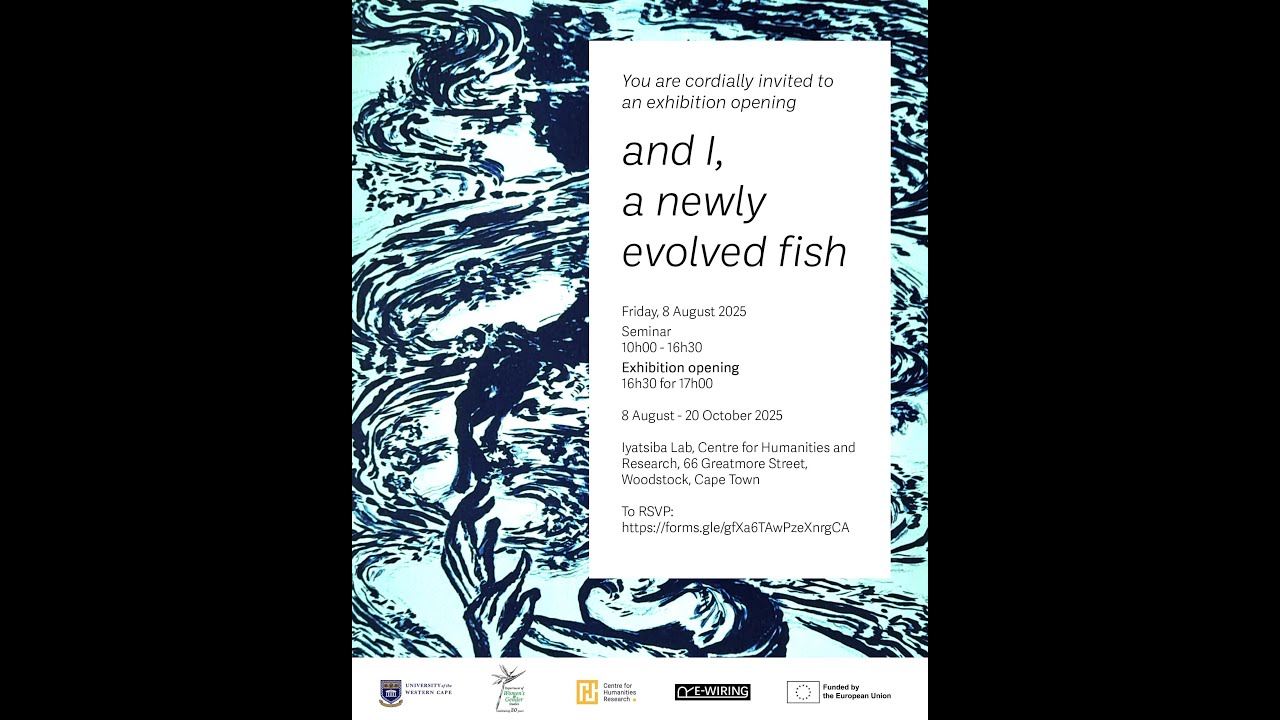
Keynote Lecture | Hugo Ka Canham: And I, A Newly Evolved Fish, Exhibition | 08 August 2025
Keywords
Summary
137 words
Critical Evaluation
Value of the Information & Strength of the Argument
The lecture offers a rich and nuanced argument that weaves together art, theory, and personal narrative. It provides valuable insights into the intersections of water, multispecies entanglements, and queer theory, challenging conventional boundaries. The argumentation is solid, drawing on a diverse range of scholars and artists, and is presented with intellectual rigor. The creative reading of Sila adds an evocative and powerful dimension, illustrating the theoretical points through a concrete historical figure.
Scientific Rigor, Source Quality, Title Accuracy
The lecture demonstrates strong scientific rigor, with references to established scholars and authors such as Édouard Glissant, Harry Garuba, Saidiya Hartman, and Avery Gordon. The sources are appropriately cited and integrated into the argument. The title accurately reflects the content, as the lecture is directly tied to the exhibition and its themes. The presentation is well-structured and the argument is coherent, though it is primarily theoretical and interpretive rather than empirical.
158 words
Title / Content Match
The title accurately reflects the content: a keynote lecture tied to the exhibition 'And I, a newly evolved fish', delivered by Hugo Ka Canham.
Quality & Reliability
8/10
The lecture is grounded in academic scholarship, referencing established theorists and authors, and is delivered by a recognized professor. The content is interdisciplinary and well-argued, though it is primarily an interpretive and theoretical exposition rather than empirical research.
Key Moments
Markers derived by PSI from the transcript: the creator did not define chapters.
- Introduction by the director of the CHR and Lwando Scott, introducing Hugo Ka Canham.
- Hugo Ka Canham begins his keynote, discussing enchantment and opacity of water in a multispecies world.
- Discussion of artworks in the exhibition, including works by Sakil Sulanki, Michaela Peterson, and others.
- Exploration of water as an unfixing agent, challenging gender and sexual categories.
- Introduction of the figure of Sila, an enslaved woman, and the creative reading of her story.
- Continuation of the narrative on Sila, incorporating themes of haunting, memory, and the search for her mother.
- Reflections on the whale as a symbol of freedom and the entanglement of life forms.
- Conclusion of the lecture and beginning of Lwando Scott's response.
- Lwando Scott offers reflections on the lecture, emphasizing attentiveness and entanglement.
Cited Sources
- Riotous Deathscapes — Hugo Ka Canham's book, referenced in the introduction and as a basis for his work.
- Unconfessed — Novel by Yvette Christians, referenced in relation to the figure of Sila.
- Lose Your Mother — Saidiya Hartman's book, referenced in the search for Sila's mother.
Concurring Sources
- Riotous Deathscapes — Hugo Ka Canham's own work, which explores similar themes of death, suffering, and black life.
- Unconfessed — Yvette Christians's novel, which provides a fictional account of Sila's life, aligning with the lecture's narrative.
Dissenting Sources
- None — No discordant sources were identified in the lecture.
Contribution & Novelties
The lecture offers a novel perspective by linking water, multispecies entanglements, and queer theory, proposing water as a metaphor and material for destabilizing colonial categories. It creatively integrates art, theory, and personal narrative, particularly in the reading of Sila’s story. The concept of ‘opacity’ as a queer and decolonial strategy is emphasized, providing a fresh angle on resistance to modernity.
Pour aller plus loin :
- Édouard Glissant’s Poetics of Relation — Glissant’s concept of opacity and relation is central to the lecture’s argument.
- Saidiya Hartman’s critical fabulation — Hartman’s method of ‘critical fabulation’ informs the creative reconstruction of Sila’s story.
- Multispecies ethnography — This approach in anthropology aligns with the lecture’s focus on multispecies entanglements.
115 words
Radar Profile
The radar profile shows high scores in quality of information and global reliability, reflecting the academic rigor and theoretical depth of the lecture. The quantity of information is moderate, as the lecture is focused on a specific theme. The technical level is moderate, as it is accessible to a general academic audience but not overly technical.
💬 No comments were provided for analysis.