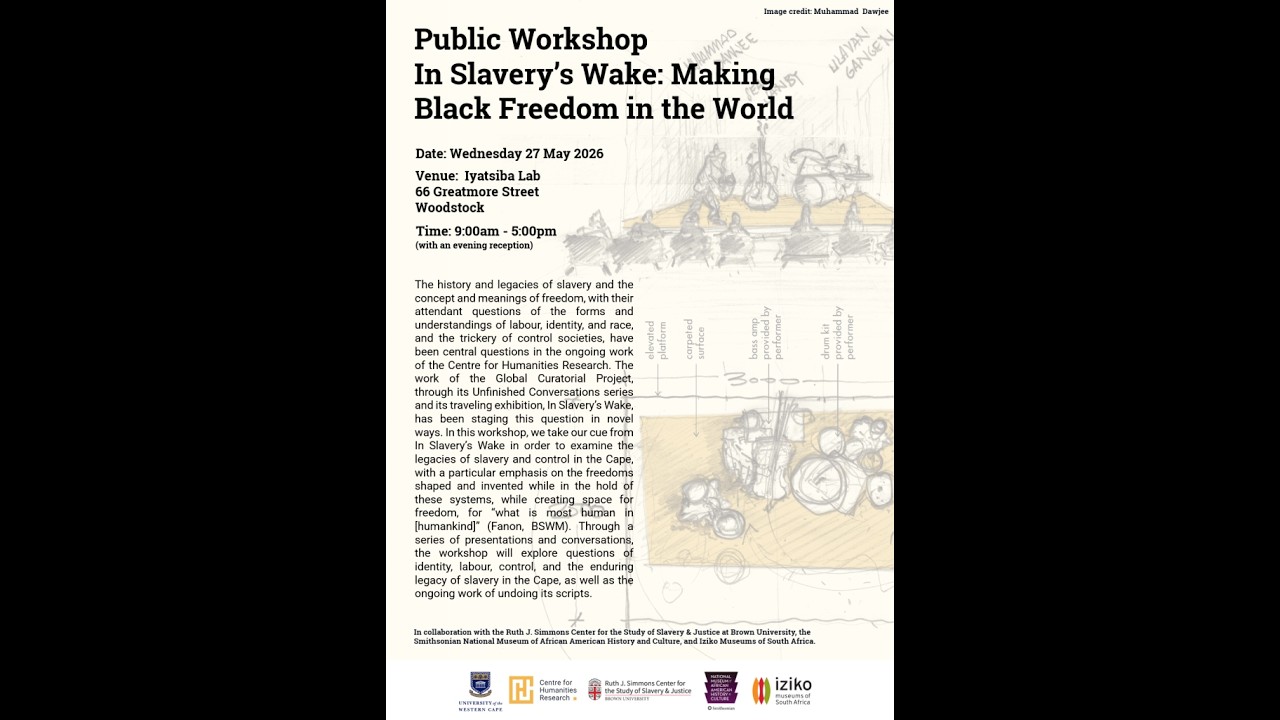
In Slavery's Wake | Introduction | Maurits van Bever Donker and Tony Bogues | 27 May 2026
Keywords
Summary
170 words
Critical Evaluation
Value of the Information & Strength of the Argument
The video provides valuable insights into the methodology and philosophy behind a major international humanities project. It argues for a collaborative, community-centered approach to curating history, challenging traditional top-down narratives. The argumentation is persuasive, grounded in concrete examples and personal experiences, though it is more descriptive than analytical.
Scientific Rigor, Source Quality, Title Accuracy
The speakers are credible academics with institutional affiliations, and the project is backed by major institutions. The title accurately reflects the content. The video does not cite specific sources, but references the project’s research and collaborations. The adéquation between title and content is strong.
107 words
Title / Content Match
The title accurately reflects the content: an introduction to the 'In Slavery's Wake' project by Maurits van Bever Donker and Tony Bogues.
Quality & Reliability
8/10
The video features two academics with established expertise in humanities and slavery studies, presenting a collaborative project with institutional backing. The content is based on documented research and community engagement, though it is primarily a descriptive account rather than a peer-reviewed study.
Key Moments
Markers derived by PSI from the transcript: the creator did not define chapters.
- Introduction by Maurits van Bever Donker, situating the CHR and the workshop.
- Tony Bogues begins his keynote, thanking hosts and sharing personal connections to Cape Town.
- Bogues explains the origins of the Global Curatorial Project and its goal to tell a global story of slavery.
- Discussion of the collaborative curation process and the challenge of multiple curators.
- The 'Unfinished Conversations' project is introduced, focusing on community engagement and oral histories.
- Bogues recounts the experience in Senegal and the importance of listening to community stories.
- Discussion of intellectual property rights and the ethical approach to interviews.
- The documentary 'Uncorked' about wine workers is highlighted, and its impact.
- Bogues concludes with reflections on the project's relevance in the present and its role as resistance.
Cited Sources
- In Slavery's Wake: Making Black Freedom in the World — Mentioned as the traveling exhibition and project.
- Unfinished Conversations — Mentioned as a series of oral histories and documentaries.
- Uncorked — Documentary about wine workers in the Western Cape.
Concurring Sources
- In Slavery's Wake: Making Black Freedom in the World — The exhibition and project are central to the video.
Contribution & Novelties
The video offers an insider’s perspective on the development of a major collaborative exhibition and oral history project, highlighting the ethical and methodological challenges of centering marginalized voices. It contributes to discussions on decolonizing museums and curatorial practices.
Pour aller plus loin :
- Global Curatorial Project — Official project page.
- Ruth J. Simmons Center for the Study of Slavery and Justice — Partner institution.
- Smithsonian National Museum of African American History and Culture — Partner institution.
- Iziko Museums of South Africa — Partner institution.
84 words
Radar Profile
The radar profile shows high scores in quality and reliability, with moderate scores in quantity and technical level, reflecting a focused, expert-led discussion rather than a broad overview.
💬 No comments were provided for analysis.