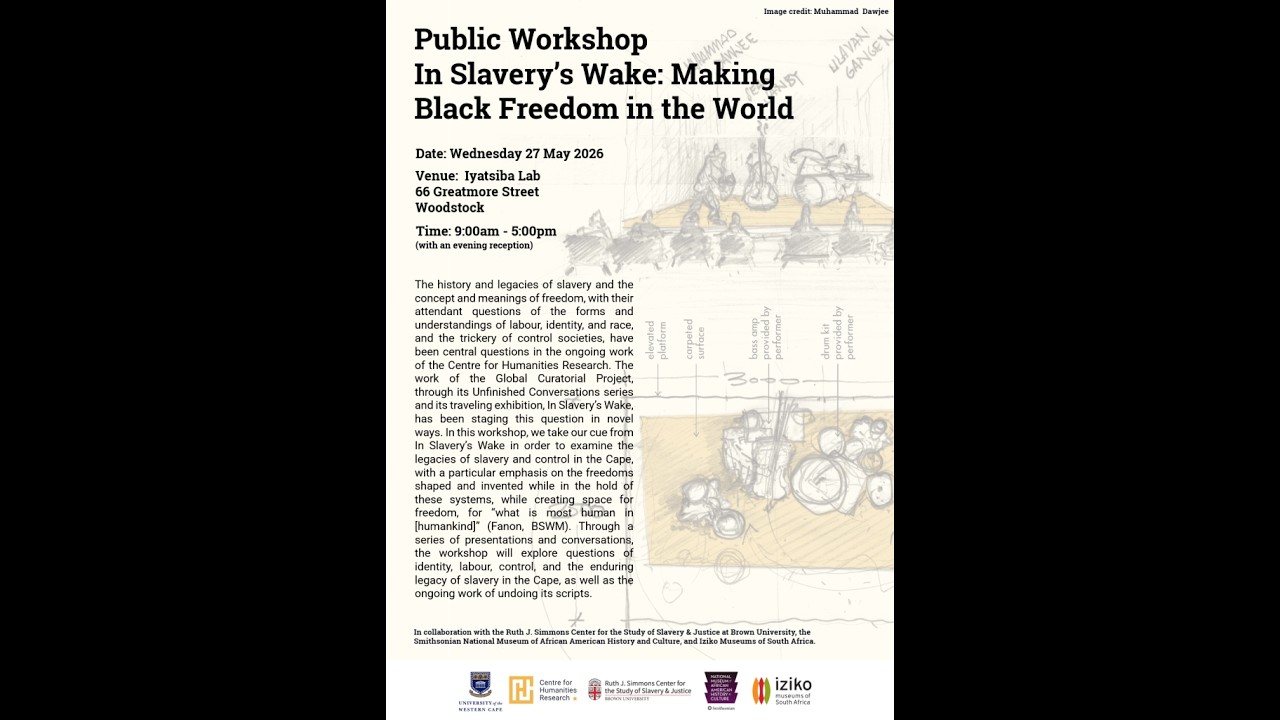
In Slavery's Wake | Premesh Lalu and Candice Jansen: Slavery, Technology, Control | 27 May 2026
Keywords
Summary
202 words
Critical Evaluation
Value of the Information & Strength of the Argument
The talk offers a rich and thought-provoking argument that connects historical events to contemporary technological developments. Lalu’s analysis of Danby’s painting and its connection to the birth of communication technologies is original and compelling. He provides a nuanced understanding of apartheid as not merely a legal system but as a technological apparatus of control. The concept of ‘proletarianization of the senses’ is a valuable contribution to critical theory. Jansen’s poetic intervention adds an affective dimension, grounding the theoretical discussion in personal and collective memory. However, the argumentation is dense and sometimes speculative, with leaps that may not be fully substantiated. The reliance on a few key sources (e.g., Erica Fretwell, Friedrich Hayek) could be expanded. Overall, the value lies in its interdisciplinary approach and its ability to provoke new ways of thinking about slavery, technology, and control.
Scientific Rigor, Source Quality, Title Accuracy
The speakers demonstrate scholarly rigor by referencing specific historical events, artworks, and academic works. Lalu cites Francis Danby, the Cambridge Philosophical Breakfast Club, Norbert Wiener, and others, grounding his argument in historical and theoretical frameworks. Jansen references David Goldblatt and Zanab Gersho, adding a visual and poetic perspective. However, the talk is not a formal academic presentation with citations, and some claims are presented without direct evidence. The title accurately reflects the content, focusing on the intersection of slavery, technology, and control. The talk is part of a workshop, so it is more exploratory than definitive.
248 words
Title / Content Match
The title accurately reflects the content, which focuses on the intersections of slavery, technology, and control as discussed by the two speakers.
Quality & Reliability
7/10
The talk is grounded in historical research and scholarly references, but it is primarily an interpretive and argumentative presentation rather than a peer-reviewed study. The speakers are established academics, and the content is coherent, but some claims are speculative and not empirically verified.
Key Moments
Markers derived by PSI from the transcript: the creator did not define chapters.
- Introduction of speakers and topic by Lee Walters.
- Premesh Lalu introduces Francis Danby's painting 'The Opening of the Sixth Seal' and its apocalyptic imagery.
- Lalu discusses the mutilation of the painting and its restitching, linking it to industrialization and the science of empire.
- Lalu connects the painting to the Cambridge Philosophical Breakfast Club and the birth of the term 'scientist'.
- Lalu introduces the concept of 'proletarianization of the senses' and the role of psychophysics in shaping racial categories.
- Lalu discusses the rise of cybernetics and its connection to apartheid as a system of communication and control.
- Lalu concludes with the need to undo apartheid by attending to the slippery signification of race.
- Candice Jansen reads her poetic piece 'A Visible Unseen' responding to a David Goldblatt photograph.
- Jansen reflects on the concept of 'looking together' and its relevance to sensory and historical understanding.
- Discussion and Q&A session begins.
Cited Sources
- The Opening of the Sixth Seal (painting) — Referenced by Premesh Lalu as a central artwork for his argument.
- Sacred Channels by Erich Hörl — Cited by Lalu to support the argument about the birth of modern communication.
- Sensory Experiments by Erica Fretwell — Cited by Lalu as a footnote on psychophysics in the US.
- The Sensory Order by Friedrich Hayek — Mentioned by Lalu in relation to the sensory order and neoliberalism.
- David Goldblatt's photograph of Gaasfontein farm — Referenced by Candice Jansen in her poetic response.
- Zanab Gersho's concept of 'looking together' — Referenced by Jansen as a methodological approach.
Concurring Sources
- Sacred Channels by Erich Hörl — Supports the argument about the birth of modern communication in the 1830s.
- Sensory Experiments by Erica Fretwell — Provides parallel evidence of psychophysics in the US.
Dissenting Sources
- None explicitly mentioned — No discordant sources were cited in the talk.
Contribution & Novelties
The talk offers a novel interdisciplinary framework linking the history of slavery to the development of communication technologies and systems of control. Lalu’s concept of ‘proletarianization of the senses’ extends Marxist analysis to sensory experience, while his reading of apartheid as a cybernetic system provides a fresh perspective. Jansen’s poetic intervention adds an affective and visual dimension, emphasizing the importance of ’looking together’ as a method to uncover layered histories.
Pour aller plus loin :
- Cybernetics — Foundational concept for understanding control and communication systems.
- Psychophysics — Historical discipline linking physics to sensory perception.
- Francis Danby — Artist of the discussed painting.
- Apartheid — Historical system of racial segregation in South Africa.
- David Goldblatt — Photographer whose work is central to Jansen’s response.
123 words
Radar Profile
The radar profile shows high scores in quantity and quality of information, reflecting the dense and interdisciplinary content. The technical level is moderate, indicating that the talk is accessible to a general academic audience but requires some background knowledge. The overall reliability is good, though the speculative nature of some arguments prevents a higher score.