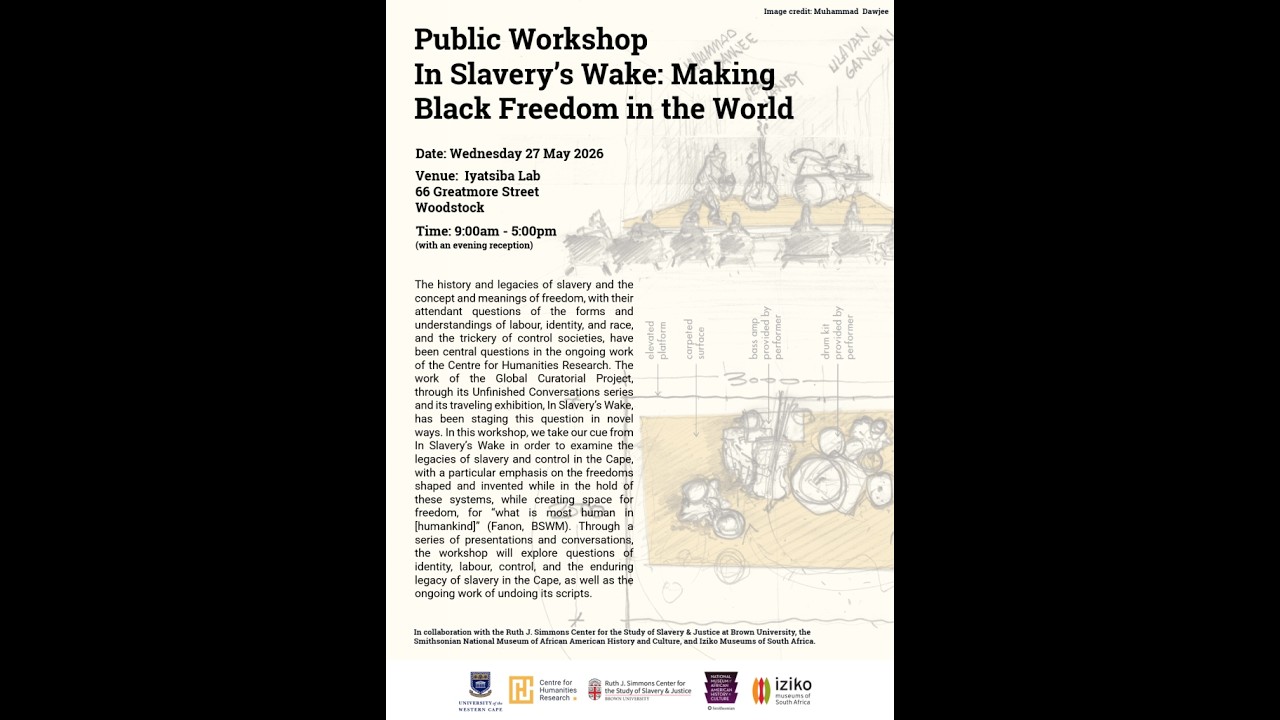
In Slavery's Wake | Curatorial Discussion | Panel 2: Curatorial Team | 27 May 2026
Keywords
Summary
152 words
Critical Evaluation
Value of the Information & Strength of the Argument
The panel provides valuable insights into the curatorial process and the complexities of representing slavery and freedom. The speakers argue for a collaborative, community-centered approach that centers the experiences of the enslaved and their descendants. The argumentation is solid, grounded in specific examples from Senegal and Brazil, and emphasizes the need to challenge traditional narratives. The discussion is persuasive in its call for a more inclusive and nuanced understanding of history.
Scientific Rigor, Source Quality, Title Accuracy
The discussion is rigorous, with speakers referencing specific historical events, archives, and community engagements. The sources are primarily institutional and academic, though not all are explicitly cited. The title accurately reflects the content, which is a curatorial discussion. The panel’s credibility is enhanced by the speakers’ affiliations with major institutions.
136 words
Title / Content Match
The title accurately reflects the content: a curatorial panel discussion about the exhibition 'In Slavery's Wake'.
Quality & Reliability
8/10
The panel features expert curators and academics from major institutions (Smithsonian, Brown University, Museum of Black Civilizations) discussing historical research and exhibition practices. The content is grounded in scholarly knowledge and institutional experience, though it is primarily a discussion rather than a peer-reviewed study.
Key Moments
Markers derived by PSI from the transcript: the creator did not define chapters.
- Introduction by Paul Gardullo, outlining the project's collaborative ethics.
- Ibrahim Achao discusses the 'Unfinished Conversations' project in Saint-Louis, Senegal.
- Achao details the history of formerly enslaved people migrating to Senegal and their labor.
- Achao explains the concept of 'Teranga' and its role in community engagement.
- Director of Museum of Black Civilizations speaks about the museum's role and the exhibition.
- Discussion of the museum's history and its mission to address slavery's legacies.
- Panelists discuss the importance of international collaboration in curatorial work.
Cited Sources
- In Slavery's Wake exhibition — The exhibition is the central topic of the discussion.
- Museum of Black Civilizations — Mentioned as a partner institution and host for the exhibition.
- Smithsonian National Museum of African American History and Culture — Paul Gardullo's affiliation and a partner institution.
- Ruth J. Simmons Center for the Study of Slavery & Justice — Partner institution mentioned in the description.
Concurring Sources
- In the Wake: On Blackness and Being — The concept of the wake, as discussed by Christina Sharpe, is referenced by the panelists.
Contribution & Novelties
The panel offers a unique perspective on the curatorial process behind a major international exhibition, emphasizing collaborative and community-based approaches. It highlights the importance of centering the experiences of the enslaved and their descendants, and challenges traditional narratives. The discussion provides concrete examples from Senegal and Brazil, offering new insights into how these histories are being reimagined.
Pour aller plus loin :
- Christina Sharpe, In the Wake: On Blackness and Being — The concept of the wake is central to the exhibition’s framing.
- Teranga (Senegalese hospitality) — The concept of Teranga is discussed as a methodological approach.
- Museum of Black Civilizations — The museum’s role and history are discussed in the panel.
112 words
Radar Profile
The radar profile shows high scores in quality of information and reliability, reflecting the expert nature of the panel. The quantity of information is moderate, and the technical level is appropriate for a general academic audience. Overall, the content is well-balanced and credible.
💬 No comments were provided for analysis.