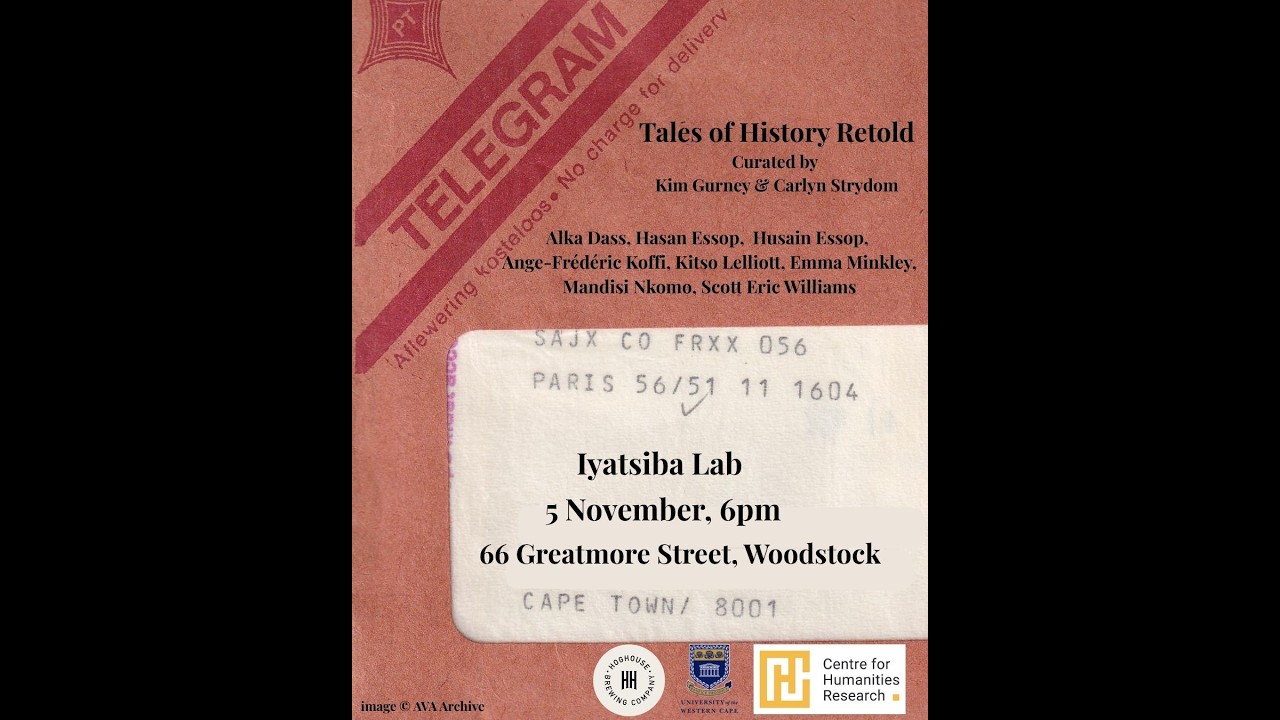
Tales of History Retold Exhibition Opening | 05 Nov 2025
Keywords
Summary
162 words
Critical Evaluation
Value of the Information & Strength of the Argument
The video provides valuable insights into the curatorial process and the conceptual framework behind the exhibition. The speakers articulate the importance of engaging with archives critically and creatively, highlighting the role of art in reimagining history. The argumentation is coherent and grounded in the institutional context, though it is primarily descriptive rather than analytical. The value lies in the firsthand perspectives of the curators and institutional leaders, offering a unique glimpse into the intersection of art, history, and digital humanities in South Africa.
Scientific Rigor, Source Quality, Title Accuracy
The video is a recording of an institutional event, and the information presented is based on the speakers’ knowledge and experience. The sources cited are the exhibition itself, the AVA archive, and related projects such as Kim Gurney’s book ‘Flip Side: The Inadvertent Archive’. The title accurately reflects the content. The rigour is moderate, as the content is not peer-reviewed but is presented by experts in the field. The description provides links to further information, which adds to the credibility.
178 words
Title / Content Match
The title accurately describes the content: a recording of the exhibition opening event.
Quality & Reliability
7/10
The video is a recording of an exhibition opening, featuring speeches by curators and institutional representatives. It provides firsthand accounts and contextual information about the exhibition and the AVA archive. The content is primarily descriptive and reflective, with no empirical data or peer-reviewed sources. The reliability is moderate, as it is an institutional recording with clear provenance.
Key Moments
Markers derived by PSI from the transcript: the creator did not define chapters.
- Introduction by curator Carlyn Strydom, welcoming attendees and explaining the exhibition's origin.
- Premesh Lalu begins his speech, discussing the exhibition's relevance to the digital humanities chair and post-apartheid context.
- Lalu elaborates on the history of aesthetic education at UWC and the role of art in undoing apartheid.
- Olga Speakes introduces AVA, its history, and the significance of its archive.
- Speakes discusses the digitization of the AVA archive and its accessibility.
- Kim Gurney gives closing remarks, thanking participants and encouraging engagement with the exhibition.
Cited Sources
- Exhibition Opening: Tales of History Retold — Official page for the exhibition opening, providing details and context.
- Zine-Making Workshop: Something Like an Archive — Information about the associated workshop, exploring memory through zine-making.
Concurring Sources
- Flip Side: The Inadvertent Archive — Book by Kim Gurney, referenced in the video as a key resource on the AVA archive.
Contribution & Novelties
The video offers a unique documentation of an exhibition that creatively engages with an institutional archive, highlighting the potential of artistic reimagination in decolonial practices. It contributes to discussions on the role of aesthetics in post-apartheid South Africa and the intersection of art and digital humanities.
Pour aller plus loin :
- Association for Visual Arts (AVA) — The institution whose archive is central to the exhibition.
- Decolonial aesthetics — Theoretical framework relevant to the exhibition’s approach.
- Digital Humanities — Field that the UK-SA Chair in Digital Humanities represents.
88 words
Radar Profile
The radar profile shows moderate scores across all dimensions, with a slight peak in 'qualite_information' and 'fiabilite_globale', reflecting the institutional credibility and firsthand nature of the content. The low 'niveau_technique' indicates the video is accessible to a general audience, while 'quantite_information' is moderate due to the focused scope of the event.
💬 No comments were provided for analysis.