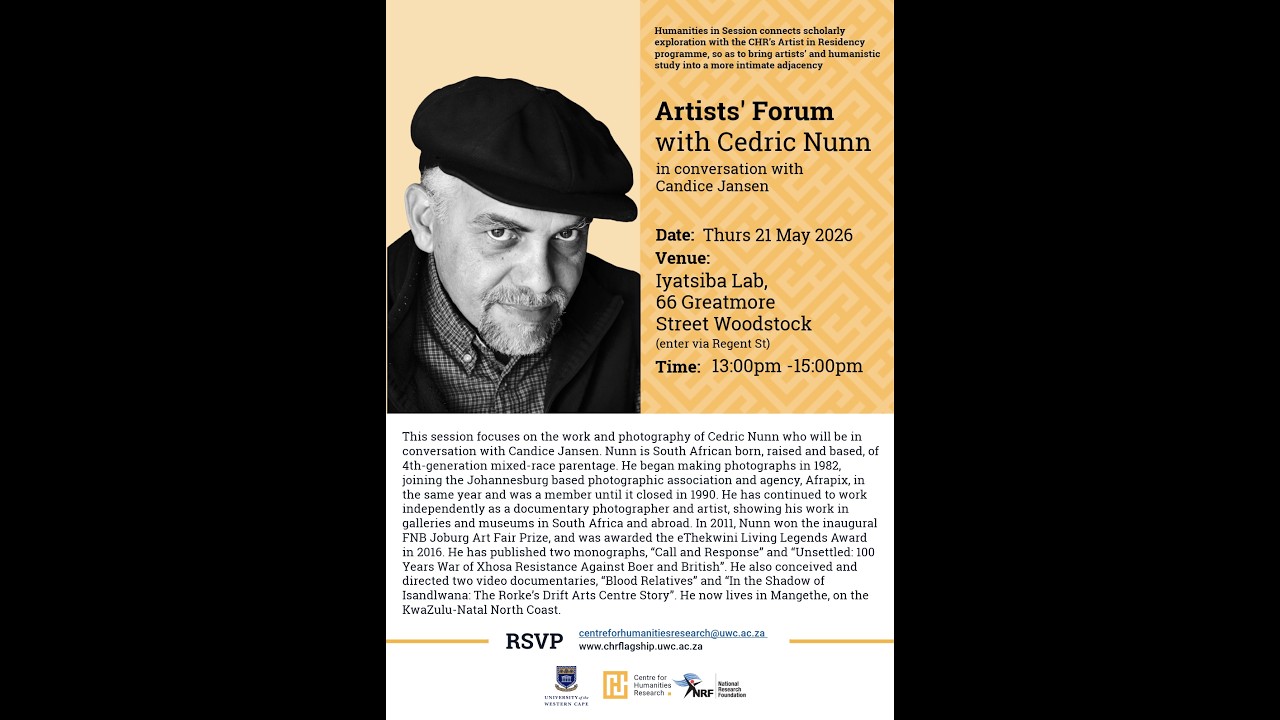
Humanities In Session | Cedric Nunn: Conversations, Thoughts, Experiments | 21 May 2026
Keywords
Summary
116 words
Critical Evaluation
Value of the Information & Strength of the Argument
The value of the information lies in Nunn’s firsthand accounts of documenting apartheid-era South Africa, offering unique perspectives on the role of photography in social struggle. His reflections on the ethical dilemmas of war photography and the personal toll of documenting violence provide deep insights. The argumentation is coherent, grounded in specific examples from his work, and enriched by his personal narrative. However, the conversational format sometimes lacks structured argumentation, and some points are not fully developed.
Scientific Rigor, Source Quality, Title Accuracy
The session is a primary source, featuring the artist himself, which lends authenticity. Nunn references his own exhibitions, publications, and documentaries, but no external sources are cited. The title accurately represents the content. The discussion is well-informed, but the lack of formal citations and the conversational nature limit its scientific rigor. No comments were provided for analysis.
149 words
Title / Content Match
The title accurately reflects the content: a session within the 'Humanities In Session' series featuring Cedric Nunn in conversation, covering his thoughts and experiments in photography.
Quality & Reliability
8/10
The session features an established photographer (Cedric Nunn) in conversation with an academic (Candice Jansen), providing firsthand accounts and reflections on documentary photography, apartheid, and post-apartheid South Africa. The discussion is grounded in Nunn's extensive career and specific works, offering authentic insights. However, it is a conversational format without formal citations or peer-reviewed sources, and the video has low viewership, limiting external validation.
Key Moments
Markers derived by PSI from the transcript: the creator did not define chapters.
- Introduction by Itumeleng Khumalo, welcoming Cedric Nunn and Candice Jansen.
- Candice Jansen introduces Cedric Nunn, sharing her personal connection to his work.
- Nunn begins discussing his early work 'Blood Relatives' and his exploration of identity.
- Nunn talks about his grandmother, Amy-Lou, and the long-term documentation of her life.
- Discussion of Nunn's work in KwaZulu-Natal during the state of emergency.
- Nunn reflects on his reluctance as a war photographer and the ethical dilemmas he faced.
- Nunn discusses his involvement with trade unions and his work in Durban.
- Nunn talks about his move to Johannesburg and his exhibition 'Johannesburg'.
- Nunn reflects on the post-apartheid era and his personal struggles with depression.
- Nunn discusses his current projects and the importance of documentary photography.
Cited Sources
- Centre for Humanities Research, UWC — Official website of the hosting institution, mentioned in the video description.
- Centre for Humanities Research, UWC on Facebook — Facebook page of the hosting institution, mentioned in the video description.
Concurring Sources
- Cedric Nunn - Wikipedia — Provides biographical information and overview of Nunn's career, consistent with the video content.
Contribution & Novelties
This session provides a rare, in-depth conversation with Cedric Nunn, offering insights into his photographic practice and the socio-political context of his work. It highlights the importance of documentary photography in preserving memory and challenging dominant narratives. The discussion of his grandmother’s long-term documentation as a unique project adds original value.
Pour aller plus loin :
- Afrapix — A photographers’ collective in South Africa that Nunn was part of, relevant to understanding the context of his early work.
- Black Consciousness Movement — A key influence on Nunn’s activism and photography.
- Liberation psychology — A psychological approach mentioned by Nunn, relevant to his personal reflections.
104 words
Radar Profile
The radar profile shows high scores in information quantity and quality, reflecting the rich content and authentic insights. The technical level is moderate, as the discussion is accessible but assumes some familiarity with South African history. Overall, the profile indicates a reliable and informative session.