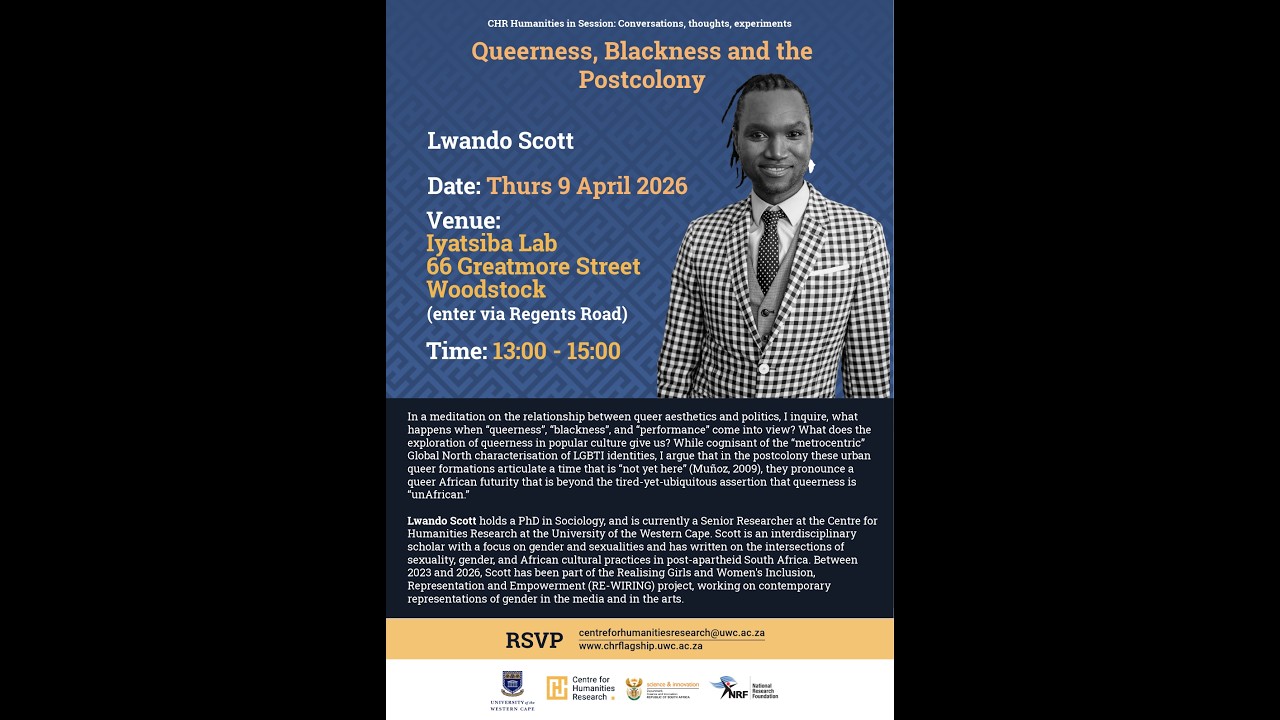
Humanities In Session | Lwando Scott: Queerness, Blackness And The Postcolony | 09 April 2026
Keywords
Summary
198 words
Critical Evaluation
Value of the Information & Strength of the Argument
The lecture provides valuable insights into the intersections of race, sexuality, and postcoloniality, drawing on a range of theoretical frameworks and empirical examples. Scott’s argument is well-structured, moving from personal research trajectory to broader theoretical considerations, and finally to concrete artistic case studies. He effectively uses the work of Nakhane and Desire Marea to illustrate his points about queer futurity and the political potential of aesthetics. The argumentation is solid, though at times it relies heavily on the authority of cited scholars rather than offering novel theoretical contributions. The lecture is particularly strong in its contextualization of queer struggles within South African history and its critique of the disarticulation of race from sexuality in postcolonial discourse.
Scientific Rigor, Source Quality, Title Accuracy
Scott demonstrates strong scholarly rigor by grounding his arguments in established academic literature, including works by Muñoz, Fanon, Barbara Smith, and others. He also references his own published work, which adds credibility. The sources are relevant and appropriately cited, though the lecture format limits the depth of engagement with each source. The title accurately reflects the content, and the lecture stays focused on the announced themes. The presentation is well-organized, with clear transitions between sections. However, the lecture is more of an overview of ongoing research than a fully developed argument, which may leave some questions unanswered.
228 words
Title / Content Match
The title accurately reflects the content, which explores the intersections of queerness, blackness, and postcoloniality in South Africa.
Quality & Reliability
8/10
The lecture is delivered by a senior researcher with a PhD in Sociology, and it draws on established academic frameworks (e.g., Muñoz, Fanon, Smith) and the speaker's own published work. The arguments are well-structured and grounded in scholarly discourse, though the presentation is primarily an oral exposition rather than a peer-reviewed publication.
Key Moments
Markers derived by PSI from the transcript: the creator did not define chapters.
- Introduction of Dr. Lwando Scott by Linda, highlighting his academic background and research focus.
- Scott introduces his research on 'queering the postcolony' and his previous publications.
- Discussion of the 'transformative constitutionalism' project and his work on transgender lives.
- Scott discusses Simon Nkoli and the linking of anti-apartheid and sexual struggles.
- Critique of the disarticulation of race from sexuality in postcolonial Africa, referencing Fanon and Barbara Smith.
- Introduction of the analysis of queer black artists Nakhane and Desire Marea.
- Discussion of Muñoz's concept of queer futurity and its application to African contexts.
- Analysis of Nakhane's music video 'Interloper' and Desire Marea's 'You Think I'm Horny'.
- Conclusion: Scott calls for imagining queer African futures and emphasizes the importance of aesthetics in politics.
Cited Sources
- Cruising Utopia: The Then and There of Queer Futurity — Scott references Muñoz's concept of queer futurity throughout the lecture.
- Black Skin, White Masks — Scott discusses Fanon's work on the black body and homosexuality.
- The Wound (film) — Scott mentions the controversy over the film The Wound in his earlier work.
- Nakhane - Interloper (Official Music Video) — Scott analyzes Nakhane's music video as an example of black queer aesthetics.
- Desire Marea - You Think I'm Horny (Official Music Video) — Scott analyzes Desire Marea's music video as an example of black queer aesthetics.
Concurring Sources
- Queer African Futurity — Scott's argument aligns with broader scholarship on queer African futures, though no specific source is cited.
Dissenting Sources
- Anti-homosexuality legislation in Africa — Scott's critique of postcolonial anti-homosexuality laws is contrasted with the existence of such laws in several African countries, which he mentions.
Contribution & Novelties
The lecture offers a nuanced perspective on the intersections of queerness, blackness, and postcoloniality, particularly in the South African context. Scott’s emphasis on the disarticulation of race from sexuality in postcolonial discourse and his call for a queer African futurity contribute to ongoing debates in queer theory and African studies. His analysis of Nakhane and Desire Marea’s work provides concrete examples of how aesthetics can envision alternative futures.
Pour aller plus loin :
- Queer Theory — Provides foundational concepts for understanding queer futurity and aesthetics.
- Postcolonialism — Contextualizes the lecture’s discussion of the postcolony and its legacies.
- José Esteban Muñoz — Key theorist of queer futurity, whose work is central to Scott’s argument.
- Simon Nkoli — Historical figure discussed in the lecture, linking anti-apartheid and queer activism.
127 words
Radar Profile
The radar profile shows high scores in quantity and quality of information, reflecting the lecture's depth and scholarly grounding. The technical level is moderate, indicating accessibility to a general academic audience. Overall, the lecture is well-balanced, with strong content and reliability.
💬 No comments were provided for analysis.