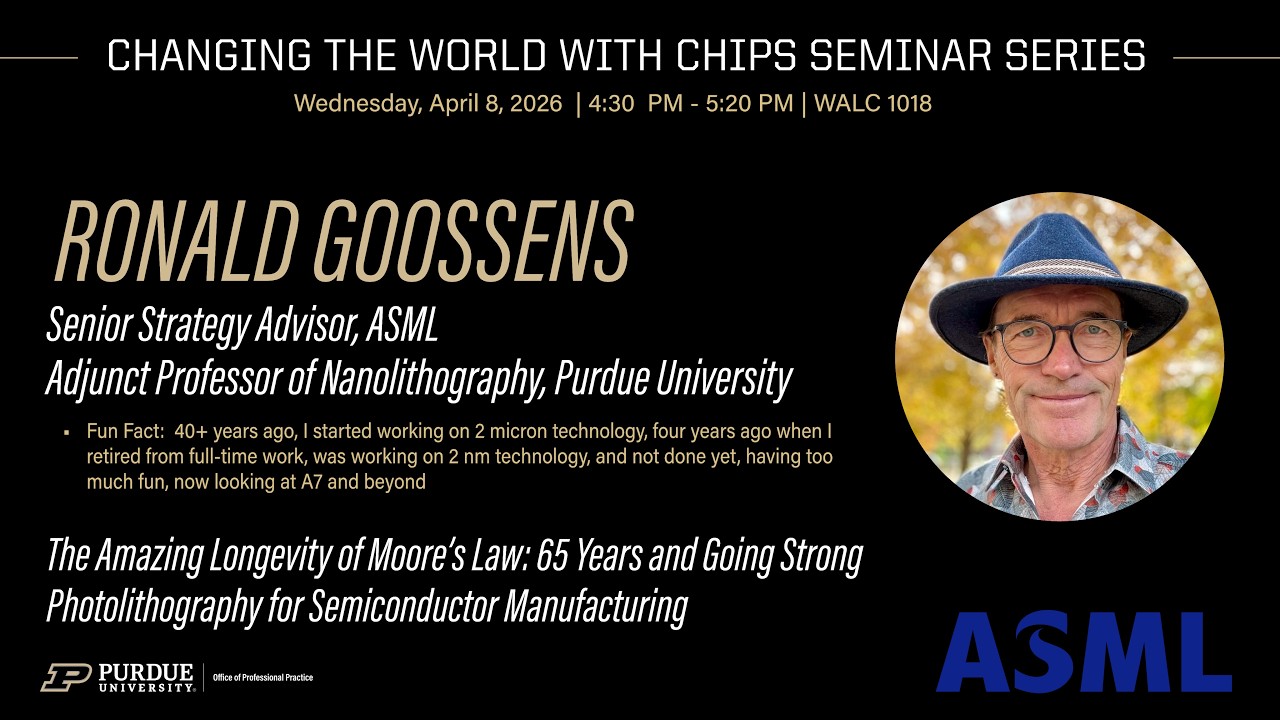
The Amazing Longevity of Moore's Law: 65 Years and Going Strong
Keywords
Summary
168 words
Critical Evaluation
Value of the Information & Strength of the Argument
The lecture provides valuable insights into the history and physics of photolithography, with a strong emphasis on the engineering challenges and solutions. The speaker’s personal experience adds credibility and depth. The argumentation is logical, tracing the evolution of lithography techniques and explaining the scientific principles behind each advancement. The use of the Rayleigh criterion as a unifying framework is effective. However, the presentation is largely anecdotal and lacks rigorous citations, relying on the speaker’s authority rather than external evidence.
88 words
Title / Content Match
The title accurately reflects the content, which focuses on the history and physics of Moore's Law and its continuation through lithography advancements.
Quality & Reliability
8/10
The lecture is delivered by a retired ASML engineer with over 40 years of experience in lithography, providing a first-hand account of technological developments. The content aligns with established scientific principles and historical facts, though it is presented from a corporate perspective and lacks formal citations.
Key Moments
Markers derived by PSI from the transcript: the creator did not define chapters.
- Introduction: speaker's background and overview of Moore's Law.
- Explanation of the planar MOSFET and its significance.
- Gordon Moore's original prediction and its accuracy.
- Introduction of the Rayleigh criterion and its application to lithography.
- Evolution of light sources: from mercury lamps to excimer lasers.
- Immersion lithography and its benefits.
- Challenges of EUV: reflective optics and mirror precision.
- History of EUV development and ASML's investment.
- Impact on transistor counts and yield improvements.
Cited Sources
- Moore's Law original paper (1965) — Referenced when discussing Gordon Moore's prediction.
- ASML official website — Mentioned as the company where the speaker worked.
Concurring Sources
- Moore's Law original paper (1965) — Supports the historical accuracy of Moore's prediction.
- ASML official website — Confirms ASML's role in EUV development.
Contribution & Novelties
The lecture offers a unique first-hand perspective on the evolution of lithography, particularly the development of EUV technology. It provides a clear explanation of the physics behind resolution improvements and the engineering challenges overcome. The speaker’s personal anecdotes add value, but the content is largely a historical overview rather than presenting new research.
Pour aller plus loin :
- Moore’s Law — Overview of the observation and its implications.
- Photolithography — Detailed explanation of the process.
- Extreme ultraviolet lithography — In-depth look at EUV technology.
- Rayleigh criterion — The resolution limit formula.
- Ernst Abbe — Contributions to optics.
97 words
Radar Profile
The radar profile shows high scores in quantity and quality of information, reflecting the speaker's expertise and the depth of content. The technical level is high but accessible, and the reliability is strong due to the speaker's direct involvement. The overall profile indicates a well-rounded and informative lecture.