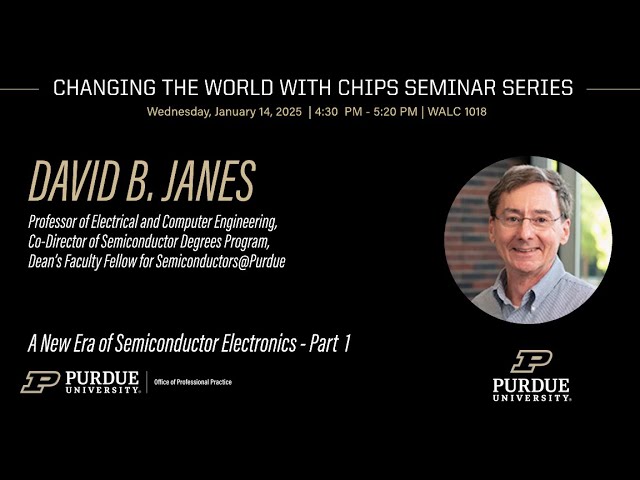
A New Era of Semiconductor Electronics - Part 1
Keywords
Summary
155 words
Critical Evaluation
Value of the Information & Strength of the Argument
The video provides a solid introduction to semiconductor technology, with clear explanations of key concepts such as conductivity, transistors, and integrated circuits. The speaker uses relatable analogies (e.g., comparing wafer size to a dinner plate) and historical anecdotes to engage the audience. The argumentation is coherent and logically structured, moving from basic definitions to historical milestones and then to manufacturing processes. The value lies in its educational content, making complex topics accessible to beginners. However, it lacks depth in certain areas, such as the specifics of the CHIPS Act and advanced semiconductor physics, but this is appropriate for an introductory course.
Scientific Rigor, Source Quality, Title Accuracy
The scientific rigor is high, as the speaker is a credible academic and the content aligns with established knowledge in the field. However, no specific sources are cited within the video, which limits the ability to verify claims independently. The title accurately reflects the content, which introduces the new era of semiconductor electronics. The video is well-structured and informative, though it does not delve into controversial or cutting-edge topics. The lack of citations is a minor weakness, but the overall reliability is good.
199 words
Title / Content Match
The title accurately reflects the content, which introduces the new era of semiconductor electronics, covering history, basics, and industry context.
Quality & Reliability
8/10
The video is an introductory lecture by a Purdue professor, providing a broad overview of semiconductor technology and industry. It is scientifically accurate, well-structured, and based on established historical facts and industry knowledge. The speaker is credible (co-director of semiconductor degree program). No specific sources are cited, but the content aligns with standard knowledge in the field.
Key Moments
Markers derived by PSI from the transcript: the creator did not define chapters.
- Introduction and welcome to the course
- Discussion of the CHIPS Act and its goals
- Explanation of what semiconductors are
- Historical overview: vacuum tubes and early electronics
- The invention of the transistor at Bell Labs
- Development of integrated circuits and early radios
- Introduction to MOSFETs and CMOS technology
- Manufacturing process: photolithography and wafer processing
- Scale of modern chips and industry overview
- Conclusion and preview of future sessions
Contribution & Novelties
The video provides a comprehensive introduction to semiconductor electronics, covering historical milestones and basic concepts. Its novelty lies in its educational approach, making the subject accessible to a broad audience. It does not present new research but serves as a foundational resource.
Pour aller plus loin :
- Transistor — Historical and technical overview of the transistor.
- Integrated circuit — Explanation of IC development and significance.
- MOSFET — Detailed description of MOSFET operation and types.
- CHIPS and Science Act — Overview of the US legislation mentioned in the video.
88 words
Radar Profile
The radar profile shows high scores in information quality and reliability, moderate in quantity and technical level, indicating a well-balanced introductory lecture that is accurate but not overly technical.