HRI Seminar Series April 9 2026 | Honour Student Presentations
Keywords
Summary
153 words
Critical Evaluation
Value of the Information & Strength of the Argument
The value of the information lies in its focus on under-researched populations and contexts: international students in northern BC and long-term care staff during COVID-19. Both studies provide qualitative insights that are often missing from quantitative health research, offering rich, contextualized data. The argumentation is solid, with clear research questions, appropriate qualitative methods, and findings that are well-connected to existing literature. The presenters effectively use frameworks like intersectionality to interpret their results, adding depth to the analysis. However, the small sample sizes and the fact that these are undergraduate theses limit the generalizability and robustness of the conclusions. The argumentation is coherent but could be strengthened by more explicit discussion of limitations and potential biases.
Scientific Rigor, Source Quality, Title Accuracy
The scientific rigor is generally good for undergraduate-level research. Both studies use established qualitative methods (thematic analysis) and provide detailed descriptions of their processes. The literature reviews are referenced, and the presenters acknowledge gaps in existing research. However, the sources cited are not explicitly listed in the video, so the quality of sources cannot be fully assessed. The title accurately reflects the content, which is a seminar featuring honour student presentations. The presentations are well-structured and adhere to academic conventions, but the lack of peer review and the preliminary nature of the findings reduce the overall rigor. The Q&A session adds value by allowing for clarification and further discussion, but it also reveals some limitations, such as the absence of participants with chronic conditions in the first study.
258 words
Title / Content Match
The title accurately reflects the content: it is a seminar series featuring honour student presentations.
Quality & Reliability
7/10
The video presents two undergraduate honour theses with qualitative methodologies, clear research questions, and transparent methods. However, the sample sizes are small and the findings are preliminary, limiting generalizability. The presentations are well-structured and grounded in existing literature, but the lack of peer review and the limited scope of the studies reduce the overall reliability.
Key Moments
Markers derived by PSI from the transcript: the creator did not define chapters.
- Introduction and land acknowledgement
- Overview of HRI seminar series and announcements
- Introduction of first speaker, Gurat Gil
- First presentation begins: background and research gap
- First presentation: methods and findings
- First presentation: discussion and conclusion
- Q&A session for first presentation
- Introduction of second speaker, Rachel Smith
- Second presentation begins: background and literature review
- Second presentation: methods and themes
- Second presentation: discussion and conclusion
- Closing remarks and thank you
Contribution & Novelties
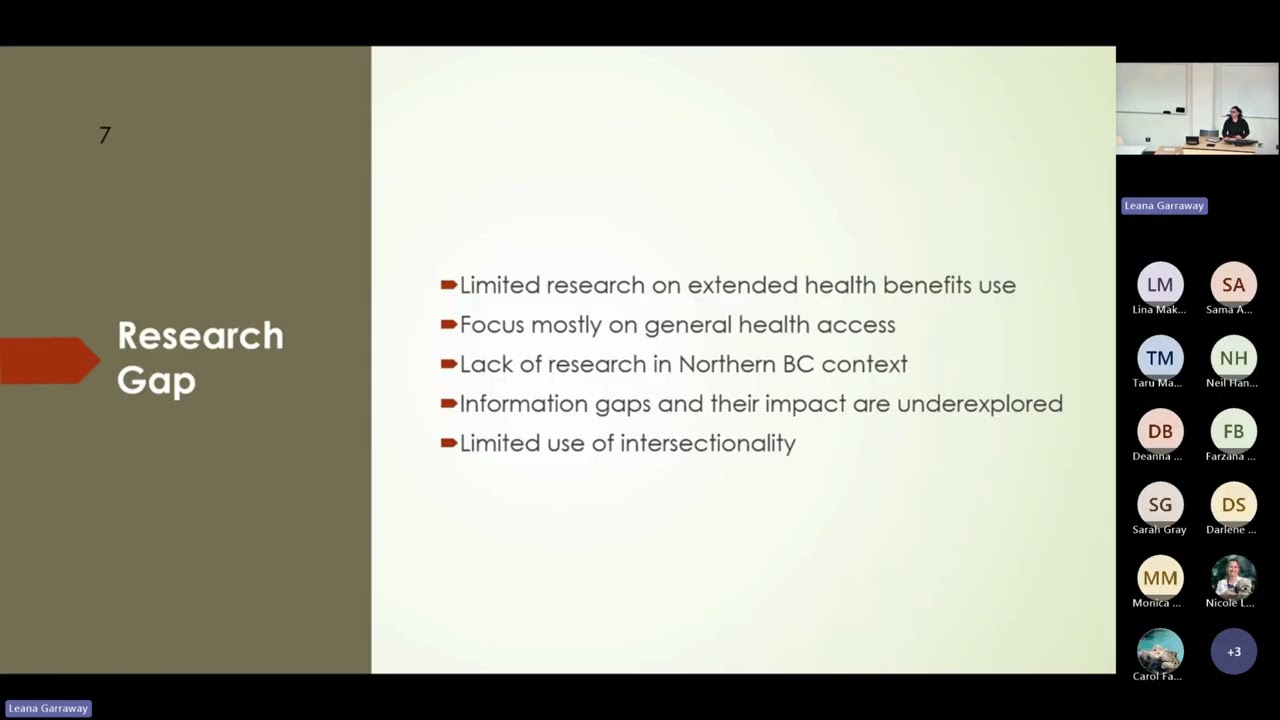
The video provides original research from undergraduate honour students, offering new insights into healthcare access for international students in northern BC and the experiences of long-term care staff during COVID-19 outbreaks. The first study addresses a gap in research on extended health benefits, while the second provides a regional perspective on a well-documented issue. Both studies use qualitative methods to capture lived experiences, adding depth to the existing literature. The presentations also highlight the importance of intersectionality in understanding healthcare access and the need for tailored interventions.
Pour aller plus loin :
- Intersectionality — A key framework used in the first study to analyze overlapping factors shaping healthcare access.
- COVID-19 pandemic in Canada — Provides context for the second study on long-term care facilities.
- Long-term care in Canada — Background on the challenges faced by long-term care facilities during the pandemic.
- International students in Canada — Relevant to the first study on international students’ healthcare access.
156 words
Radar Profile
The radar profile shows a balanced performance across all dimensions, with slightly higher scores in quality of information and fiabilite, reflecting the solid qualitative methodology and clear presentation. The lower score in niveau technique suggests the content is accessible to a general audience, while quantite_information is moderate due to the limited scope of the studies.