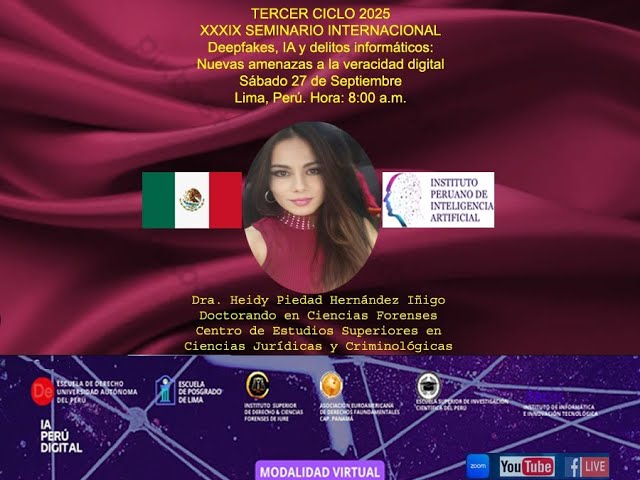
Deepfakes, IA y delitos informáticos: Nuevas amenazas a la veracidad digital
Keywords
Summary
166 words
Critical Evaluation
Value of the Information & Strength of the Argument
The value of the information lies in providing a clear, accessible introduction to digital forensics, covering essential procedures and tools. The speaker effectively uses analogies and case studies to illustrate key points, making the content engaging for non-experts. However, the argumentation is largely descriptive rather than analytical, with limited critical evaluation of the methods or their limitations. The presentation would benefit from more concrete examples of deepfake detection and AI-specific forensic challenges, as the title suggests. The reliance on anecdotal cases, while illustrative, does not provide robust scientific evidence for the effectiveness of the described techniques.
Scientific Rigor, Source Quality, Title Accuracy
The scientific rigor is moderate; the speaker references legal frameworks (Mexican Code, GDPR) and mentions tools used in practice, but does not cite specific academic studies or peer-reviewed sources. The quality of sources is acceptable for an introductory talk, but the lack of citations weakens the scientific credibility. The title is somewhat misleading as the content focuses more on general digital forensics than on deepfakes and AI specifically. The speaker’s expertise is evident, but the presentation would benefit from more precise terminology and up-to-date references on AI-related threats.
199 words
Title / Content Match
The title promises a focus on deepfakes, AI, and cybercrimes, but the content primarily covers general digital forensics, with only brief mentions of deepfakes and AI. The title is somewhat misleading.
Quality & Reliability
6/10
The presentation is an expert opinion by a forensic science doctoral candidate, providing a general overview of digital forensics, tools, and legal frameworks. It lacks depth on deepfakes and AI-specific threats, and includes some inaccuracies (e.g., 'G blocker' vs 'write blocker'). The content is largely introductory and relies on anecdotal examples rather than rigorous scientific evidence.
Key Moments
Markers derived by PSI from the transcript: the creator did not define chapters.
- Introduction to digital forensics and its importance.
- Explanation of bits and digital data.
- Step-by-step forensic process: identification, preservation, analysis.
- Discussion of write blockers and forensic imaging.
- Overview of forensic tools: EnCase, FTK, Autopsy, Wireshark, Volatility.
- Case study: Pemex ransomware attack.
- Explanation of IP addresses and VPNs.
- Case study: cyberstalking and VPN misconfiguration.
- Conclusion and call for more digital forensic experts.
Cited Sources
- Código Nacional de Procedimientos Penales (Mexico) — Referenced for legal framework on evidence preservation and chain of custody.
- General Data Protection Regulation (GDPR) — Referenced for data protection requirements in the EU.
Concurring Sources
- Digital Forensics: An Introduction — General agreement on the importance of forensic procedures.
Dissenting Sources
- Deepfake detection: A survey — The video does not address specific deepfake detection techniques, which are complex and evolving.
Contribution & Novelties
The presentation provides a basic overview of digital forensics, emphasizing the importance of evidence integrity and chain of custody. It introduces common tools and techniques, but does not offer novel insights or advanced methodologies. The discussion of deepfakes and AI is superficial, lacking specific detection techniques or case studies.
Pour aller plus loin :
- Deepfake detection methods — Overview of deepfake technology and detection challenges.
- Digital forensics process — Detailed explanation of forensic procedures and standards.
- Chain of custody — Importance of maintaining evidence integrity in legal contexts.
88 words
Radar Profile
The radar profile shows moderate scores across all dimensions, with slightly higher scores in quantity of information and reliability, but lower in technical level and quality. This indicates a balanced but introductory presentation, suitable for a general audience but lacking depth for experts.
💬 No comments were provided for analysis.