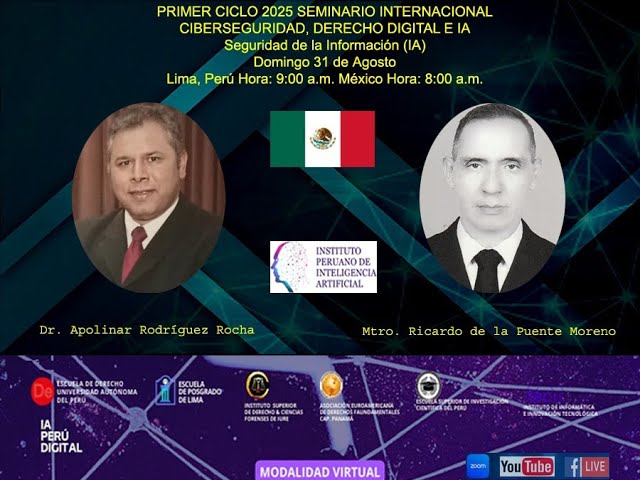
Seguridad de la Información (IA)
Keywords
Summary
182 words
Critical Evaluation
Value of the Information & Strength of the Argument
The value of the information lies in its clear articulation of digital rights and the legal framework surrounding information security, which is useful for a general audience. The argumentation is based on the speakers’ professional experience and legal expertise, but it lacks empirical data or case studies to strengthen the claims. The discussion is more descriptive than analytical, and the speakers often rely on general statements without deep technical or scientific backing. The argumentation is coherent but not particularly rigorous, as it does not engage with counterarguments or provide evidence for the assertions made.
Scientific Rigor, Source Quality, Title Accuracy
The scientific rigor is moderate: the speakers are qualified, but they do not cite specific sources or studies during the presentation. The quality of sources is limited to their own expertise and general references to legal frameworks. The title ‘Seguridad de la Información (IA)’ is somewhat broad, and the content does not delve deeply into AI-specific security issues, focusing more on general information security and digital rights. The adequacy between title and content is acceptable but not precise. No comments were provided for analysis.
193 words
Title / Content Match
The title 'Seguridad de la Información (IA)' is broad and the content covers information security and AI from a legal and regulatory perspective, which is consistent but not deeply technical.
Quality & Reliability
6/10
The presentation is largely an expert opinion with a legal and regulatory focus, but it lacks rigorous scientific depth and specific data. The speakers are qualified in law and cybersecurity, but the content is general and sometimes anecdotal. No concrete sources are cited, and the discussion is more conceptual than technical.
Key Moments
Markers derived by PSI from the transcript: the creator did not define chapters.
- Introduction and welcome by the Peruvian Institute, presentation of speakers.
- Dr. Apolinar Rodríguez introduces himself and his background in law and digital media.
- Mtro. Ricardo de la Puente introduces himself, his experience in IT and cybersecurity.
- Discussion on digital citizenship and the need for security as a human right.
- Overview of digital rights: universal access, privacy, freedom of expression, etc.
- Explanation of the pillars of security: confidentiality, integrity, availability, and authenticity.
- Discussion on dimensions of protection: network, cloud, terminals, and the role of service providers.
- Further elaboration on legal aspects and the need for regulation.
- Q&A or concluding remarks (if any).
Contribution & Novelties
The presentation offers a legal and human rights perspective on information security, which is valuable for understanding the regulatory and ethical dimensions. It emphasizes the concept of digital citizenship and the state’s role in guaranteeing digital rights. However, it does not introduce novel technical concepts or research findings.
Pour aller plus loin :
- Digital rights — Overview of digital rights and their evolution.
- Information security — Foundational concepts of information security.
- Right to be forgotten — Legal concept discussed in the context of data protection.
85 words
Radar Profile
The radar profile shows moderate scores across all dimensions, indicating a balanced but not exceptional presentation. The strengths lie in the quantity of information and the legal perspective, while technical depth and source reliability are weaker.