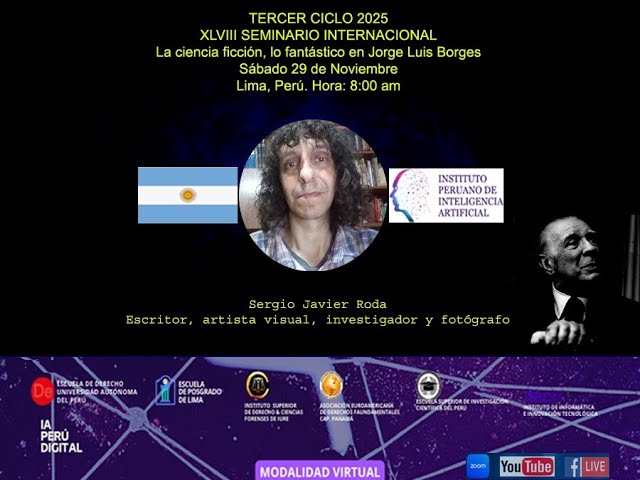
La ciencia ficción, lo fantástico en Jorge Luis Borges
Keywords
Summary
150 words
Critical Evaluation
Value of the Information & Strength of the Argument
The value of the information lies in its insightful connections between Borges’s literary techniques and science fiction tropes, such as the use of ’thinking machines’ and the anticipation of digital universes. Roda’s argument is coherent and well-structured, but it relies heavily on personal concepts and analogies rather than on rigorous textual evidence or scholarly sources. The speaker’s enthusiasm and deep familiarity with Borges’s work are evident, but the lack of citations weakens the overall argumentative solidity.
Scientific Rigor, Source Quality, Title Accuracy
The presentation demonstrates a good understanding of Borges’s oeuvre and its literary context, but it lacks rigorous sourcing. Roda mentions various authors and works (e.g., H.G. Wells, Chesterton, Olaf Stapledon) but does not provide specific references or citations. The title accurately reflects the content, and the speaker’s expertise is apparent, but the absence of verifiable sources reduces the scientific rigor. No comments were provided for analysis.
157 words
Title / Content Match
The title accurately reflects the content, which focuses on science fiction and the fantastic in Borges's literature.
Quality & Reliability
6/10
The speaker demonstrates deep knowledge of Borges's work and literary theory, but the presentation is largely interpretive and lacks rigorous citations or verifiable sources. The argument is coherent but relies heavily on personal concepts and analogies.
Key Moments
Markers derived by PSI from the transcript: the creator did not define chapters.
- Introduction and thanks to the Instituto Peruano de Inteligencia Artificial.
- Discussion of Borges's early influences, including his father's library and the concept of the 'universe'.
- Introduction of the 'Borges genre' and the idea of a unique literary methodology.
- Analysis of Borges's use of 'semiotic invasion' in 'Tlön, Uqbar, Orbis Tertius'.
- Comparison of Borges to Leonardo da Vinci as a creator of 'thinking machines'.
- Discussion of Borges's anticipation of the internet and multiverses in his works.
- Exploration of Borges's appropriation of detective fiction and Chesterton's influence.
- Conclusion and summary of Borges's legacy as a visionary inventor.
Cited Sources
- Borges's works (e.g., Ficciones, El Aleph) — Mentioned as primary sources for the analysis.
- H.G. Wells's science fiction — Cited as an influence on Borges's technique.
- Chesterton's detective fiction — Cited as an influence on Borges's logical rigor.
Concurring Sources
- Borges and Science Fiction — General scholarly consensus on Borges's influence on speculative fiction.
Dissenting Sources
- Critics who argue Borges is not science fiction — Some literary critics contend that Borges's work should not be classified as science fiction, as it lacks traditional genre elements.
Contribution & Novelties
The presentation offers a novel perspective on Borges’s relationship with science fiction, proposing that he created a unique genre that blends metaphysical speculation with traditional science fiction elements. Roda introduces the concept of ’thinking machines’ and compares Borges to Leonardo da Vinci, highlighting his anticipatory vision. The talk also emphasizes Borges’s technique of ‘semiotic invasion’ and his influence on modern technology and AI.
Pour aller plus loin :
- Jorge Luis Borges — Overview of Borges’s life and works.
- Science fiction — Definition and history of the genre.
- Metaphysics — Philosophical background relevant to Borges’s themes.
- Intertextuality — Concept related to Borges’s literary techniques.
- The Library of Babel — Specific work discussed in the talk.
114 words
Radar Profile
The radar profile shows moderate scores across all dimensions, indicating a balanced but not exceptional presentation. The quantity of information is relatively high, but the quality and reliability are moderate due to the lack of citations. The technical level is moderate, suitable for a general audience.