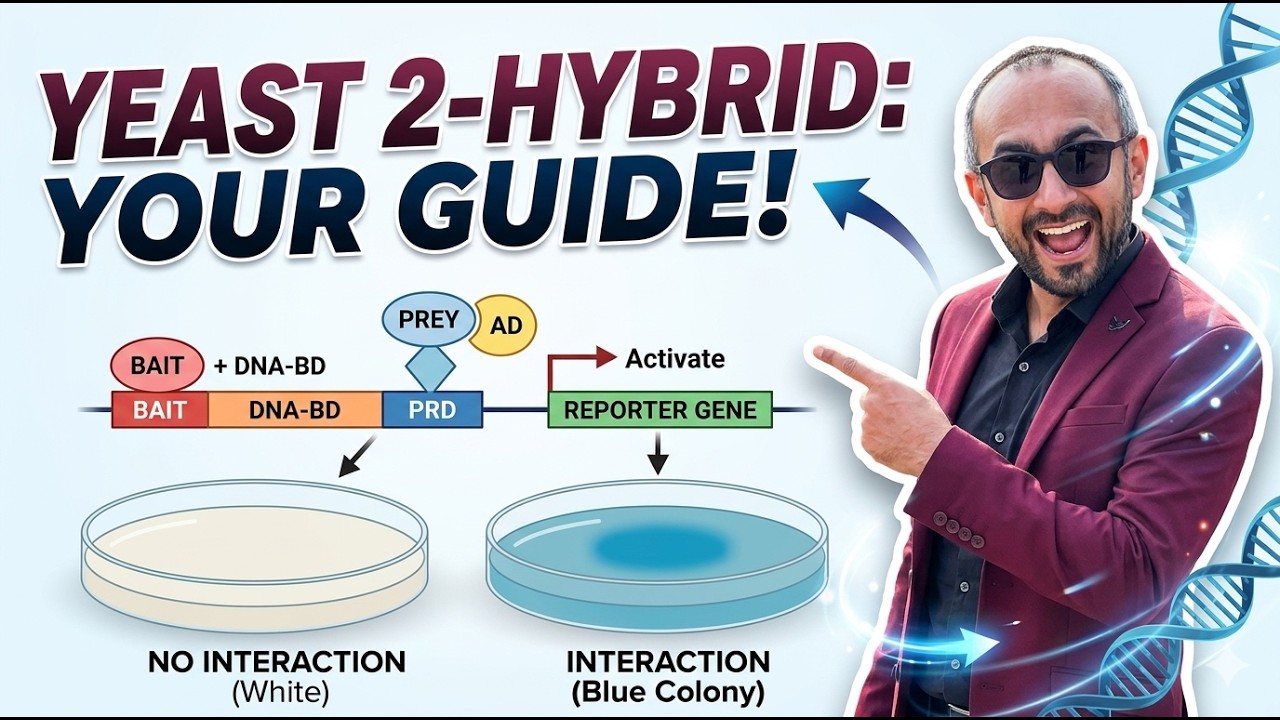
Yeast 2 Hybrid System | Protein-Protein Interactions | PENS#111
Keywords
Summary
179 words
Critical Evaluation
Value of the Information & Strength of the Argument
The video provides a solid introduction to the yeast two-hybrid system, explaining the underlying logic clearly and systematically. It effectively uses diagrams and step-by-step reasoning to illustrate how the technique works, from the modular nature of transcription factors to the detection of interactions via reporter gene expression. The argumentation is coherent and builds logically, making it accessible to beginners. However, it does not delve into quantitative aspects or comparative analysis with other methods, and it lacks discussion of recent variations like membrane Y2H or high-throughput screening. The value lies in its pedagogical clarity, but it offers limited depth for advanced practitioners.
Scientific Rigor, Source Quality, Title Accuracy
The video is scientifically accurate and well-structured, but it does not cite specific sources or references. The title accurately reflects the content, which is a focused lecture on the Y2H system. The description mentions that it is part of a ‘Protein Engineering’ series, but no external references are provided. The lack of citations reduces its utility for verification, though the content aligns with established knowledge in molecular biology. The video does not include any commercial or promotional content.
194 words
Title / Content Match
The title accurately reflects the content, which is a detailed lecture on the yeast two-hybrid system for detecting protein-protein interactions.
Quality & Reliability
7/10
The video provides a clear and accurate explanation of the yeast two-hybrid system, covering principles, methodology, and limitations. The content is scientifically sound, but lacks citations to primary literature and does not discuss recent advancements or variations of the technique.
Key Moments
Markers derived by PSI from the transcript: the creator did not define chapters.
- Introduction to protein-protein interactions and the need for in vivo detection methods.
- Explanation of the GAL4 transcription factor and its modular domains (BD and AD).
- Construction of bait and prey vectors by fusing proteins to BD and AD.
- Transformation into yeast and the principle of interaction-dependent reporter gene activation.
- Detection using lacZ reporter and X-gal substrate, resulting in blue colonies.
- Discussion of limitations: auto-activation, false positives/negatives, and nuclear localization issues.
Contribution & Novelties
The video offers a clear and concise tutorial on the yeast two-hybrid system, which is a foundational technique in molecular biology. It provides a step-by-step explanation that is particularly useful for students and researchers new to the method. The content is accurate but does not introduce novel concepts or recent advancements. For further exploration, the following resources are recommended:
Pour aller plus loin :
- Yeast two-hybrid screen - Wikipedia — Provides a comprehensive overview and history of the technique.
- Fields and Song (1989) - Nature — The original paper describing the yeast two-hybrid system.
- Membrane yeast two-hybrid (MYTH) - PMC article — Discusses adaptations for membrane proteins.
- Interactome mapping - Nature Reviews Molecular Cell Biology — Reviews large-scale protein interaction mapping.
121 words
Radar Profile
The radar profile shows balanced scores across all dimensions, with slightly higher quality of information and technical level, indicating a well-structured educational video. The lower quantity of information and global reliability reflect the lack of citations and depth, but overall it is a reliable introductory resource.