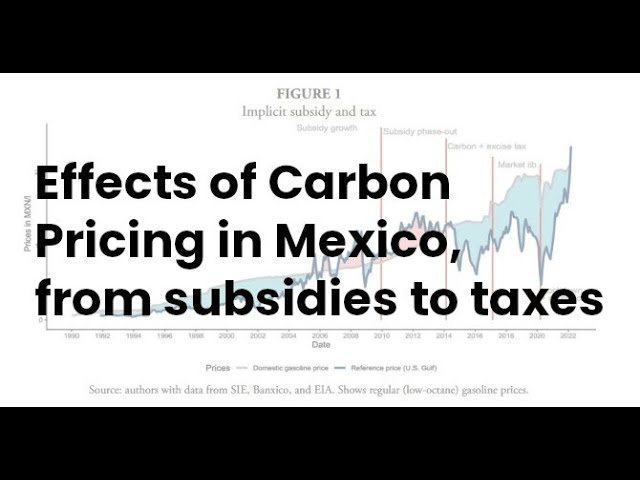
Effects of Carbon Pricing in Mexico, from subsidies to taxes
Keywords
Summary
190 words
Critical Evaluation
Value of the Information & Strength of the Argument
The presentation provides valuable insights into the design and implementation of carbon pricing in a middle-income country. The argumentation is solid, based on empirical data and a clear logical framework. The speaker effectively explains the political economy constraints and the gradualist approach, which is often overlooked in policy discussions. The use of counterfactual analysis strengthens the argument, showing the impact of the reforms. However, the presentation is largely from a single perspective and does not delve into potential criticisms or alternative viewpoints.
Scientific Rigor, Source Quality, Title Accuracy
The scientific rigor is high, as the talk is based on a peer-reviewed article published in the Economics of Energy and Environmental Policy. The speaker cites specific data and provides a detailed account of policy changes. The title accurately reflects the content. The presentation is well-structured and the speaker’s expertise is evident. However, the lack of independent verification and the reliance on the speaker’s own research may introduce bias. The sources cited are primarily the article and the speaker’s own work, with no external references provided.
183 words
Title / Content Match
The title accurately reflects the content, which focuses on Mexico's transition from fossil fuel subsidies to carbon taxes.
Quality & Reliability
8/10
The speaker is a recognized expert with relevant academic and policy experience. The presentation is based on a peer-reviewed article and provides detailed data and analysis. However, it is a single perspective and lacks independent verification.
Key Moments
Markers derived by PSI from the transcript: the creator did not define chapters.
- Introduction: Mexico's fossil fuel subsidies and the need for carbon pricing.
- Historical context: Subsidies since the 1950s and the role of PEMEX.
- Distributional effects of subsidies: regressive impact on income distribution.
- Gradual phase-out of subsidies and the political economy of the decision.
- Introduction of the carbon tax in 2014 and its symbolic role.
- Energy reform and price liberalization: moving towards market prices.
- Impact on tax revenues and progressivity of carbon taxation.
- Resilience of the tax structure during COVID-19 and Ukraine crisis.
- Implicit vs explicit carbon pricing: the role of excise taxes.
- Environmental impact: reduction in gasoline and diesel consumption.
Cited Sources
- From Negative to Positive Carbon Pricing in Mexico — The article on which the webinar is based, published in Economics of Energy and Environmental Policy 11(2).
Concurring Sources
- World Bank Carbon Pricing Dashboard — Provides data on carbon pricing initiatives worldwide, including Mexico.
Contribution & Novelties
The webinar provides a detailed case study of Mexico’s transition from fossil fuel subsidies to carbon pricing, highlighting the gradualist approach and the importance of implicit carbon pricing through excise taxes. It offers insights into the political economy of such reforms and their distributional effects.
Pour aller plus loin :
- Carbon pricing — Overview of carbon pricing mechanisms.
- Fossil fuel subsidies — Background on subsidies and their impacts.
- Social cost of carbon — Concept used to value carbon emissions.
79 words
Radar Profile
The radar profile shows high scores in information quantity, quality, and reliability, with a slightly lower technical level. This indicates a well-informed and credible presentation that is accessible to a broad audience.
💬 No comments were provided for analysis.