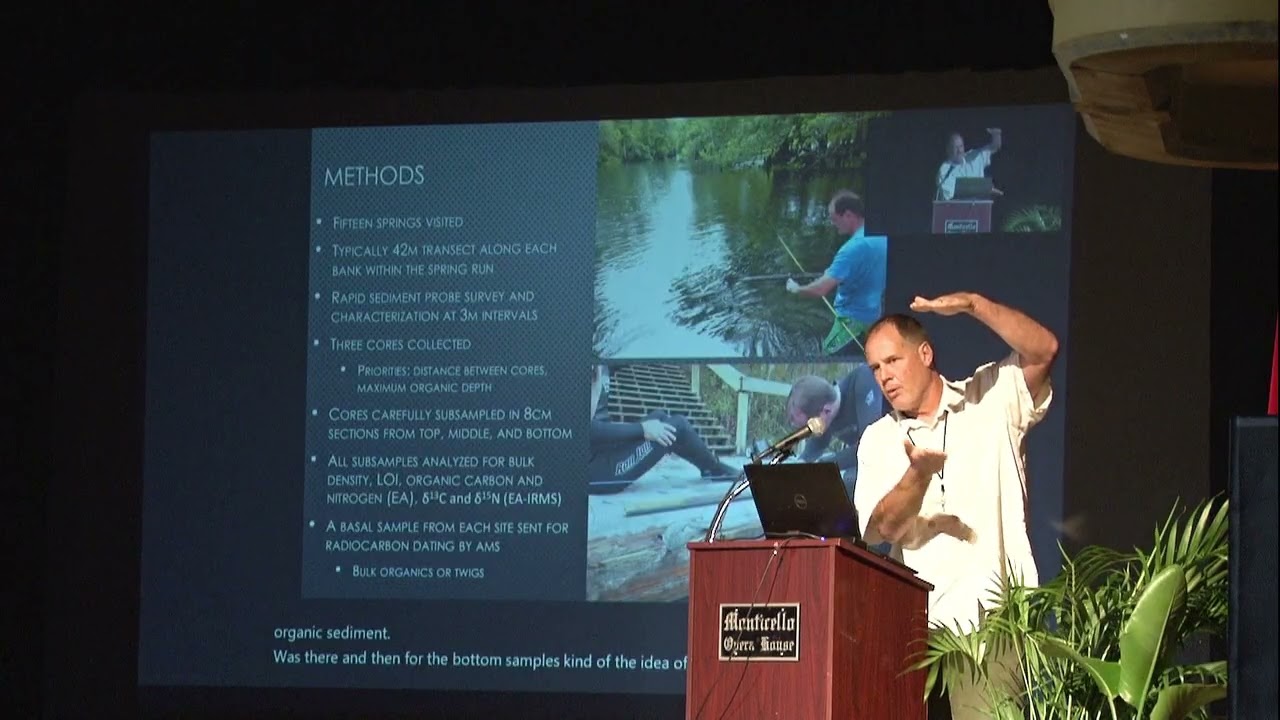
ARI 2025 WATER-WIND-FIRE Conference Ben Tanner
Keywords
Summary
127 words
Critical Evaluation
Value of the Information & Strength of the Argument
The presentation provides valuable data on the age and depth of organic sediments in Florida springs, which is important for understanding nutrient dynamics and paleoenvironmental history. The argumentation is solid, based on empirical evidence from radiocarbon dating and multiproxy analyses. The speaker acknowledges limitations, such as out-of-stratigraphic-order dates and the coarse nature of the initial survey, which strengthens credibility. The conclusion that organic sediments are not a recent nutrient source is well-supported by the long accumulation histories.
86 words
Title / Content Match
The title accurately reflects the content, which focuses on organic sediment accumulation in Florida spring runs.
Quality & Reliability
8/10
The presentation is based on original research with radiocarbon dating and multiproxy core analysis, published in 2020. The methodology is sound, and the speaker acknowledges limitations and out-of-stratigraphic-order dates. However, the talk is a conference presentation and not peer-reviewed in itself.
Key Moments
Markers derived by PSI from the transcript: the creator did not define chapters.
- Introduction and acknowledgments
- Background on Florida springs and threats
- Research questions and methodology
- Results from individual springs
- Radiocarbon dates and organic matter content
- Stable isotopes and carbon-nitrogen ratios
- Wakiva Spring detailed core analysis
- Implications and future research directions
Cited Sources
- Organic Sediment Accumulation Within Spring Runs Associated with the St. Johns, Santa Fe, and Suwannee Rivers — The study presented in the talk, published in 2020.
Concurring Sources
- Florida Springs and Manganese — General information on Florida springs and their ecosystems.
Contribution & Novelties
The research provides new data on the age and depth of organic sediments in Florida spring runs, highlighting their potential as paleoenvironmental archives. It challenges the assumption that recent organic accumulation contributes to nutrient issues in springs. The detailed core from Wakiva Spring offers a long-term record of environmental change.
Pour aller plus loin :
- Radiocarbon dating — Essential method used in the study.
- Loss on ignition — Technique for measuring organic matter content.
- Stable isotope analysis — Used to infer past environments.
- Pleistocene-Holocene transition — Context for the sediment record.
- Water lettuce (Pistia stratiotes) — Debate on nativity in Florida.
101 words
Radar Profile
The radar profile shows high scores in quantity and quality of information, with moderate technical level and high reliability, indicating a well-balanced and credible presentation.