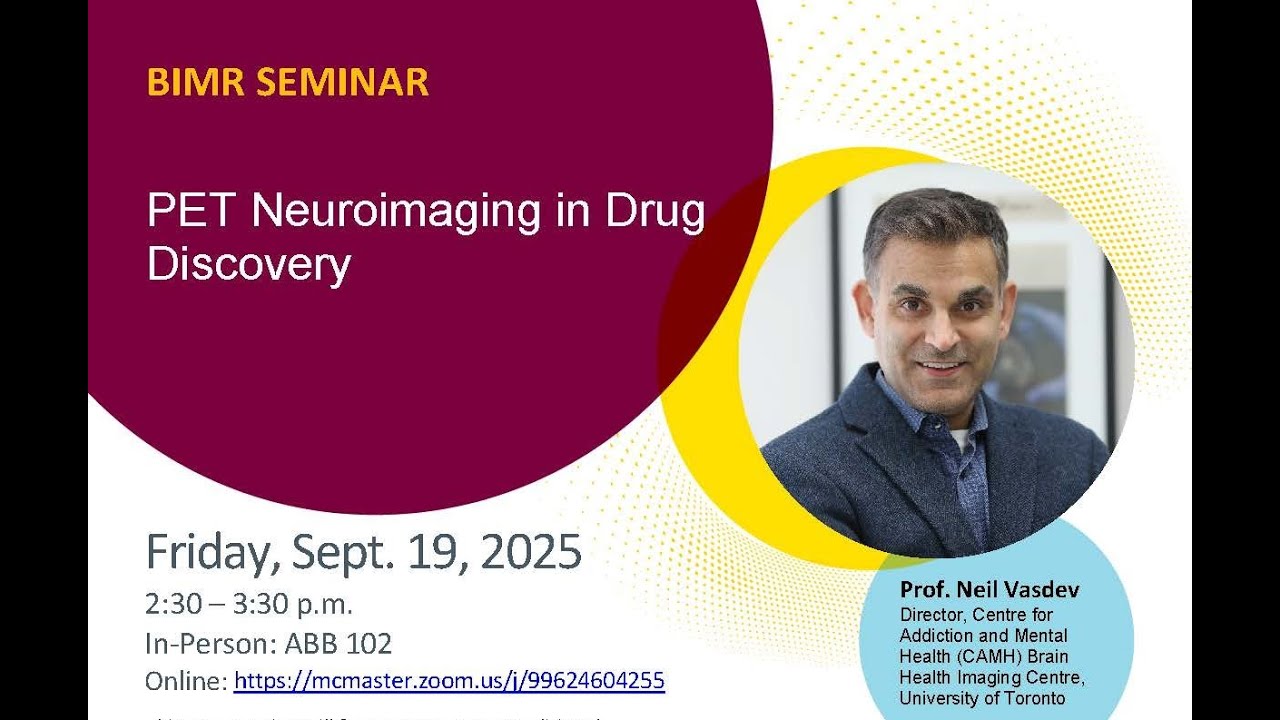
BIMR Seminar - Dr. Neil Vasdev - PET Neuroimaging in Drug Discovery
Keywords
Summary
132 words
Critical Evaluation
Value of the Information & Strength of the Argument
The presentation offers valuable insights into the practical applications of PET imaging in drug discovery, supported by concrete examples from the speaker’s extensive experience. The argumentation is solid, demonstrating how radiochemistry innovations can overcome challenges and lead to clinically approved tracers. The speaker effectively argues for the need to move beyond traditional one-step labeling methods and embrace multi-step radiosynthesis to expand the scope of PET imaging.
75 words
Title / Content Match
The title accurately reflects the content, focusing on PET neuroimaging applications in drug discovery.
Quality & Reliability
8/10
Presentation by a leading expert in radiochemistry and PET imaging, with extensive experience in developing FDA-approved tracers. The content is based on peer-reviewed research and practical applications, but lacks detailed citations during the talk.
Key Moments
Markers derived by PSI from the transcript: the creator did not define chapters.
- Introduction to PET imaging and cyclotron technology
- History of radiochemistry at McMaster and development of [18F]FDOPA
- Role of PET in drug development: dosing, target engagement, and pharmacokinetics
- Challenges in radiochemistry and the need for multi-step synthesis
- Development of tau PET tracers and FDA approval of Tauvid
- Collaborations with pharma and future directions in PET imaging
Cited Sources
- BIMR Seminar Series — Seminar series where this talk was presented
Concurring Sources
- FDA approves Tauvid — FDA approval of the tau PET tracer mentioned in the talk
Contribution & Novelties
The talk provides an expert perspective on the current state and future of PET neuroimaging in drug discovery, emphasizing the importance of innovative radiochemistry. It highlights the speaker’s contributions to FDA-approved tracers and the potential for multi-step radiosynthesis to expand the field.
Pour aller plus loin :
- Positron emission tomography — Overview of PET imaging.
- Tau protein — Role of tau in neurodegenerative diseases.
- Alzheimer’s disease — Background on the disease and imaging biomarkers.
74 words
Radar Profile
The radar profile shows high scores across all dimensions, indicating a well-rounded and reliable presentation. The strongest aspects are the quantity and quality of information, while the technical level is slightly lower, reflecting the intended audience.