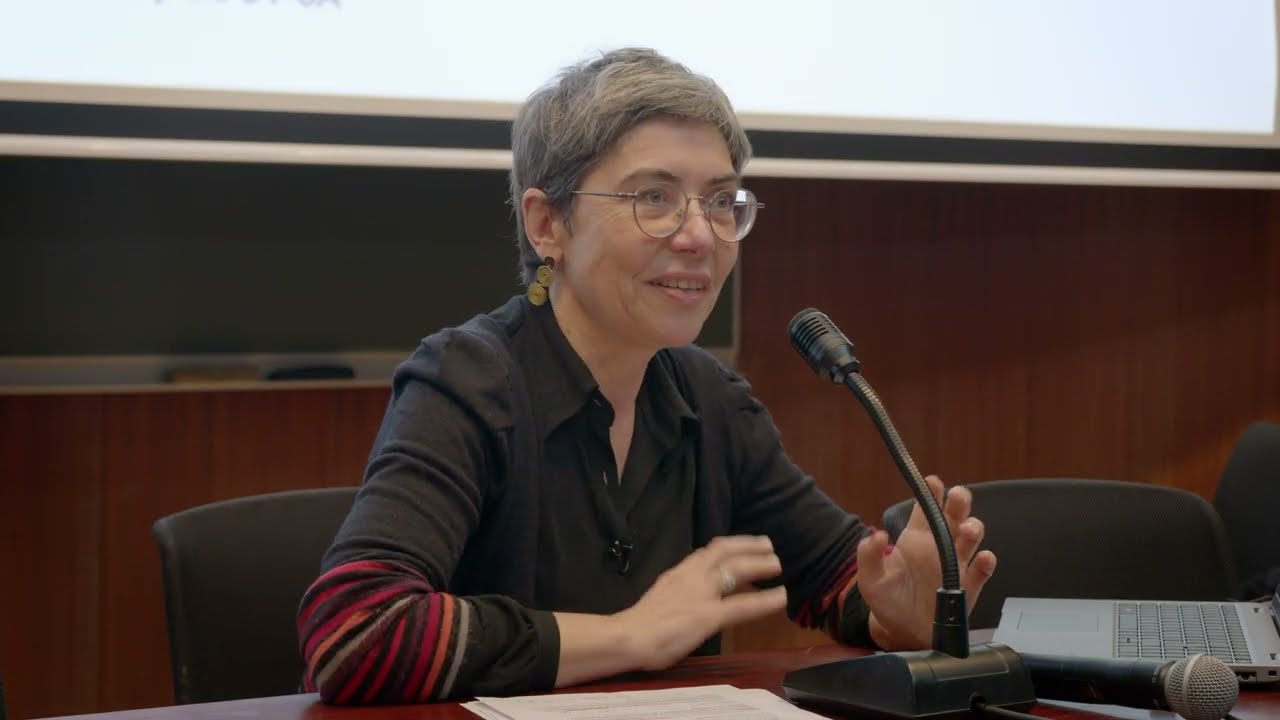
L'éclatement de la Yougoslavie
Keywords
Summary
163 words
Critical Evaluation
Value of the Information & Strength of the Argument
The lecture offers valuable insights into the Yugoslav wars, providing a clear chronological narrative while also analyzing underlying causes. The speaker effectively argues against the simplistic label of ’ethnic conflict’, emphasizing the political decomposition of the state and the role of nationalist leaders. She highlights the importance of understanding the conflict as a struggle for territory and power, rather than ancient hatreds. The argumentation is solid, supported by historical facts and her academic expertise. She also addresses the international community’s response, including the failures of humanitarian intervention and the eventual NATO intervention. The lecture is well-structured and accessible, making it a valuable resource for understanding this complex period.
Scientific Rigor, Source Quality, Title Accuracy
The scientific rigor is high, given the speaker’s academic credentials and her published work on the Balkans. While the lecture does not cite specific sources in real-time, it draws on established historical knowledge and her own research. The title accurately reflects the content, which is a comprehensive overview of the Yugoslav breakup. The lecture is well-organized, with clear explanations of key events and actors. The speaker also provides critical analysis, such as questioning the term ’ethnic conflict’ and highlighting the political dimensions. Overall, the content is reliable and well-presented.
212 words
Title / Content Match
The title accurately reflects the content, which focuses on the disintegration of Yugoslavia and the subsequent wars.
Quality & Reliability
8/10
The speaker is a recognized academic (maître de conférences at INALCO) with a PhD and publications on the Balkans. The lecture is well-structured, historically accurate, and nuanced, avoiding simplistic narratives. However, it is an oral presentation without formal citations, and some claims (e.g., casualty figures) are approximate.
Key Moments
Markers derived by PSI from the transcript: the creator did not define chapters.
- Introduction by Isabelle, situating the lecture in the context of the Srebrenica genocide commemoration.
- Anne Madelain begins her lecture, describing Yugoslavia's position during the Cold War and its federal structure.
- Discussion of the start of the war in Croatia in 1991, including the siege of Vukovar and the role of paramilitary groups.
- Analysis of the war in Bosnia, the siege of Sarajevo, and the emergence of ethnic cleansing.
- Examination of the international response, including UN peacekeeping and humanitarian aid, with a video excerpt about firefighters in Mostar.
- Discussion of the Dayton Accords and the partition of Bosnia into two entities.
- Overview of the Kosovo conflict, the repression of the Albanian majority, and the 1999 NATO intervention.
- Conclusion summarizing the main arguments and the need to understand the conflict politically.
Cited Sources
- L'expérience française des Balkans — Anne Madelain's book, mentioned in the introduction, based on her thesis.
- Revue Balkanologie — Academic journal co-edited by Anne Madelain, mentioned as a venue for her research.
Concurring Sources
- International Criminal Tribunal for the former Yugoslavia (ICTY) — The ICTY's judgments and documents corroborate the events described, including the Srebrenica genocide.
Contribution & Novelties
This lecture provides a nuanced and historically grounded analysis of the Yugoslav breakup, challenging common stereotypes about the Balkans. It emphasizes the political and structural factors, such as the decomposition of the federal state and the role of nationalist leaders, rather than attributing the conflict to ancient ethnic hatreds. The speaker also highlights the international community’s failures and the complexities of intervention. This perspective is valuable for understanding the conflict beyond simplistic narratives.
Pour aller plus loin :
- Guerres de Yougoslavie — Overview of the Yugoslav Wars.
- Accords de Dayton — Details on the peace agreement.
- Massacre de Srebrenica — Information on the genocide.
104 words
Radar Profile
The radar profile shows high scores across all dimensions, indicating a well-rounded and reliable lecture. The speaker's expertise and clear presentation contribute to strong scores in information quality and reliability, while the technical level is appropriate for an academic audience.