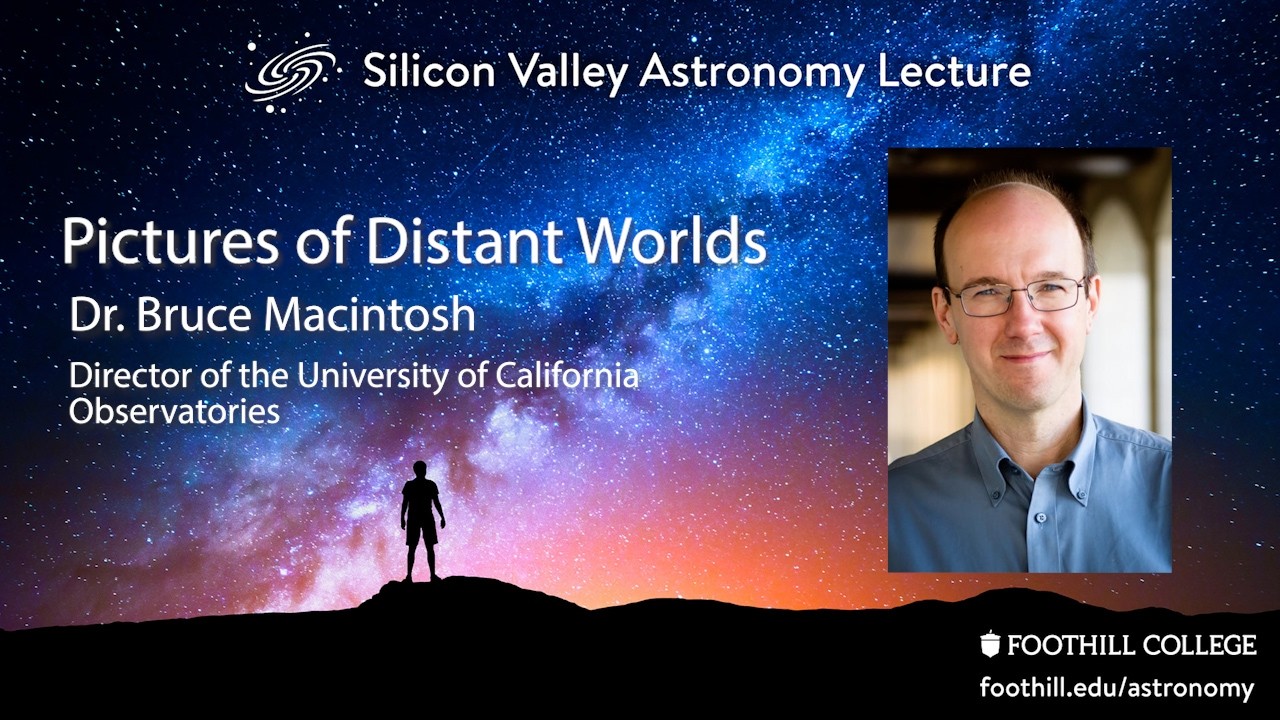
Pictures of Distant Worlds
Keywords
Summary
180 words
Critical Evaluation
Value of the Information & Strength of the Argument
The lecture provides valuable insights into the field of exoplanet direct imaging, combining historical context with cutting-edge research. Macintosh’s argumentation is solid, based on his extensive experience as a leading researcher. He effectively explains complex concepts like adaptive optics and coronagraphy in an accessible manner, using analogies and clear examples. The inclusion of the Lick Observatory update adds a personal and timely element, demonstrating the challenges of maintaining historic observatories. The lecture is well-structured, moving from historical foundations to current techniques and future prospects, and it successfully conveys the excitement and significance of the search for other worlds.
Scientific Rigor, Source Quality, Title Accuracy
The lecture demonstrates high scientific rigor, with accurate historical references and up-to-date information on exoplanet research. Macintosh cites specific missions (Kepler, TESS, JWST) and instruments (Gemini Planet Imager) without overstating results. The title ‘Pictures of Distant Worlds’ accurately reflects the focus on direct imaging. The content is well-aligned with the title, and the speaker’s authority is evident. No major discrepancies or misleading claims were identified.
178 words
Title / Content Match
The title accurately reflects the content, which focuses on direct imaging of exoplanets and the technology involved.
Quality & Reliability
9/10
Lecture by a leading expert (director of UC Observatories, PI of Gemini Planet Imager) with accurate historical context and current research details. No obvious errors or misleading claims.
Key Moments
Markers derived by PSI from the transcript: the creator did not define chapters.
- Introduction by Andrew Fraknoi and presentation of Dr. Bruce Macintosh
- Update on Lick Observatory windstorm damage and repair efforts
- Historical context: Ptolemy, Copernicus, Kepler, and Galileo
- Discovery of first exoplanets via radial velocity method
- Transit method and the Kepler mission
- Direct imaging technique and the Gemini Planet Imager
- Future space telescopes and the search for Earth-like planets
Cited Sources
- Gemini Planet Imager — Mentioned as the instrument Macintosh was PI of.
- Kepler Mission — Discussed as a major transit survey.
- TESS Mission — Mentioned as a current transit survey.
- James Webb Space Telescope — Mentioned as a future observatory for exoplanet studies.
Concurring Sources
- NASA Exoplanet Archive — Provides data on exoplanet discoveries, consistent with the lecture's claims.
- Exoplanet Exploration Program — NASA's official exoplanet resource, supporting the information presented.
Contribution & Novelties
The lecture provides a comprehensive overview of direct imaging of exoplanets, from historical context to current technology and future prospects. It highlights the importance of adaptive optics and coronagraphy, and the potential for future space telescopes to image Earth-like planets. The inclusion of the Lick Observatory update adds a unique perspective on the challenges of maintaining historic observatories.
Pour aller plus loin :
- Direct imaging of exoplanets — Overview of the technique.
- Adaptive optics — Key technology for direct imaging.
- Coronagraph — Instrument used to block starlight.
- Gemini Planet Imager — Specific instrument discussed.
- HR 8799 — System with directly imaged planets.
- Beta Pictoris b — Another directly imaged exoplanet.
110 words
Radar Profile
The radar profile shows high scores in quality, reliability, and technical level, with slightly lower but still strong scores in quantity and technical depth. This indicates a well-balanced, expert-led lecture that is both informative and accessible.
💬 Sur les 0 commentaires analysés, aucune tendance n'a pu être dégagée.