Estimating early warning signals and tipping points in climate
Keywords
Summary
145 words
Critical Evaluation
Value of the Information & Strength of the Argument
The talk provides valuable insights into the robustness of early warning signals in higher-dimensional systems. The speaker demonstrates that even when observations are contaminated by other variables, the classical early warning signals (increasing variance and autocorrelation) are preserved, but the estimated time to tipping is conservative. This is an important practical consideration for climate scientists. The argumentation is rigorous, based on mathematical derivations and clear assumptions. The speaker acknowledges the limitations of the work, such as the assumption of linear forcing and the use of a single time series, and engages with questions from the audience, strengthening the credibility of the presentation.
Scientific Rigor, Source Quality, Title Accuracy
The talk is scientifically rigorous, with a clear mathematical framework and explicit assumptions. The speaker does not cite specific sources during the talk, but the content is based on well-established theory in stochastic dynamics and bifurcation theory. The title accurately reflects the content, as the talk focuses on estimating early warning signals and tipping points in climate. The presentation is part of a workshop at the Isaac Newton Institute, which adds to its credibility. No comments were provided for analysis.
197 words
Title / Content Match
The title accurately reflects the content, as the talk focuses on estimating early warning signals and tipping points in climate models.
Quality & Reliability
8/10
The talk is given by a recognized expert in the field, presenting novel mathematical results in a rigorous manner. The content is based on established theory (saddle-node bifurcations, early warning signals) and the speaker clearly states assumptions and limitations. However, the work is presented as unfinished and not yet peer-reviewed, which slightly reduces the reliability score.
Key Moments
Markers derived by PSI from the transcript: the creator did not define chapters.
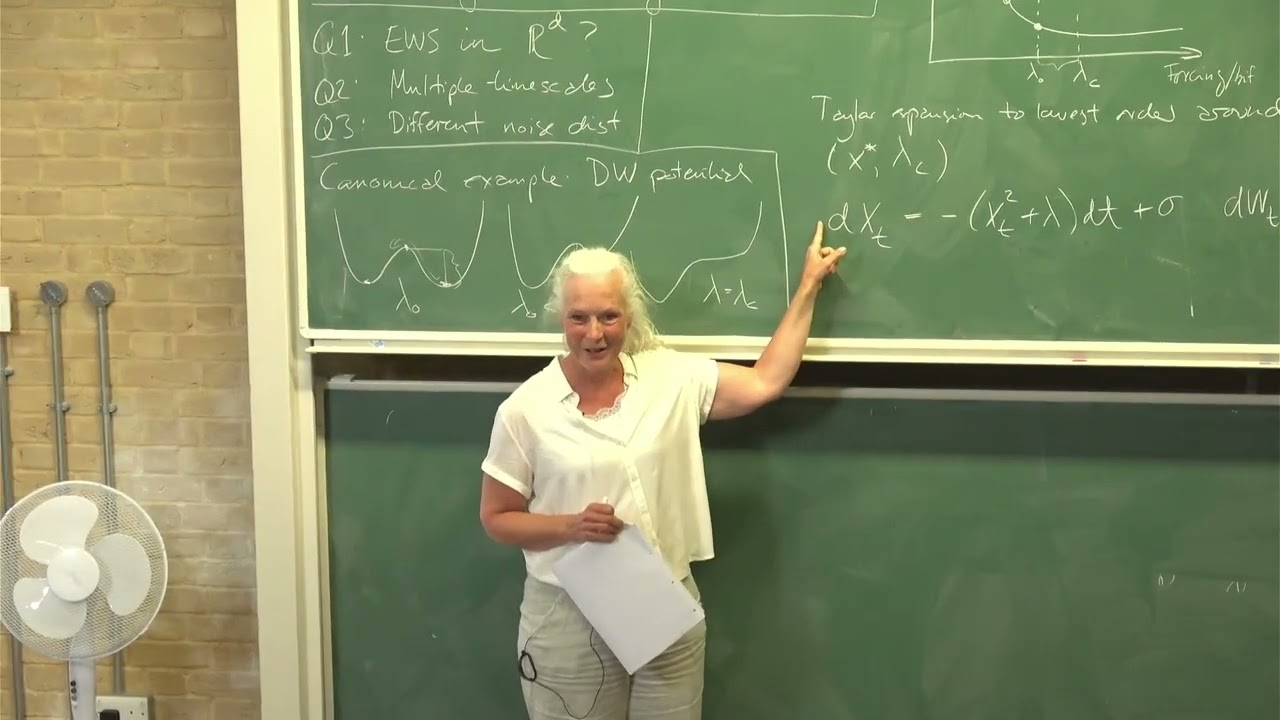
- Introduction: three questions on early warning signals in higher dimensions, multiple time scales, and noise distributions.
- Review of classical early warning signals: increasing variance and autocorrelation near saddle-node bifurcation.
- Derivation of the normal form for saddle-node bifurcation and the Ornstein-Uhlenbeck approximation.
- Question 1: Effect of observing a high-dimensional system in a direction not aligned with the bifurcation direction.
- Analysis of variance and autocorrelation of the observed variable, showing early warning signals are preserved.
- Estimation of time to tipping: contamination leads to conservative estimates (overestimation of time).
- Discussion with audience on the implications of the results and potential extensions.
- Question 2: Multiple time scales and acceleration in the system.
- Question 3: Different noise distributions and their impact on early warning signals.
Cited Sources
- Isaac Newton Institute for Mathematical Sciences — The talk is hosted by the Isaac Newton Institute, and the website provides information about the institute and its programs.
- Seminar page for the talk — The seminar page provides details about the talk, including the speaker, date, and associated workshop.
Concurring Sources
- Isaac Newton Institute for Mathematical Sciences — The talk is hosted by the Isaac Newton Institute, which is a reputable institution for mathematical sciences.
Contribution & Novelties
The talk presents novel results on the robustness of early warning signals in higher-dimensional systems, showing that even when observations are contaminated by other variables, the signals are preserved but the estimated time to tipping is conservative. This has practical implications for climate risk assessment. The speaker also discusses the influence of multiple time scales and noise distributions, though these are not fully developed due to time constraints.
Pour aller plus loin :
- Early warning signals of critical transitions — Overview of the concept and its applications.
- Saddle-node bifurcation — Mathematical background on the bifurcation type discussed.
- Ornstein-Uhlenbeck process — Stochastic process used in the derivations.
106 words
Radar Profile
The radar profile shows high scores in technical level and information quality, reflecting the advanced mathematical content and the expert presentation. The reliability score is also high, but slightly lower due to the preliminary nature of the work. The quantity of information is moderate, as the talk focuses on a few key questions rather than a broad overview.