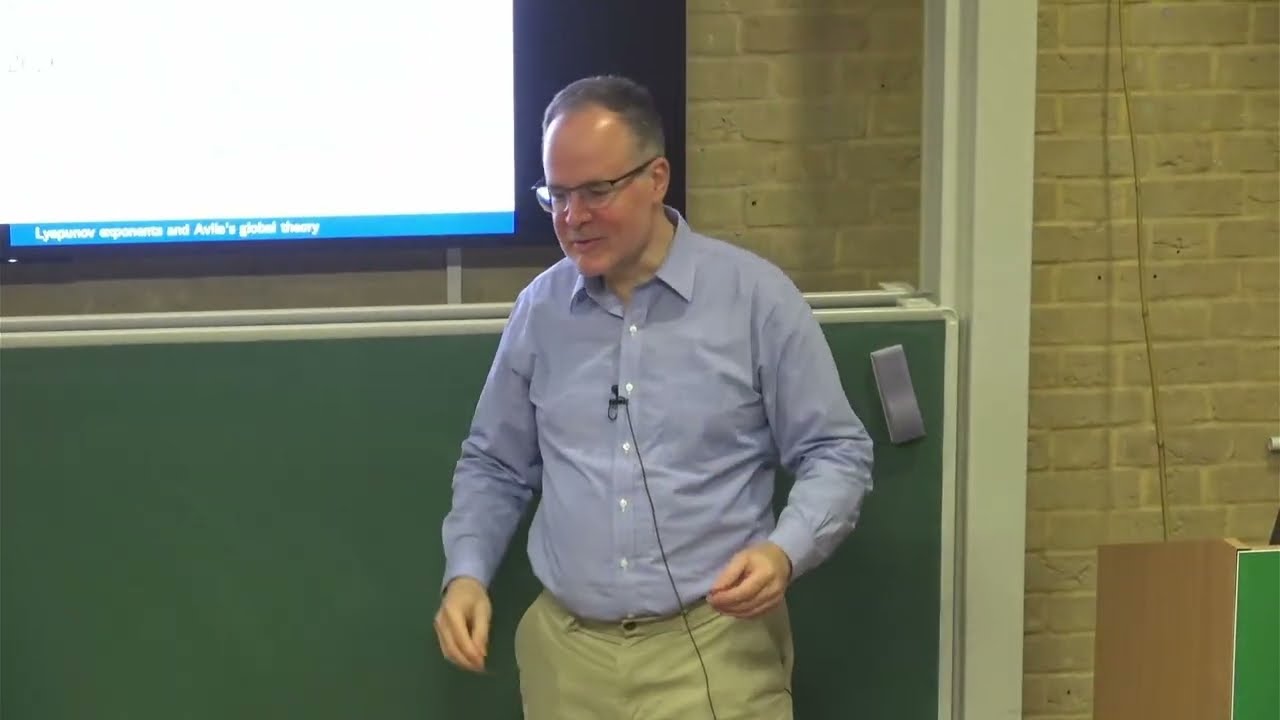
Lyapunov exponents, Schrödinger cocycles, and Avila’s global theory
Keywords
Summary
177 words
Critical Evaluation
Value of the Information & Strength of the Argument
The talk provides a high-value overview of a sophisticated area of mathematical physics, synthesizing results from spectral theory, dynamical systems, and mathematical physics. The argumentation is rigorous, with clear logical progression from basic definitions to advanced theorems. Schlag emphasizes the connections between seemingly disparate concepts, such as the Thouless formula linking Lyapunov exponents to the integrated density of states. He also highlights the importance of Avila’s global theory, which provides a classification of analytic cocycles. The talk is well-structured, with a clear outline and transitions between topics. However, due to the technical nature, the argumentation may be challenging for non-specialists, but it is solid for the intended audience.
Scientific Rigor, Source Quality, Title Accuracy
The talk demonstrates high scientific rigor, with precise mathematical statements and references to key results in the field. Schlag mentions the work of Avila, Goldstein, and others, and the talk is part of a research program at the Isaac Newton Institute. The title accurately reflects the content, covering the three main topics. The talk is not a review but an original presentation of research ideas, and the sources cited are primarily the mathematical literature. The description provides links to the institute and the specific seminar, which are reliable sources. Overall, the rigor is high, and the title is appropriate.
222 words
Title / Content Match
The title accurately reflects the content, covering Lyapunov exponents, Schrödinger cocycles, and Avila's global theory as promised.
Quality & Reliability
8/10
The talk is given by a leading expert (Wilhelm Schlag) at a prestigious institution (Isaac Newton Institute). The content is mathematically rigorous, with clear definitions and theorems. However, as a seminar talk, it is not peer-reviewed and assumes a high level of expertise. The presentation is dense and may omit some technical details.
Key Moments
Markers derived by PSI from the transcript: the creator did not define chapters.
- Introduction and overview of the talk's structure.
- Discussion of periodic Schrödinger operators and the discriminant.
- Introduction of ergodic Schrödinger operators and the integrated density of states.
- Thouless formula and its implications.
- Extension to block Jacobi operators and applications.
- Anderson localization and the avalanche principle.
Cited Sources
- Isaac Newton Institute for Mathematical Sciences — The talk was hosted at the Isaac Newton Institute, and the website provides information about the institute and its programs.
- Seminar page for the talk — The specific seminar page for this talk, providing details about the event and possibly related resources.
Concurring Sources
- Avila's global theory of analytic quasiperiodic cocycles — This paper by Artur Avila is directly relevant to the talk's topic and provides the theoretical framework discussed.
- Thouless formula — The Wikipedia article provides a concise explanation of the Thouless formula, which is a key result mentioned in the talk.
Contribution & Novelties
The talk provides a comprehensive synthesis of recent developments in the spectral theory of quasi-periodic Schrödinger operators, with a focus on Lyapunov exponents and Avila’s global theory. It highlights the connections between dynamical systems and spectral theory, and discusses the avalanche principle as a key tool. The talk is valuable for researchers seeking an overview of the field and its open problems.
Pour aller plus loin :
- Avila’s global theory of analytic quasiperiodic cocycles — This paper by Artur Avila presents the global theory of analytic quasiperiodic cocycles, which is central to the talk.
- Thouless formula — The Wikipedia article provides an accessible introduction to the Thouless formula, which relates Lyapunov exponents to the integrated density of states.
- Anderson localization — The Wikipedia article explains the phenomenon of Anderson localization, a key concept discussed in the talk.
137 words
Radar Profile
The radar profile shows high scores in technical level and information quality, reflecting the advanced and rigorous nature of the talk. The quantity of information is also high, but the global reliability is slightly lower due to the lack of peer review and the informal setting of a seminar.