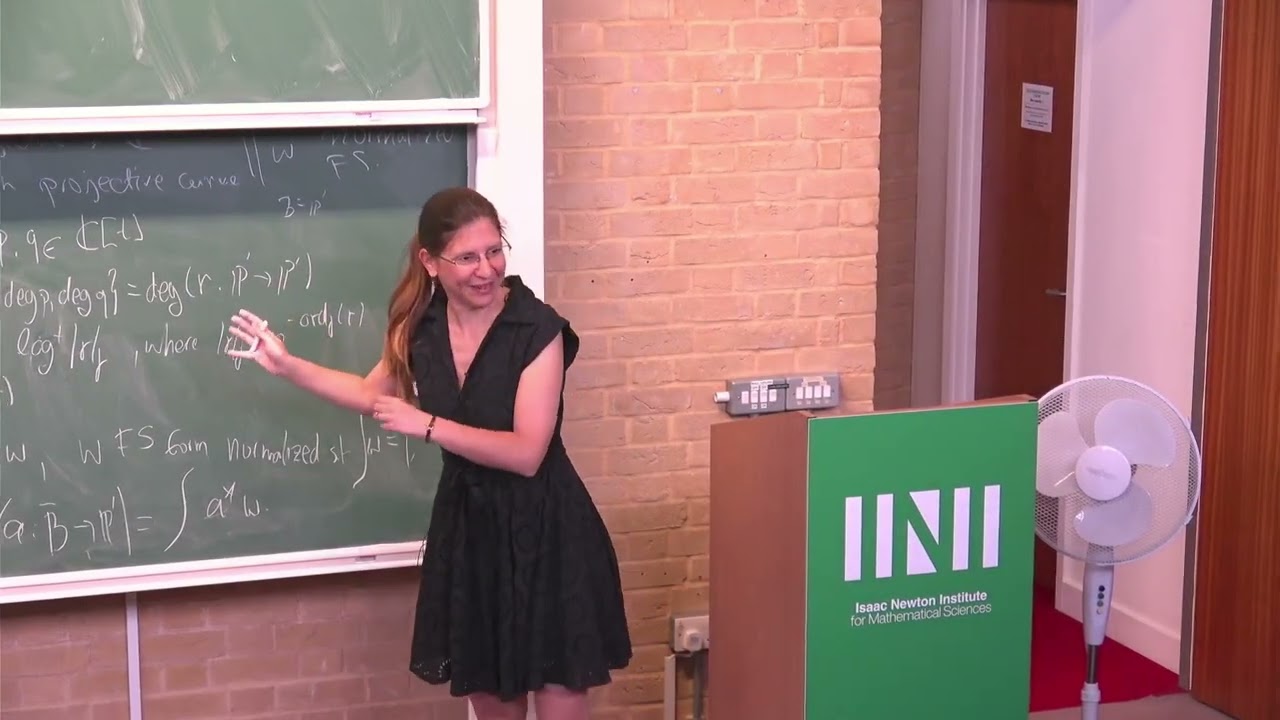
Mini Course: Small Points and Bifurcations: Geometry in Families of Rational Maps, Part II
Keywords
Summary
206 words
Critical Evaluation
Value of the Information & Strength of the Argument
The lecture provides a high-value synthesis of recent research in complex dynamics and arithmetic geometry, connecting bifurcation theory with height functions. The argumentation is rigorous, building from definitions to theorems with clear logical steps. The speaker carefully explains the intuition behind each result and the role of key assumptions, such as isotriviality. The presentation is well-structured, with a clear narrative from height theory to stability, then to common preperiodic points and unlikely intersections. The use of examples and the discussion of edge cases (e.g., exceptional maps) strengthen the argumentation. The lecture is aimed at a specialist audience, but the reasoning is transparent and the results are placed in a broader context, making it a valuable contribution to the field.
Scientific Rigor, Source Quality, Title Accuracy
The lecture demonstrates high scientific rigor, with precise definitions, theorems, and proofs. The speaker cites relevant literature, including works by DeMarco, Benedetto, Baker, and others, though specific references are not listed in the description. The title accurately reflects the content, which is a focused mini-course lecture on the geometry of families of rational maps. The sources mentioned are appropriate and authoritative. The lecture is part of a program at the Isaac Newton Institute, which adds to its credibility. No public comments were provided, so no analysis of audience reception is possible.
225 words
Title / Content Match
The title accurately reflects the content: a mini-course lecture on small points and bifurcations in families of rational maps, focusing on geometric aspects.
Quality & Reliability
9/10
Lecture by a recognized researcher at a leading mathematical institute, presenting original research and established results with rigorous mathematical argumentation. The content is highly technical and assumes advanced background, but the reasoning is precise and well-structured.
Key Moments
Markers derived by PSI from the transcript: the creator did not define chapters.
- Introduction and recap of previous lecture; outline of four questions.
- Definition of height over function fields; analogy with rational numbers.
- Canonical height and its geometric interpretation; connection to stability.
- Introduction of bifurcation current and its properties; DeMarco's theorem.
- Discussion of isotriviality and its role in stability; examples.
- Statement of main theorem: Zariski density of common preperiodic points.
- Proof sketch of the main theorem; use of stability and preperiodic points.
- Extension to second fiber power; unlikely intersections and uniform bounds.
- Corollaries: finiteness of related specializations and uniform bound on common preperiodic points.
- Conclusion and outlook; questions from the audience.
Cited Sources
- Isaac Newton Institute for Mathematical Sciences — Institute hosting the lecture; provides context and credibility.
- Event page: Complex dynamics: interactions and influences — Official event page for the mini-course, containing program details.
Concurring Sources
- DeMarco, L. (2001). Dynamics of rational maps: Lyapunov exponents, bifurcations, and capacity. — Cited in the lecture for foundational results on bifurcation currents and stability.
- Benedetto, R. (2005). Heights and preperiodic points for polynomial maps. — Cited for results on preperiodic points and heights.
- Baker, M. (2009). A finiteness theorem for canonical heights attached to rational maps over function fields. — Cited for results on canonical heights and stability.
Contribution & Novelties
This lecture presents recent research results on the geometry of common preperiodic points in families of rational maps, connecting complex dynamics with arithmetic geometry. The main novelty is the theorem on Zariski density of common preperiodic points and its extension to unlikely intersections, providing uniform bounds. The lecture also offers a clear exposition of height theory over function fields and its relation to bifurcation currents.
Pour aller plus loin :
- Bifurcation current — Overview of the concept central to the lecture.
- Canonical height — Background on canonical heights in arithmetic dynamics.
- Complex dynamics — General reference for the field.
- Unlikely intersections — Concept relevant to the latter part of the lecture.
111 words
Radar Profile
The radar profile shows very high scores across all dimensions, with the lowest being 'quantite_information' at 9, indicating a dense but well-paced lecture. The high 'niveau_technique' and 'qualite_information' reflect the advanced and rigorous content, while 'fiabilite_globale' is strong due to the authoritative source and clear argumentation.