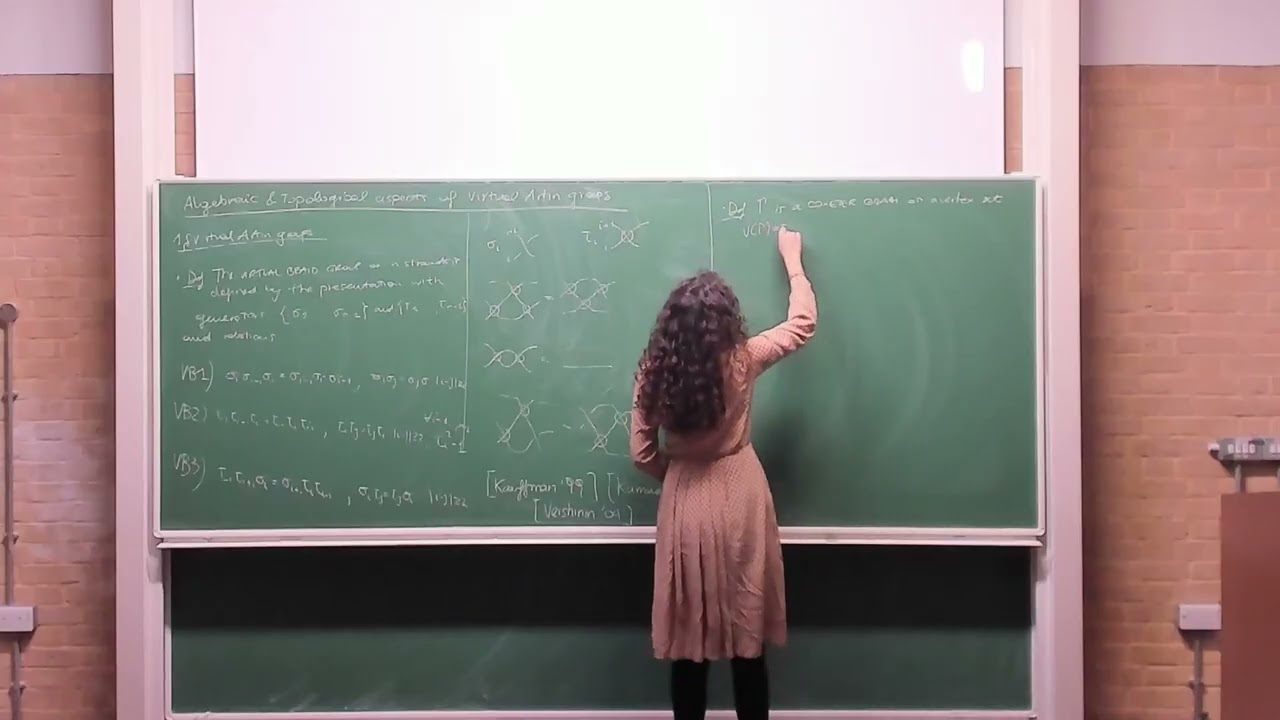
Dr. Federica Gavazzi |
Keywords
Summary
114 words
Critical Evaluation
Value of the Information & Strength of the Argument
The talk provides a clear and rigorous introduction to virtual Artin groups, with precise definitions and examples. The speaker motivates the study by showing how virtual braid groups generalize braid groups, and then extends to general Artin groups. The argumentation is solid, relying on known theorems and recent results. The main result on indecomposability is presented with a sketch of the proof strategy, involving the structure of the kernel KVA as an Artin group and its action on a tree. The talk also situates the result within the broader context of open problems in Artin group theory, such as the center conjecture and the isomorphism problem.
Scientific Rigor, Source Quality, Title Accuracy
The talk is based on the speaker’s PhD thesis and recent work by Bellingeri, Paris, and others. The speaker cites specific theorems and papers, though not with full references. The content is consistent with current research in geometric group theory. The title is incomplete and does not reflect the content, which is a significant drawback. The talk is presented at the Isaac Newton Institute, a reputable institution, adding to its credibility. However, as a research talk, it is not peer-reviewed, and some statements are conjectural.
206 words
Title / Content Match
The title is incomplete and does not reflect the content; it only shows the speaker's name. The actual topic (virtual Artin groups) is not mentioned.
Quality & Reliability
8/10
Presentation by a researcher at a recognized institute (INI), based on her PhD thesis and recent work by Bellingeri, Paris, and others. The content is technical and precise, with references to published results. However, it is a research talk, not peer-reviewed, and some statements are conjectural.
Key Moments
Markers derived by PSI from the transcript: the creator did not define chapters.
- Introduction to virtual braid groups: definition and generators.
- Diagrammatic interpretation of virtual braids and relations.
- Definition of Coxeter graphs and Artin groups.
- Definition of virtual Artin groups and their properties.
- Discussion of natural homomorphisms and semi-direct product structure.
- Presentation of the main result: indecomposability of virtual Artin groups.
- Consequences for automorphism groups.
- Review of decomposability results for Coxeter and Artin groups.
- Open problems and future directions.
Cited Sources
- INI Seminar page — Event page for the talk, providing context and possibly abstract.
- Isaac Newton Institute website — General information about the institute and its research programmes.
- INI LinkedIn — Social media presence of the institute.
Concurring Sources
- Bellingeri, Paris, and Tieleman (2023) on virtual Artin groups — The paper introducing virtual Artin groups, as mentioned in the talk.
Contribution & Novelties
The talk presents recent research on virtual Artin groups, a relatively new area. The main novelty is the result on indecomposability, which contrasts with classical Artin groups where this is conjectural. The talk also highlights the semi-direct product structure and its implications. This contributes to the understanding of these groups and opens avenues for further research.
Pour aller plus loin :
- Artin group — General definition and properties.
- Coxeter group — Background on Coxeter groups and their classification.
- Virtual braid group — Related concept in knot theory.
- Geometric group theory — Broader context for the study of groups via geometry.
100 words
Radar Profile
The radar profile shows high scores in technical level and information quality, reflecting the advanced mathematical content and the speaker's expertise. The quantity of information is also high, but the overall score is slightly lower due to the incomplete title and the lack of accessible references.